
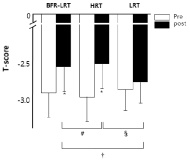
Purpose The purpose of this study was to investigate the effects of low-intensity resistance training with blood flow restriction on serum VEGF, bone markers and bone mineral density in elderly women. Methods The subjects were divided into three groups: low-intensity resistance training with blood flow restriction(BFR-LRT, n=8); high intensity resistance training(HRT, n=8); low- intensity resistance training (LRT, n=5). Both the BFR-LRT and LRT groups worked out knee extension and leg curl exercises at 20% of each estimated one-repetition maximum(1RM) and HRT group worked out knee extension and leg curl exercises at 70% of each estimated 1RM 3 days per week for 12 weeks. Results As a result after 12 weeks, serum VEGF level have increased significantly among BFR-LRT group compared to HRT and LRT groups. Serum Bone ALP level have increased significantly among BFR-LRT and HRT groups compared to LRT group. Calcaneus BMD have increased significantly among BFR-LRT and HRT groups compared to LRT group. Conclusions In conclusion, despite using low-intensity load, BFR-LRT is a efficient training alternative to HRT for improving bone metabolism in older women.
Purpose The purpose of this study was to examine the effects of 16 weeks’ combined exercise training on insulin resistance, inflammatory markers, oxidative stress, leukocyte telomere length, body composition, and daily living fitness in elderly women with type 2 diabetes mellitus (DM). Methods Twenty-eight participants were randomly assigned into one of two groups, i.e., exercise training group (EX: n=14) and control group (CON: n=14). Subjects in EX participated in 3 sessions of 60 min-combined exercise for 16 weeks, whereas subjects in CON were asked to maintain their normal life pattern during the same period. The variables regarding insulin resistance, inflammatory markers, oxidative stress, leukocyte telomere length, body composition, and daily living fitness were measured and compared between two groups as well as between pre-post test utilizing a repeated two-way ANOVA. Results Main results were as follows: 1) Fasting plasma insulin and HOMA-IR tended to decrease in EX, whereas increased significantly in CON. 2) IL-6, TNF-α, hs-CRP decreased in EX, but the changes were not statistically significant. 3) MDA increased significantly and GPx decreased significantly in both EX and CON. 4) Leukocyte telomere length increased significantly in EX. 5) Fat-free mass increased in EX, whereas fat mass and percent body fat decreased significantly in EX. 6) Arm curl, chair stand, sit & reach, tandem test, 10m walking speed, and up & go improved significantly in EX. Conclusion It was concluded that the combined exercise for 16 weeks had a positive effect on improving insulin resistance, increasing leukocyte telomere length, as well as enhancing body composition and daily living fitness in elderly women with type 2 diabetes.

Purpose The study examined the effects of a 12-week high intensity circuit training (HICT) on abdominal fat, physical fitness, blood lipids, and insulin resistance in middle-aged obese women. Methods Thirty obese women, aged 32-48 yrs, were recruited and randomly assigned to either HICT group (TR; n = 15) or control group (CON; n = 15). Subjects in the TR group participated in HICT of which resistance exercise and aerobic exercise were performed with a duration of 40 min/session and 3 sessions/wk for 12 weeks, whereas subjects in the CON group were asked to maintain their normal life patterns. Dependent variables included abdominal fat area, body composition, physical fitness, blood lipids profiles, and insulin resistance index. Analysis of variance with repeated measures with Bonferroni corrections was used to compare the outcomes between two groups. Results Main findings of the present study were as follows: 1) compared to the CON group, the TR group had significant reductions in overall (i.e., body mass index and percent body fat) and abdominal obesity (i.e., waist circumference, total abdominal fat area, visceral fat area, subcutaneous fat area, and visceral fat area-subcutaneous fat area ratio), 2) compared to the CON group, the TR group had significant improvements in health-related physical fitness (i.e., muscular strength, muscular endurance, muscle power, flexibility, balance, and cardiorespiratory endurance), and 3) compared to the CON group, the TR group had significant improvements in fasting lipids, glucose, insulin, and insulin resistance. Conclusions The current findings of the study suggested that HICT would be an effective exercise intervention to improve metabolic complications associated with obesity and poor physical fitness in obese middle-aged women.


Purpose The purpose of this study was to identify the relationship among the social responsibility (economic responsibility, community cultural activity and social contribution activity), the image of the club, and the assets (image, reliability, attitude and loyalty) of the mother company. Methods The objectives of this research were the home fan in “2018 Shinhan Bank My Car KBO League.” A survey was conducted for 350 home fans of SK Wyverns who gathered in Incheon SK Happiness Dream Baseball Ground to watch the games of SK Wyverns vs. Samsung Lions held from April 6 (Fri.) to April 8 (Sun.). Data processing was done with PASW Ver. 18.0 and AMOS 18.0. Results Firstly, among the sub-factors of social responsibility, economic responsibility, community cultural activity and consumer protection had significant influence on the team image. Secondly, the team image had meaningful influence on the mother company image. Thirdly, the mother company image had significant influence on the mother company trust, mother company attitude and mother company loyalty. Fourthly, the mother company trust had significant influence on the mother company loyalty. Fifthly, the mother company attitude had significant influence on the mother company loyalty. Conclusions The mother companies of professional baseball clubs, too, will have to seek various ways for joint working with professional baseball clubs while actively supporting the activities of the professional baseball clubs being aware that professional baseball clubs give positive effect to the mother companies.
Purpose The goal of this article is to examine the unwritten law of sports - a moral law - in relation to the purposeful act of continuing to score, when winning has been already secured, in normative terms of sportsmanship. Methods To do this, this article analyzed previous debates on the unwritten law about overwhelming victory and looked at the pros and cons of this law. Then, I contemplated the reasons for these opposite views, as well as the values and theories underpinning these views from the perspective of the nature and morality of sports. Results My argument is that respect for sport should mean more than observing sporting rules and include respect for the tradition and practice of each sport: hence the necessity of the unwritten law regarding overwhelming victory. I also suggested that the mercy rule be applied in a heavily lopsided game in order to maintain sportsmanship in a rational way. Conclusion My discussion on the unwritten law about overwhelming victory from the viewpoint of sportsmanship may reveal the significance of the essence of sports, attitude towards competition as mutual request for excellence, and the importance of winning.

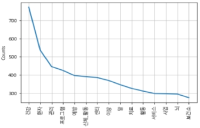
Purpose The purpose of this study is to introduce the basic concepts and procedures for topic modeling and to explain topic modeling to news articles about dementia-related physical activities. And it is also to discuss the possibility of using topic Modeling in the field of physical education. Methods In this study, the LDA algorithm of topic modeling is explained and the analysis procedure is summarized step by step by text preprocessing, text formatting, and topic number determination. The application cases were selected from 274 news articles about dementia-related physical activities reported in 13 major daily newspapers from 2000 to 2018. Results When the number of topics is 3, the Coherence Score figure is the highest. Topic 1 is about welfare services for dementia patients, Topic 2 is about prevention of dementia, and Topic 3 is about dementia research. The ratio by each subject is Topic 2 (46.0%), Topic 3 (33.2%) and Topic 1 (20.8%) in order of high ratio. Conclusion Topic modeling is an effective methodology to extract potential information excluding subjectivity of researchers. It is expected to be used when searching for information in massive texts in the field of physical education.


Purpose The purpose of this study was to investigate the differences in physique and physical fitness according to maturity between primary and middle school baseball players. Methods Participants were 112 elite youth baseball players (49 primary school; 63 middle school). Skeletal age estimated maturity. Physique (height, arm span, thigh volume), body composition (weight, muscle mass and body fat), physical fitness (strength, power, agility, flexibility, coordination, anaerobic power and aerobic power) were measured. An independent sample t-test was used to conduct verify the difference between physique and physical fitness according to maturity. Results The results of analyzing physical and physical fitness according to maturity showed that there was a significant difference (p<.05) between the early maturation group and on-time group in primary school baseball players, body fat percentage, muscle mass percentage, sit-up, anaerobic power and reaction time. There was a significant difference between the early maturation group and the on-time group in the middle school baseball players, weight (p<.05), thigh volume (p<.05), fat mass (p<.05), muscle strength (p<.01), power (p<.05) and coordination (p<.05). Conclusions In conclusion, the maturity of a growing baseball player may be influenced by the performance, so maturity status should be considered when judging the performance of a growing baseball player, especially a middle school baseball player.

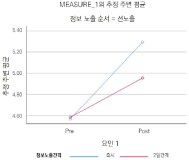
Purpose The purpose of the study was to examine the effect of exposure sequence and time gap between two exposures in image transfer in the context of sport sponsorship. Methods To accomplish the purpose of the study, one preliminary study and one main study were performed. The sample was drawn using a convenience sampling (33 for preliminary study and 120 for the main study). The data were analyzed using one sample t-test, repeated measure ANOVA(mixed design). Results The data for the main study indicated that the mean of the post-test was statistically higher than that of pre-test, which indicated that the image of the sporting event was transferred to the image of the brand Dell. This indicated that the image transfer actually took place although image similarity between sporting events and sponsoring brand was not conditioned. The hypotheses of the study were tested using a mixed design with exposure sequence and time gap between exposures as two between subject factors. The results indicated that the interaction was statistically significant. When two sponsorship information were given consecutively, the first sport event’s image was transferred more than the image of the secondly presented sport event, which indicated primacy effect. However, when the two sponsorship information was given with two days time gap, the image of the second sport event was transferred more than the first sport event’s image, which indicated a recency effect. Conclusions Two meaningful findins were delivered through the current study. First, even when there was no image similarity between sport event and brand, image transfer took place through sponsorship arrangement. Second, if primacy and recency effects are properly incorporated, image transfer can be achieved in a more effective way in sponsorship context.


Purpose The purpose of this study was to analyze the research topics of the articles which were published through European Sport Management Quarterly(ESMQ) from 2009 to 2018. The prior topic analysis studies of the ESMQ classified topics based on the key words using NASPE-NASSM SMPS categories. Therefore they couldn't fully reflect the content of the articles. Methods The topic modeling of the current study was conducted with the Latent Dirichlet Allocation(LDA) which generates topics based on the word usage in the article. A total of 265 articles were converted from 'pdf' format to 'txt' ANSI format for topic modeling analysis. The whole topic modeling process was done using R program and the model was set to generate 10 topics from the article. Results The 3 sport management experts were hired to label the name of the topics and the name of the topics are as follow : (1) Impact of mega sport event, (2) Cause-related marketing, (3) Factors affecting the results of the competition, (4) Managing sport organization, (5) European sport leagues, (6) Strategic management, (7) Sport economics, (8) Sport in communities, (9) Sport consumers, (10) Elite sports. It is not quite possible to compare the results of the current topic modeling results with the previous ones because of the methodological differences. However, even though the standards are different, Sport marketing topic showed the largest growth among the 10 topics extracted. Conclusions This study used the LDA probabilistic algorithm to analyze research topics, which made the analyses more objective and wholistic. However, the insights of the researchers were still needed to interpret and labeling the topics.
Purpose This study aims to contemplate the identity and significance of sport ethics as an independent academic field by examining how it began and developed, where it is now, and where it will or should be moving forward. Methods First, a history of sports philosophy which gave birth to sport ethics is surveyed. Second, the emergence of sport ethics in the historical development of sport philosophy is analyzed. Third, major methodologies and theoretical frames of sport ethics are introduced. Last, what needs to be done in South Korea in relation to sport ethics is suggested. Results Sport ethics in the future is expected to resort to interdisciplinary approaches which combine a variety of academic disciplines and methodologies. In addition, sport ethics must relate its theory to practice. The pressing task for sport ethics in South Korea is to establish its identity as a separate academic field. In order to do this, we should figure out what to study in sport ethics, and continue to study about the range, methodology, and theoretical frame of sport ethics. Conclusions The establishment and development of an academic field becomes only possible when fully supported by numerous scholars’ work, practical achievement of the field, and a diversity of policy and institution, and a continued discussion and agreement on the content and methods of the discipline. In order to enhance its status as well as professionalism of sport ethics scholars, researchers of various academic backgrounds should study sport ethics, exchange ideas on theory and methodology, and spread results of studies through education, guiding through the development of sports.
