
Purpose The purpose of this study is to calculate the ranking of vault players in artistic gymnastics by individual and by country using the PageRank algorithm. The purpose of this study is to provide basic data that can be used in gymnastics events by comparing the performances of historical vault players with those of previous Olympic competitions. Methods The data collected for this purpose is a score of 117 vault players based on the results of the Olympic final event published in the International Gymnastics Federation (FIG). For data analysis, PegeRnak algorithm was used for calculating the ranking of vault players using MS-Excel and NetMiner. Results The results are as follows that. First, the PageRank algorithm is possible to calculate for historical vault players' rankings. Specifically, the ranking of vault players for historical Olympic calculated by PageRank ranked as Gervasio Deferr from Spain (ESP) at 1st, Alexei Nemov from Russia (RUS) at 2nd, and Klaus Koste from Germany (GDR) at 3rd. Second, Network of vault players' ranking is separated by each generation of Olympic games. Conclusions As a conclusions, it is possible to calculate national ranking of vault games of gymnastics by using PageRank algorithm.


Purpose The purpose of this study is to examine the elite sport system in Germany by selecting six keyword. Methods In order to review the literature, we reviewed the reports of sports organizations such as the Ministry of the Interior, the Olympic Games of Germany, the Sports Council of Germany, and the German sports policy, history, business, programs and financial status. Conclusion In Germany, athletic associations were created in the 40s and 50s and strengthened infrastructure, projects, and workforce infrastructure by the 60s and 90s. Through its long history and tradition, Germany is at the forefront of both the Winter and Sommer Olympics. Among them, the German Olympic Sports Federation, researchers Institute, Olympic training centers, Sports School, Kader-systems and federal police·military·customs are the main keyword of elite sports. In order to support the national players in Germany, the regional Olympic training center supports sports science, sports gymnasium, sports athletic high school, sports elite school, athletes' house are operated for selection and training of excellent athletes. And all the players are in the carder system and there is a system that allows them to enter the federal police, soldiers and customs so that they can support the human resources, facilities and programs as well as train and work at the same time.
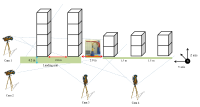
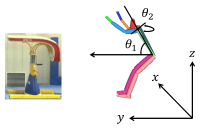
Purpose The purpose of the study was to perform a comparative analysis of the YANG Hak Seon technique carried out by "K" athlete with the kinematical data of "Y" athlete and propose a method to improve the YANG Hak Seon technique of "K" athlete. Method The subject recruited for the study was a male athlete from Korean national team (Age: 21, height: 1.65 m, body weight: 59.6 kg, and career: 11 years). Four high - speed cameras were used to analyze the 3D motion of the YANG Hak Seon technique performed by "K" athlete. The variables selected for analysis were the velocity of COM, displacement of COM, the rotational & torsional angle of the trunk and rotational & torsional angular velocity of the trunk. The results obtained were compared to the preexisting data of the "Y" athlete (data set from the published research). Results Firstly, the horizontal displacement of the YANG Hak Seon technique of the "K" athlete was observed to be shorter along with lower vertical displacement during landing compared to “Y” athlete. In addition, the overall horizontal velocity was low and vertical velocity was not generated which rises during the BC (board contact) phase. Although the rotational angular velocity of the trunk was lower during the BC, HC (horse contact) phase and LD (landing) phase, torsional angular velocity was higher during the LD. Conclusion In order to improve the completeness of the YANG Hak Seon technique of the K player, it is necessary to enter with a fast and low posture on the footplate during the initial phase. In the BC phase, it is essential to raise the COM simultaneously while landing on the footplate and increase the rotational angular velocity of the trunk.
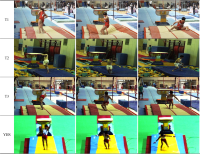

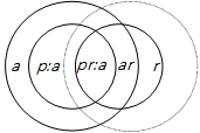
Purpose The purpose of this study was (1) to analyze judges’ evaluation on rhythmic gymnastics performance by applying generalizability theory and (2) to suggest recommendations to improve judges' rating. Methods Data were 34 players’ scores from Senior Part at 29th KGA President’s Cup National Rhythmic Gymnastics Championship in Korea. Difficulty and execution scores in ball, clubs, hoop and ribbon event were analyzed. Analysis models containing components of area and reputation rank were designed and multivariate generalizability theory were used for analysis. Results The G-study results showed (1) that the error source about players has more significant impact to evaluation than other error sources in analysis model containing components of only player and judge, (2) that the error source about players has more significant impact to evaluation than other error sources in analysis model adding components of area, but the error source about area has more significant impact to evaluation of clubs event than other error sources, (3) that the error source about players has more significant impact to evaluation than other error sources in analysis model adding components of reputation rank, but the error source about reputation rank has more significant impact to evaluation of hoop event than other error sources in analysis model adding components of area. The D-study results showed generalizability coefficient was stable in analysis model without components of area and reputation rank, but generalizability coefficient in analysis model containing components of area and reputation rank not stable in some event. Conclusion Recommendations for improving judging were discussed.

Purpose The purpose of this study is to analyze the performance contents of men's floor exercise and to provide basic materials for achieving excellent results at world competitions. Methods Teams ranked 1 - 12 who participated in the World Championships' floor movement group competition selected a total of 59 players by the convenience sampling method and carried out technical statistics, frequency analysis, member variable variance analysis, and post hoc analysis. Results First, as a result of frequency analysis of the difficulty of each group, all the teams ranked 1 to 12 liked the most difficulty of C and found that they do not like the F difficulty the most. Secondly, there was a difference in average for each group's start score, ranking 1st to 4th> 5th to 8th> 9th to 12th place. Thirdly, there was a difference in average of difficulty levels for each group B, C, E, and it became very significant with E difficulty.Results of post hoc analysis B difficulty (9th to 12th> 1st to 4th, 5th to 8th), C difficulty (9th to 12th> 1st to 4th), E difficulty (1st to 4th> 5th to 8th ·9th to 12th). Conclusion These results show that in floor exercise, the art of more than C difficulty and the connection technology of A, B, C, difficulty, E and F, difficult difficulty such as difficulty, creative and dynamic performance composition is excellent It clearly states that it is a condition for getting results.
Purpose This study was carried out for the purpose of providing national players of our country by grasping various techniques and difficulty composition of world-level players. Methods For doing so, this research was executed by objecting 9 finalists in parallel bar of 2012 London Olympics and 8 finalists in parallel bar of 2016 Rio Olympics. Collected datum were treated with average, standard deviation, percentage (%) by using SPSS 18.0, and they was analyzed while securing feasibility through expert meeting. Results Research results are same as follows. First, Rio Olympics players appeared higher than London Olympics such like 6,61 points in average D-score of 2012 London Olympics final game and 7.0 points in average D-score of Rio Olympics final game. Second, I group was turned up to prefer Healy technique (34.88%) of D difficulty in two olympics. Third, Ⅱ group carried out Bwd. uprise and salto fwd. p. to sup technique of D difficulty by each 4 players (36.35%) in two olympics, so the technique was displayed as preferred techniques of players. Fourth, Ⅲ group executed at the London Olympics, C difficulty was the most frequently used, but at the Rio Olympics, D difficulty and E difficulty were the most frequent. Fifth, Players in London Olympics and Rio Olympics executed Basket to hdst technique, and it appeared to be most preferred technique by players. Sixth, Ⅴ group executed at the London Olympics, D difficulty was the most frequently used, but at the Rio Olympics, F difficulty was the most frequent. Conclusions These findings will be useful datum to gymnasts and instructors of our country by providing valuable datum in preparing 2020 Tokyo Olympics after grasping preferred techniques and trends of world-excellent players.
