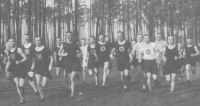
The research is to shed new light to historical meaning and value of Carl Diem who was a pillar of modern sports in Germany and also served as an athlete, PE administrator, journalist, sports scholar and dean of a university. He has been highly regarded in Korea as a trail-blazer of German sports, but in his own country, he who once served as the secretary general of the 1936 German Olympics was at the center of controversy since he was named as a pro-Nazi, and even the name of a place named after him was deleted. Having said that, as an athlete, he played a huge role in organizing sports clubs where he worked as an chairman; organized and held various sports competition events; laid the academic groundwork for the modern sports in Germany by majoring in Sports in the United States. Above all, he is the one who came up with the torch relay and staved to define the significance of the Olympic Games by founding the International Olympic Academy. His academic and practical capabilities were proven through the establishment of Deutsche Sporthochschule Köln, also known as German Sport University Cologne. And Carl Diem Research Institute is still up and running to this day. Thus, in this research, I’d like to take a look at his passion for sports and changes of German sports including the German Olympics and offer a multi-faceted view on him who was evaluated during a historical turmoil back then.
The purpose of this research is to provide the information about sports injury by surveying and analyzing a result, and to lead analytic and scientific training among the subjects being elite summer sport athletes. All sports injuries are recorded on injury report form and the following results were obtained. In Cycle sport, the prevalence of injuries of the low back, knees were highest. and In Table tennis sport, the prevalence of injuries of the ankle was highest due to the chronic fatigue. The prevalence of injuries of the shoulder, low back were highest due to the overuse of joints. In Badminton sport, the prevalence of injuries of low back, knees, ankles were highest by overtraining. In Gymnastics, the prevalence of injuries of the low back, knees, ankles were highest. In Archery sport, there is a lot of injuries to the shoulder and neck. In Weight lifting sport, the prevalence of injuries of the low back, knees, and ankles were highest. In Golf sport, the prevalence of injuries of knees, low back were highest. In Hockey sport, the prevalence of injuries of ankles, knees, low back were highest. In Boxing sport, the prevalence of injuries of hands, shoulder, the low back were highest, In Judo sport, there are overall damage occurred in parts of the whole body, but the prevalence of injuries of ankles, knees, low back were highest. In Fencing sport, the prevalence of injuries of the low back, knees were highest. In Wrestling sport, although there is a difference slightly depending on freestyle and Greco-Roman, but the prevalence of injuries of knees, ankles, low back were highest. In Handball sport, the prevalence of injuries of ankles, knees were highest. In Taekwondo, the prevalence of injuries of ankles, knees, feet were highest.
