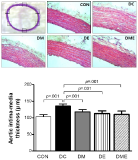
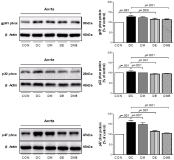
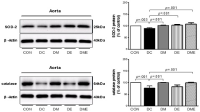
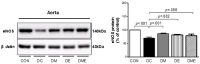
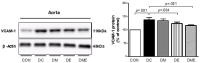
Purpose The purpose of this study was to investigate the effect of treadmill exercise and MitoQ treatment on NADPH oxidase, antioxidation and vascular function-related factors in aortic of D-galactose-induced aging rats. Methods To induce the animal model of aging, D-galactose was diluted in saline, and a dose of 100mg /kg was intraperitoneally injected into Sprague-Dawley rats once a day for a total of 10 weeks. Rats were divided into five groups: Control group (CON, n=9), D-galactose control group (DC, n=9), D-galactose+MitoQ group (DM, n=9), D-galactose+Exercise group (DE, n=9), D-galactose+MitoQ + Exercise group(DME, n=9), and treadmill exercise was conducted for 5 days/week during 8 weeks with gradual increase of intensity. MitoQ treatment was intraperitoneally injected at a concentration of 100μM/kg twice a week for 8 weeks during the research period. Results The result showed that treadmill exercise and MitoQ treatment decreased the expression of NADPH oxidase level and increased antioxidant enzyme such as SOD-2, catalase. It lead to positive effects such as increasing the level of eNOS, a protein involved in vascular function while decreasing the level of VCAM-1. In addition, as a result, it showed the structurally reduced intima-media thickness. Conclusions It can be concluded that treadmill exercise and MitoQ treatment are effective in ameliorating and treating vascular dysfunction resulting from aging.
Purpose The purpose of this study was to investigate the effects of training methods on body composition, isokinetic strength and muscle endurance, cardiopulmonary function, and anaerobic power in female judo players. Methods Subjects performed weight training (n=10) and circuit weight training (n=10) consisting of 10 sports items for 12 weeks. In order to analyze the effects of training, body composition, isokinetic strength and muscle endurance, cardiopulmonary function, and anaerobic power were measured and the effect of training was verified. Results First, the comparison of body composition between WT and CWT groups showed that significant interaction effect between group and period was found in all variables (weight: F=1082.694, p=.001, body fat mass F=199.999, p=.001; skeletal muscle mass F=2481.698, p=.001, and percentage body fat: F=496.246, p=.001). Second, there was a significant interaction effect between group and duration in shoulder muscle strength and knee endurance (EPTL: F=6.598, p=.019; EAPL: F=12.860, p=.002). Conclusions The result of this study showed that the interaction effect between period and group was not significant according to the training method but the overall effect of the circuit weight training group was more positive than the weight training group. Therefore, it can be concluded that the 12 weeks circuit weight training can contribute to improve the performance of female Judo players by improving body composition, strength and muscle endurance, cardiopulmonary function and anaerobic power.
