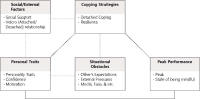
[Purpose] This study was designed to explore Yuna Kim’s psychological strengths and the contextual factors, which led her to obtain the gold medal and the reflection of peak performance and preparation at the 2010 Olympics. It was hoped that by sharing the experience of one of the top athletes, other athletes would learn from her and prepare themselves better for Olympics in the future. [Methods] A case study method was applied with a qualitative approach. To obtain the purpose of the study, five in-depth interview sessions including introductory and member checking procedures were conducted. The interviews were recoded and transcribed verbatim, and content analysis was used to inductively analyse the data. [Results] The four general dimensions that were discovered in the results included Social-external Factors, Personal Traits, Coping Strategies, and Peak Performance. The social-external factors consisted of social support and attached/detached relationships while personal traits were personality traits, confidence and motivation. Coping strategies to overcome external and situational pressures were detached coping and resilience whereas peak performance was reflected on flow and the state of being mindful. [Conclusion] In conclusion, Yuna Kim’s strength was parallel with the previous research on the top athletes and other findings such as adaptive perfectionism and a sense of rivalry in the research were discussed.

Purpose This study was designed to develop a team building program that helps freshmen student-athletes to adapt to college life and enhance team function and process and to examine the effects of this program. It could provide basic information of a team building program that effectively accelerates team function in the college team sports domain. Methods The program was developed through this process. First, an open-ended questionnaire was utilized to discover the needs of the program. Second, the results of needs of the program and important factors of team-building program were taken into consideration. Third, expert meetings were conducted. Consequently, the program consisted of three stages of total 10 sessions which was 90 min long. The questionnaires(Group Cohesion Questionnaire and Coach-Athlete Relationship Questionnaire), experience report, and program evaluation form were used as measures to identify the effects of the developed program. SPSS version 24.0 and inductive analysis were used to analyze the data. Results The results of this study are as follows. First, there was no statistically significant influence between developed program and the level of group cohesion. In contrast, the level of coach-athlete interaction was significantly increased. Second, the analysis of experience report revealed that this program reduced interpersonal conflict between team members and formed positive interpersonal relationship by mind of respect and consideration. Conclusion In conclusion, the hierarchical culture was strongly formed and team member suffered from the dual role of athlete and student in Korean college team sports. Thus, these should be resolved in order to enhance team function and process. As a results, this process could increase team performance as well as offer psychological stability to college student-athletes.
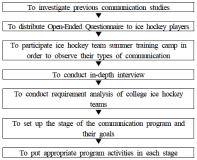
This study was designed to develop a communication training program for college ice hockey teams and examine the effects of this program. College ice hockey players and coaches participated in this study. The various types of data were collected and analyzed to assess the needs of the program and to develop the program with expert meetings. To analyze the effects of the developed program, questionnaires, experience reports, and in-depth interviews were conducted as measures. The results of this study are as follows. First, ice hockey team communication consisted of eight factors (i.e., sympathy, respect, trust, two-way verbal communication, firm expression of opinion, training program communication, developing rapport, and cohesion). Thus, the program developed based on eight factors and consisted of three stages of total 12 sessions which was 90 min to 100 min long. Second, this program increased communication satisfaction, coach-athlete interaction, group cohesion and exercise effectiveness, and these quantitative results were statistically significant. Moreover, qualitative analysis revealed that this program enhanced sympathy, social cohesion, and task cohesion among participants as well as positively changed their communication skills better than before. The communication training program which was developed through this study could provide basic information of a communication training program in the sports domain and positively influence overall sports team effectiveness and performance.
