Frailty in older adults is related to an increased risk for poor health outcomes including falls, disability, hospitalization and mortality. The purpose of this study was to determine the thresholds of a functional fitness associated with frailty for community-dwelling woman aged 65 or older. In this study, the National Fitness Award(NFA) items for elderly were utilized as the physical function and fitness testing for korean elderly women. The total of 444 community-dwelling woman completed the testings. Frailty status was classified by the Japan LTCI system ‘Kihon Checklist’ in the study. The prevalence of the frailty was 19.1% in the study. The frail elderly were older and showed higher obesity index such as weight, body mass index (BMI), percent body fat and waist circumference than the normal elderly. After adjusting for age and BMI which was related to frailty, fitness testing items were compared depending on frailty. As the result, the frail elderly showed significantly lower fitness levels in grip strength, 30-second chair stand test, timed up and go, figure-of-8 walk around two cones, and 2-minute step test than the normal elderly. When the fitness cut-off values were analyzed using the ROC curve, also, grip strength: 34.13%, 30-second chair stand test: 14 reps, timed up and go: 7.09 seconds, figure-of-8 walk around two cones: 30.88 seconds, and 2-minute step test: 93 reps. In addition, based on the cut-off values of each fitness item, the group with a low fitness level showed a 1.86 to 3.09 higher odds ratio of frailty than the group with a high fitness level, even after age and BMI were adjusted. In conclusion, these findings indicate that the fitness cut-off values in this study are fitness levels for preventing frailty of Korean elderly women and there will be a need for a large-scale study including subdivided fitness cut-off values for each age group and targets elderly men as well.
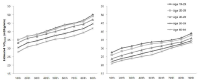
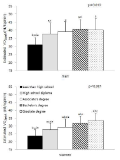
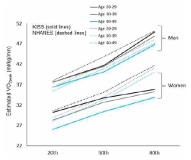
To provide the distribution of cardiorespiratory fitness including Bruce treadmill exercise time and estimated peak oxygen uptake (VO2peak) and investigate association with cardiorespiratory fitness and metabolic syndrome, sedentary lifestyle, or education level among Korean adults. Analysis of data on 2,006 adults (19-64 yr) who had completed a maximal grade treadmill exercise test, from the Sports Institute of Sports Science Fitness Standards (KISS FitS) project 2014-2015. The mean maximal exercise time was 11’26’‘, 11’18’‘, 11’06’‘, 10’03’‘ and 8’51’‘ (minutes and seconds) for men 19-29, 30-39, 40-49, 50-59 and 60-64 years of age, respectively, for women, it was 9’49’‘, 9’09’‘, 8’42’‘, 8’01’‘ and 7’33’‘ for the corresponding age groups. The mean peak oxygen uptake was estimated as 42.3, 41.8, 41.2, 37.6 and 33.6 ml/kg/minute for men 19-29, 30-39, 40-49, 50-59 and 60-64 years of age, respectively, For women, it was 34.0, 31.8, 30.3, 28.0 and 26.4 ml/kg/minute for the corresponding age groups. A positive association between cardiorespiratory fitness level and education level was observed for both men and women. Furthermore, participants with sedentary lifestyle had a significantly lower cardiorespiratory fitness than participants with activity lifestyle. Finally, Men with moderate and high fitness level had 50% and 87% lower odds for the metabolic syndrome, and women had 48% and 50% lower odds for the metabolic syndrome, respectively, than the ones with low fitness level after adjustment for age, smoking, alcohol intake, and sedentary lifestyle. These results can be used to track future Korean assessments and to evaluated interventions. The differences in fitness status by education level, sedentary lifestyle or metabolic syndrome can also be used to develop health policies, program and educational services.
PURPOSE This study aimed to investigate the effects of trunk stabilization exercise (TSE) with abdominal expansion maneuver (AEM) that lasted for 8 weeks on postural stability and functional movement in college athletes. METHODS Twenty college athletes participated in the program (AEM=9, Control=11) and were subjected to 8-week TSE. The AEM group performed exercise by applying AEM techniques during TSE, and control group performed TSE without breathing-related instructions. Both groups measured postural stability with lower-quarter Y-balance test (LQYBT) and functional movement with functional movement screen (FMS) before and after applying TSE to verify the interaction before and after this study with the two groups. Two-way repeated analysis of variance was performed to evaluate the differences between groups and time for an absolute value of LQYBT and FMS, followed by Bonferroni’s multiple comparison tests for post-hoc analysis. RESULTS As a result of the left and right LQYBT, there was a significant difference between the time x group (p=.041, p=.033), and post-hoc analysis indicated that there was a significant difference between the AEM and control groups (p=.000, p=,000). Furthermore, the FMS total score indicated that there was a significant difference between the time × group (p=.039), and the post-hoc analysis showed the AEM group had significant results (p=.001), while there were no significant results in the control group (p=.255). CONCLUSIONS Application of AEM during TSE seems to be effective with regard to postural stability and functional movement in college athletes.
