PURPOSE This study aimed to evaluate energy availability and dietary intake among female Korean national handball players and to examine the effects of sports nutrition on their dietary habits. METHODS Sixteen players from the 2024 Korean women’s national handball team participated in the study. Bioelectrical impedance analysis was used to assess body composition. Low energy availability (LEA) was assessed using the Low Energy Availability in Females Questionnaire (LEAF-Q). Dietary intake was evaluated before and after a sports nutrition education program using seven consecutive 24-hour recalls. Professional nutrition analysis software was utilized to assess weekday and weekend intakes of major macro- and micro-nutrients. A face-to-face nutrition education session was provided after the first dietary intake survey. The program covered the functions and recommended levels of macro- and micronutrients, specifically focusing on their link to sports performance. RESULTS Based on the LEAF-Q assessment, 37.5% of female national handball players were classified as being at risk, with particularly high tendencies of suffering injuries (62.5%) and gastrointestinal symptoms (75%). Following the nutrition education intervention, fat-free mass and skeletal muscle mass increased significantly, while fat mass and body fat percentage decreased (p < .05). Improvements were also observed in dietary intake of the players, with a significant increase in carbohydrate and protein consumption and a reduction in fat intake, along with achieving recommended levels on both weekdays and weekends. However, intakes of vitamin D, calcium, and iron remained below recommended levels before and after the intervention. CONCLUSIONS This study demonstrated that female national handball players faced insufficient energy availability and nutrient imbalances, particularly in vitamin D, calcium, and iron. Nutrition education prompted favorable changes in body composition and macronutrient intake, confirming its effectiveness. These findings highlight the importance of ensuring adequate energy intake, while persistent micronutrient gaps underscore the need for sustained, specific nutritional strategies.
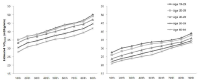
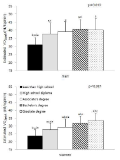
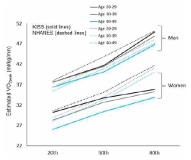
To provide the distribution of cardiorespiratory fitness including Bruce treadmill exercise time and estimated peak oxygen uptake (VO2peak) and investigate association with cardiorespiratory fitness and metabolic syndrome, sedentary lifestyle, or education level among Korean adults. Analysis of data on 2,006 adults (19-64 yr) who had completed a maximal grade treadmill exercise test, from the Sports Institute of Sports Science Fitness Standards (KISS FitS) project 2014-2015. The mean maximal exercise time was 11’26’‘, 11’18’‘, 11’06’‘, 10’03’‘ and 8’51’‘ (minutes and seconds) for men 19-29, 30-39, 40-49, 50-59 and 60-64 years of age, respectively, for women, it was 9’49’‘, 9’09’‘, 8’42’‘, 8’01’‘ and 7’33’‘ for the corresponding age groups. The mean peak oxygen uptake was estimated as 42.3, 41.8, 41.2, 37.6 and 33.6 ml/kg/minute for men 19-29, 30-39, 40-49, 50-59 and 60-64 years of age, respectively, For women, it was 34.0, 31.8, 30.3, 28.0 and 26.4 ml/kg/minute for the corresponding age groups. A positive association between cardiorespiratory fitness level and education level was observed for both men and women. Furthermore, participants with sedentary lifestyle had a significantly lower cardiorespiratory fitness than participants with activity lifestyle. Finally, Men with moderate and high fitness level had 50% and 87% lower odds for the metabolic syndrome, and women had 48% and 50% lower odds for the metabolic syndrome, respectively, than the ones with low fitness level after adjustment for age, smoking, alcohol intake, and sedentary lifestyle. These results can be used to track future Korean assessments and to evaluated interventions. The differences in fitness status by education level, sedentary lifestyle or metabolic syndrome can also be used to develop health policies, program and educational services.
PURPOSE This study aimed to develop a Korean version of the Low Energy Availability in Females Questionnaire (LEAF-Q) by translating the original English version into Korean using cross-cultural translation guidelines and conducting a face validity assessment. METHODS Following structured cross-cultural translation guidelines, a provisional final version (Pre-K-LEAF-Q) was created through initial translation, synthesis of initial translations, back translation, synthesis of back translations, and expert committee review. Additionally, its face validity was tested with 30 female participants. RESULTS After completing the translation process, the expert committee comprehensively compared each translation to finalize the Pre-K-LEAF-Q. This version was crafted to ensure semantic, idiomatic, experiential, and conceptual equivalence. Among the 30 females who participated, three noted that certain phrases were unclear or awkwardly expressed. The expert committee reviewed these five comments from the face validity test and modified three of the phrases. CONCLUSIONS The K-LEAF-Q was developed through cross-cultural translation and face validity testing to suit the cultural and linguistic context of Korea. It is expected to be a valuable tool for Korean female athletes.
PURPOSE The purpose of this review was to summarize the current knowledge on the trends in athletes’ health problems (and their preventive strategies) caused by low energy availability (LEA) and relative energy deficiency in sports (RED-S). METHODS In this narrative review, we summarized previous studies by searching the literature in the PubMed, Google Scholar, and Science Direct databases. RESULTS Energy availability (EA) refers to the amount of energy from caloric intake used for exercise, and a LEA is considered as a surrogate marker of RED-S. In several previous studies, chronic low energy availability in female athletes has been reported to cause health problems such as endocrine dysfunctions, immunosuppression, and psychological disorders, and to also affect the hypothalamic-pituitary-gonadal (HPC) axis and bone health. Moreover, it has been suggested that an increase in injury risk and a decrease in exercise performance may occur. CONCLUSIONS Since it can be difficult to recover from the health deteriorations caused by RED-S, early detection (of related signs and symptoms) and prevention are very important. Therefore, athletes, coaches, and parents need to develop educational programs that ease the recognition of the problems caused by various symptoms related to RED-S and promote educational interventions.
