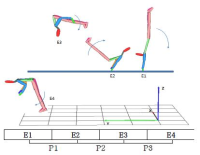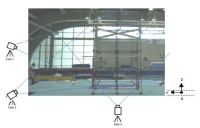
The purpose of this study was to identify the characteristics through technical analysis of dismount to perform the successful landing. The subjects in this study were male gymnastic players of the national team, hish-speed cameras were used to record the salto backward dismount on the parallel bars of the subjects and to study the qualitative and quantitative analysis. The evaluations including feedback of each subjects’problem were as follow: KHH showed early release timing compared to other players. It could be one of factors which can not decelerating the rotational speed, so the correction of posture is needed. NYI didn’t slide to the left at the release phase, and showed big rotation of body compared to other players so the center of mass moved to the rear. The correction of the hand position at flight phase is necessary to perform the V-shaped position. RSD landed in a state where the rotation is insufficient, so the training using elasticity of parallel bars at phase 2, and the correction of hand position are in need. PMS’s rotation angular velocity of body increased consistently, so showed instable land. Therefore the training to ensure the height of flight is required. PEJ showed high vertical position of CM at the release phase which is help for height of flight. He performed ideal V-shaped position, and took a relatively stable landing position. BGR also showed high vertical position of CM and performed ideal V-shaped position, so he landed in a posture in which the most stable. YHS should push vertically rather than horizontally at the moment of release. Especially, the hand position is not on the hamstring but on the back of the knee to perform the ideal V-shaped position. CJY showed little hip angle at the release phase, so he can’t take a position for vertical rise. Also he showed the lowest knee angle and performed rotation and landing in a state that cannot extend the knee. If such problems are corrected, it will be helpful to landing position not only in parallel bars but also in other events.