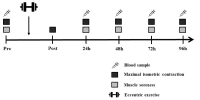
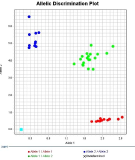
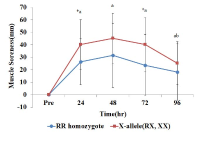
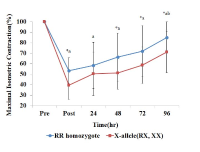
[Purpose] The purpose of this study was to examine the change of muscle damage markers after maximal eccentric exercise and to verify the difference of recovery according to ACTN3 gene polymorphism. [Methods] Fifty healthy males participated in this study. Subjects performed 25 times/1 set (total 2 set) maximal eccentric contractions of the elbow flexor muscles on a modified preacher curl machine with a between-sets rest time of 5 min. Maximal isometric contraction (MIC) was measured 6 times (pre, post, after 24 h, 48 h, 72 h and 96 h). Muscle soreness (SOR) was measured 5 times (pre, after 24 h, 48 h, 72 h and 96 h). Blood samples were collected 5 times (pre, after 24 h, 48 h, 72 h and 96 h). ACTN3 gene polymorphisms were identified using polymerase chain reaction (PCR). Data were analyzed using a 2-way repeated measure ANOVA and post hoc Bonferroni test. [Results] Analysis of ACTN3 gene polymorphism revealed the following distribution: 22% RR (n=11), 50% RX (n=25), and 28% XX (n=14). Individuals were classified into the RR homozygote group (n=11) and the X-allele group (n=39). MIC showed a significant difference between groups and interaction (p<.05). The groups differed significantly in MIC at 48 h, 72 h, and 96 h after exercise and the X-allele group decreased more than the RR homozygote group. The groups differed significantly in muscle soreness and interaction (p<.05). SOR in the X-allele group was significantly higher than in the RR homozygote group at 24 h after exercise. Although blood CK activity was lower in the RR homozygote group than in the X-allele group, but there was no significant difference between the groups (p>.05). [Conclusion] The RR homozygote group showed lower muscle strength reduction rate, muscle soreness and blood CK activity than the X-allele group. This indicates that RR individuals have a lower risk of exercise-induced muscle damage than those with an X-allele.
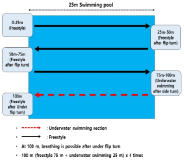
Purpose The purpose of this study is to compare the physical fitness levels among artistic swimmers in artistic swimmer national team trials. It is aimed to strengthen the physical fitness evaluation criteria of the national team and construct a physical fitness evaluation item suitable for an artistic swimming event. Methods A total of twenty two female elite artistic swimmers participated in this national team selection trial. Measurement list was performed body composition (Height, Weight, Body fat(%), Skeletal muscle mass, Lean body mass, BMI, Shoulder width, Arm span), Basic physical fitness (Push-up, Sit-up, Chin-up, Endurance of trunk backward extension and Sargent jump), Flexibility (Trunk backward extension, Shoulder flexibility, Frog position and Underwater split R, L) and Swimming test (100 m freestyle, 400 m freestyle). Data were analyzed by Independent t-test using SPSS Statistics ver 25.0. Results Age and skeletal muscle mass were significant difference between the two groups (p<.05). Also, 400 m swimming test was significantly different (p<.001). However, there were no significant differences in basic physical fitness and flexibility. Conclusions These results suggest that selected athletes are excellent not only in acting but also in physical fitness. Based on these results, it is necessary to construct a physical fitness items for the preliminary artistic swimming and to classify the physical fitness evaluation criteria according to the characteristics of the artistic swimmers.