
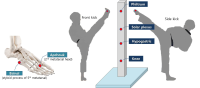
Purpose The aim of this study was to assess accuracy, consistency and performance time of the kick(front kick, side kick) of elite Poomsae players who accustomed excessive high kick. Methods Accuracy, consistency and performance time were measured by 3D motion capture system. Twelve elite Poomsae players(age: 28.83±1.80 yrs, height: 171.75±4.29 cm, weight: 67.58±3.6 kg) performed Poomsae kick according to the four target(philtrum, solar plexus, hypogastric, knee) and target or non-target. Results 1) Both of Front kick and Side kick were evaluated highest accuracy and consistency at philtrum. 2) Both of Front kick and Side kick were tend to increase on accuracy and consistency as the target height increasing. 3) The accuracy of Front kick and Side kick was decreased when the target is not provided at hypogastric and solar plexus. 4) There were statistically significant differences in performance time according to the height of four targets on Side kick but no differences on Front kick in performance time. Conclusion Overall elite Poomsae players who are familiar with kicking in high target were assessed poor kicking performance on lower target.


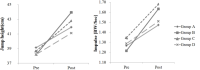
The purpose of this study was to find which percentage of 1RM for squat to improve the result of squat jump most effectively after plyometric training with different percentage of 1RM for squat. 24 men in their twenties were measured 1RM for squat and separated in 4 groups by 6 participants. Group A, B, C, and D used 0, 15, 30, and 45% of 1RM, respectively in the plyometric training. All groups had 1 hour training 3 days per week for 8 weeks(24 sessions). This study designed to increase the number of sets of exercises gradually. In week 1 and 2, participants trained 1 set of plyometrics with no load. The number of sets increased 2 to 4 in the week 3-4 to 7-8. The jump height(cm) and vertical impulse(%BW) of squat jump before and after plyometric training were measured by 3D motion capture system and force plate. All 4 groups showed the improvement of squat jump height and vertical impulse, but specially group B was most improved(p<0.5).
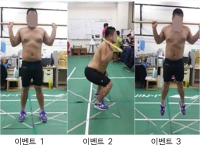
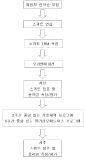
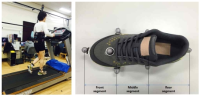
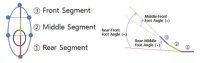
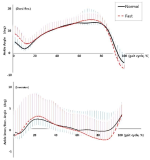
The objective of this study was to reveal the characteristics of lower extremity motions of middle-aged women in accordance with their walking speed, and also to suggest elements of improving functions of walking-shoe for the improvement of gait stability. Total 30 healthy middle-aged women were asked to walk in their preferred speed and also speed 20% faster than that. Using the 3D motion capture system and the plantar pressure measuring system, the characteristics of lower extremity motions were measured. For the analysis on differences in motions between preferred and faster speeds, the paired t-test was performed. At this time, the significance level was set up as α=.05. The walking in faster speed showed the greater ground contact angle than walking in preferred speed while its gait stability was low. Also, the faster walking showed the bigger plantar pressure, and especially, the pressure on the great toe was high. It would be necessary to improve functions of shoes for the gait stability and dispersion of pressure on feet while fast walking.



The purpose of this study was to examine the influence 12 weeks of Hatha yoga exercise has upon changes in postural control ability of high school girls. The research subjects were 27 high school girls (yoga group: 15, control group: 12). Changes that took place after yoga exercise were comparatively analyzed after having them train Hatha yoga for 12 weeks. The research variables that were measured were the moving range of COP in static postural balance, Rambling & Trembling in the moving range of COP, and postural change in the sagittal plane. The mean and the standard deviation(SD) were calculated on each measurement item by using the SPSS Ver 21.0 statistical program. To verify difference in pre-value between groups, an independent t-test was carried out. The verification of change according to time within the group after 12 weeks of yoga exercise was conducted in a paired t-test. To inspect interaction by time and group before and after yoga exercise, two-way repeated measures ANOVA was implemented. As a result, the moving distance of the pre and post direction in the moving range of COP was reduced. Rambling and Trembling in the pre-and-post direction significantly decreased. And in postural change of the sagittal plane, there was significant interaction between two groups in the neck and thigh parts. It was thought that the 12 weeks hatha yoga exercise has positive influence upon improving the postural control mechanism in female high school students and has an effect even on change in the postural control ability of an individual.
