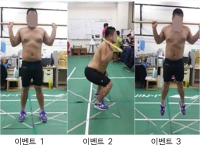
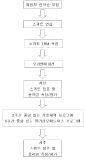
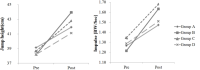
The purpose of this study was to find which percentage of 1RM for squat to improve the result of squat jump most effectively after plyometric training with different percentage of 1RM for squat. 24 men in their twenties were measured 1RM for squat and separated in 4 groups by 6 participants. Group A, B, C, and D used 0, 15, 30, and 45% of 1RM, respectively in the plyometric training. All groups had 1 hour training 3 days per week for 8 weeks(24 sessions). This study designed to increase the number of sets of exercises gradually. In week 1 and 2, participants trained 1 set of plyometrics with no load. The number of sets increased 2 to 4 in the week 3-4 to 7-8. The jump height(cm) and vertical impulse(%BW) of squat jump before and after plyometric training were measured by 3D motion capture system and force plate. All 4 groups showed the improvement of squat jump height and vertical impulse, but specially group B was most improved(p<0.5).
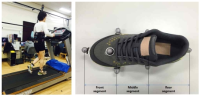
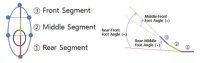
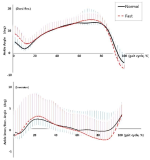
The objective of this study was to reveal the characteristics of lower extremity motions of middle-aged women in accordance with their walking speed, and also to suggest elements of improving functions of walking-shoe for the improvement of gait stability. Total 30 healthy middle-aged women were asked to walk in their preferred speed and also speed 20% faster than that. Using the 3D motion capture system and the plantar pressure measuring system, the characteristics of lower extremity motions were measured. For the analysis on differences in motions between preferred and faster speeds, the paired t-test was performed. At this time, the significance level was set up as α=.05. The walking in faster speed showed the greater ground contact angle than walking in preferred speed while its gait stability was low. Also, the faster walking showed the bigger plantar pressure, and especially, the pressure on the great toe was high. It would be necessary to improve functions of shoes for the gait stability and dispersion of pressure on feet while fast walking.