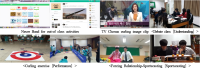
Purpose The purpose of this study was (1) to develop and to apply flipped learning strategies in Physical Education(PE) classes based on Sportscasting Model and (2) to examine the responses of students after PE lesson. Methods Participants were 10th high school students(N=216, male=115, female=101) in high school. Instruction strategies of flipped learning was developed after theoretical investigation, and the unit plans for curling and instructional materials were developed and applied. Open-ended questionnaires and in-depth interviews were used to collect the data. Qualitative content analysis combined with of structures in lesson was used to analyze the data. Results Results showed that (1) 11 instruction strategies of flipped learning were developed, (2) and the unit plan combining out-of class activities and in-class activities organically based on Sportscasting Model and instructional materials for unit of curling were developed and applied. In step of sportscasting, forcing relationship method-sportscasting based on the survey of students was developed and applied. (3) And 31 factors of Sportscasting Model and 15 factors of flipped learning were drawn from the analysis of questionnaires and interviews. Conclusion And to conclude, this research has a value of early study to develop and apply instruction strategies of flipped learning, the unit plan and instructional materials for combining Sportscasting Model with flipped learning organically. Discussions were provided in terms of the development of flipped learning applied in PE classes and responses of students.

Sportscasting in Physical Education (Lee, 2011) is a class activity that students simulate sports broadcasting (e.g., students report, analyze, and comment on game play). It encourages problem solving (PS) learning for students. Scaffolding is the support with the intention of helping the student achieves his/her learning goals and contributes to problem solving. However, limited studies have examined if sportscasting with scaffolding is effective instructional strategies for PS. The purpose of this study was to examine effects of sportscasting with scaffolding on PS abilities, and on academic achievement. Participants were 46 college students. The static-group comparison design was used: an experiment group (N=26) with supportive scaffoldings (e.g., conceptual explanation, terminology dictionary, visual materials) and a control group (N=20) with reflective scaffoldings (e.g., organizing the environment, using appropriate cues to guide behaviors, and modeling). The results revealed that students in reflective scaffoldings had higher PS abilities than students in supportive scaffoldings. However, two groups were not statistically different in academic achievement. Sportscasting with instructional scaffolding promote a deeper level of cognitive skills and male students performed better than female students. The effective scaffolding types (Lewis, 2010) for sportscasting were discussed to help students to foster PS skills.