
Purpose The purpose of this study was to investigate the changes of gait patterns and muscle activations according to dual tasks during stair ascending. Methods Twelve sedentary young male adults(Age: 27.0±1.8 yrs, Weight: 65.8±9.9 kg) without any lower extremity injuries participated in the study. Participants performed stair walking up 7 floors and their ascending motion on each floor was analyzed according to dual tasks. A wireless electromyography (EMG) were attached on the Rectus Femoris(RF), Biceps Femoris(BF), Gastrocnemius(GN), Tibialis Anterior(TA) muscle to calculate integrated EMG(iEMG) and co-contraction index(CI). Chest and left heel accelerometer signal were recorded by wireless accelerometer and those were used to calculate approximate entropy(ApEn) for analyzing gait pattern. All analyses were performed with SPSS 21.0 and for repeated measured ANOVA and Post-hoc was LSD. Results The results of this study indicated that dual task appeared to increase their time, CI and there were a statistically significant difference in most muscle on each floors compared to the non dual tasks. Also, ApEn were a statistically significant difference in only left and right direction than non dual task. Subjects showed more irregular pattern and instability muscle activation response during dual tasks. Conclusion Because there are many dangers often use of stairs in everyday life, in the future, we have to make a lot of efforts to prevent fall.
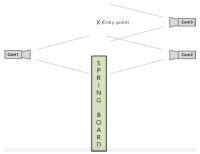
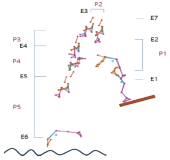
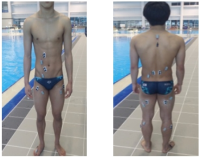
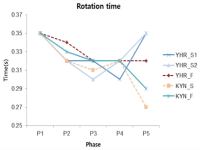
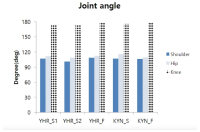
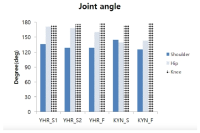
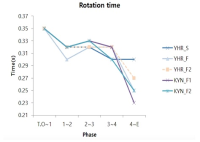
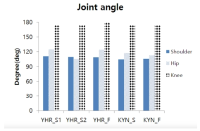
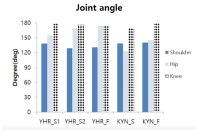
Purpose The purpose of this study is to overcome the shortcomings of 109C(Forward 4 ½ somersault) skill(Level 3.7) for two members of the men’s national diving team(YHR, KYN). Methods For qualitative analysis of the performed skill, three high-speed cameras and water-attached EMGs consisting of a total of ten placements were used. We instructed the two players to perform single-leg jump and double-leg jumps a total of three times each. Results The results of this study indicate that YHR and KYN appeared to increase their time or maintain the same time compared to the previous phase and displacement appeared higher when skill success occurred after the double-leg jump. The Shoulder & hip joints of YHR, KYN appeared larger in E2 and the hip joint of KYN appeared to increase in E1. Single-leg jump appeared similar or decreased the performed time of the previous phase in the last P5. YHR appeared larger only at a hip joint angle and KYN appeared smaller at the hip joint. The muscle activity(iEMG) of the two players appeared greater during skill failure than most of the muscles. Conclusions When perfectly performing 109C skills, the acquisition of medals in international competitions is possible. Therefore, in the future, it is necessary to study all of the variables that pertain to 109C.
PURPOSE This study aims to analyze the effects of injury prevention video feedback on kinetic variables of the knee joint during the cutting maneuver. METHODS Twenty-eight healthy men participated and motion and force data were collected using infrared cameras, a force plate, and a Witty timing system. Paired t-tests were employed for data evaluation using the SPSS 26.0 program. RESULTS Results showed increased abduction and lateral rotation angles of the knee joint at the lower height of the center of mass (COM) (p<. 05). The lateral rotation of the knee joint decreased at initial ground contact (p<.05). Flexion angular velocity increased at initial ground contact after video feedback (p<.05) and decreased at the lower height of COM (p<.05). Abduction angular velocity decreased at the lower height of COM (p<.05), and internal rotation angular velocity was increased on the initial ground contact (p<.05). Maximum ground reaction force for anterior-posterior and medial-lateral directions increased after video feedback (p<.05). Flexion and internal rotation moments increased, and adduction moment also increased (p<.05). CONCLUSIONS In conclusion , video feedback effectively reduced knee load during the cutting maneuver, contributing to injury prevention for the knee joint.
