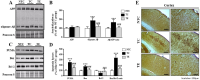
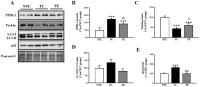
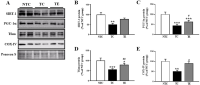
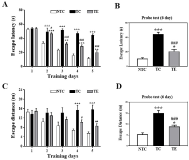
Purpose The aim of this study was to investigate the effects of treadmill exercise on mitochondrial quality control in the APP/sw transgenic mice model of Alzheimer's disease(AD). Methods The experimental mice were divided into non-tg-control (NTC, n=10), tg-control (TC, n=10), and tg-exercise (TE, n=10), and treadmill exercise was conducted for 12 weeks (15m/min, 60min, 5 times/week). And then, we measured the cognitive function using MWM and the brain cortex was evaluated to determine whether any changes in the oligomer Aβ, apoptotic-related factors, mitophagy and mitochondrial biogenesis. Results As a result, treadmill exercise significantly reduced oligomer amyloid and also had a positive effect on proteins (PUMA, Bax, Bcl-2) associated with apoptosis. In addition, through the treadmill exercise, PINK-1 decreased, and increased parkin, showing that active inhibition of mitophagy has been partially relaxed. It has been confirmed that the key autophagy markers LC3 and p62 significantly reduce p62 expression in TE group compared to TC group, and that LC3-II/LC3-I ratio tended to decrease, although not significant, increasing the activity of mitophagy. Next, proteins related to mitochondrial biosynthesis (SIRT-1, PGC-1α, Tfam, and COX-IV) have been identified, and the treadmill exercise has confirmed that the expression of all proteins has increased in part. Finally, cognitive has been shown to improve cognitive by shortening both swimming distance and time through treadmill exercise. Conclusions Thus, our finding suggested treadmill exercise alleviates cognitive dysfunction by improving mitochondrial quality control(mitophagy, mitochondrial biogenesis) and neuronal cell death via reducing amyloid accumulation, which may play a role in a preventive strategy for AD.
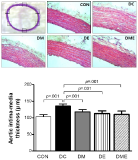
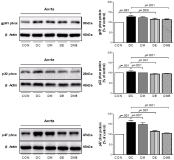
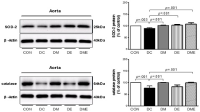
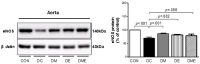
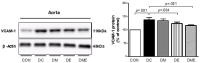
Purpose The purpose of this study was to investigate the effect of treadmill exercise and MitoQ treatment on NADPH oxidase, antioxidation and vascular function-related factors in aortic of D-galactose-induced aging rats. Methods To induce the animal model of aging, D-galactose was diluted in saline, and a dose of 100mg /kg was intraperitoneally injected into Sprague-Dawley rats once a day for a total of 10 weeks. Rats were divided into five groups: Control group (CON, n=9), D-galactose control group (DC, n=9), D-galactose+MitoQ group (DM, n=9), D-galactose+Exercise group (DE, n=9), D-galactose+MitoQ + Exercise group(DME, n=9), and treadmill exercise was conducted for 5 days/week during 8 weeks with gradual increase of intensity. MitoQ treatment was intraperitoneally injected at a concentration of 100μM/kg twice a week for 8 weeks during the research period. Results The result showed that treadmill exercise and MitoQ treatment decreased the expression of NADPH oxidase level and increased antioxidant enzyme such as SOD-2, catalase. It lead to positive effects such as increasing the level of eNOS, a protein involved in vascular function while decreasing the level of VCAM-1. In addition, as a result, it showed the structurally reduced intima-media thickness. Conclusions It can be concluded that treadmill exercise and MitoQ treatment are effective in ameliorating and treating vascular dysfunction resulting from aging.