PURPOSE This study aimed to develop a model for life skills transfer in sport. METHODS A literature review of research on life skills transfer was conducted. The prior representative studies on sport life skills and transfer models were selected and discussed to improve the validity of this study. RESULTS First, based on the basic psychological needs of the internalization and generalization of life skills, the model for life skills transfer should consider the influence of the explicit and implicit climate and environment. Furthermore, access to cognitive processes is required based on the conceptualization and integration of transfer. Second, the concept of a transfer was defined, and key issues of the cognitive processes that support the connection between the sport domain and out of the sport domain were discussed. Third, the model for life skills transfer in sport was presented. In this model, life skills transfer occur through sport context, cognitive process, promoting factors, and out of sport context. CONCLUSIONS Since the 2000s, research on life skills and transfer in sport has developed quantitatively based on positive youth development theory. Unfortunately, research on this area in South Korea is very insufficient. This study suggests a model for life skills transfer in sport based on an extensive and systematic analysis of the prior research, and this model can be used for future research.
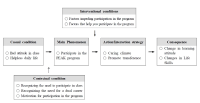
Purpose The purpose of this study was to explore the process of participation in the PEAK program of collegiate athletes based on grounded theory. Methods In-depth interviews were conducted with 12 athletes from Y University who were registered in Korea Taekwondo Association. The collected data were analyzed by using the open coding, axis coding, and selective coding of the grounded theory, completed the paradigm model among the extracted concepts, and extracted the core categories through the story outline. Results As the result of data analysis, 'participating in the PEAK program' was found as the central phenomenon, and the causal situation was 'bad attitude in class' and 'helpless daily life'. The contextual conditions were 'recognition of the need for class participation and dual career' and 'motivation to participate in the program', and the intervening conditions were 'factors that hinder participation in the program' and 'factors that help program participation'. The action/interaction strategies were ‘caring climate’ and ‘promoting transfer’, and depending on the consequence, ‘learning attitude change’ and ‘life skill change’ appeared. Conclusion Participants improved their learning attitude through the PEAK program and confirmed the possibility of life skills transfer. It is hoped that this study can lead to implementation of various studies and discussions about life skills and transfer.
