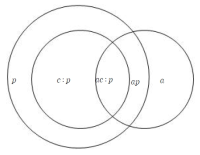
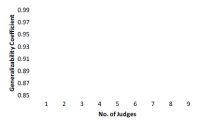
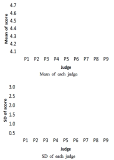
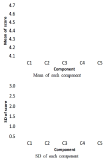
The purpose of this study was (1) to analyze judges’ evaluation on figure skating performance and statistical analysis and (2) to make recommendation to improve judges' performance. Data were 62 figure skaters’ scores from Senior Woman 1 Group Part at 2015 The National Figure Skating Championship in Korea. Data of presentation part in Short Program were analyzed. Presentation part consists of skating skills, transitions/linking footwork/movement, performance/execution, choreography/composition and interpretation. Nine judges evaluate skater's presentation with the score 10.0 for each factor. Generalizability theory, descriptive statistics and ANOVA were utilized. Results showed that generalizability coefficient of presentation part was over 0.9, therefore stable reliability was secured. The error source about players has more significant impact to evaluation than other error sources. Generalizability coefficient was stable when reducing the number of judges up to 2. Also, judges generally represented aspects of similar evaluation, but different aspects appeared on a few judges’ assessment in the components of presentation. Discussions were provided in terms of the reliability of the judging method for the presentation part of figure skating and the effective measurement condition.
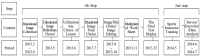
The purpose of this study was (1) to develop instructional contents for teaching and learning sportsmanship and (2) to examine the perceptions of sports instructors on that contents. Instructional contents based on sympathy was constructed from Youtube clips. Final version was developed to apply situated learning in class and was comprised of twenty-sportsmanship video clips and worksheets. Participants were sports instructors (N=208) in elementary and middle schools. Open-ended question and interview on call were used to collect the data. Qualitative content analysis was used to analyze the instructors’ perception regarding instructional contents. Results of this study showed that sports instructors responded to the contents as thoughtful experience (1) making myself realize the value of opponent, (2) making myself realize the value of sports, (3) making myself realize the value of judge, (4) making myself realize the value of coach/athlete. This study concluded that instructional contents was touching and emotional. Implication of instructional contents for teaching and learning sportsmanship, pros and cons of the contents and teaching tips were discussed.


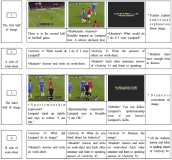
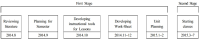
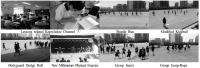
Researchers and teachers in physical education have emphasized sportsmenship in sport education setting. However, how to teach sportsmenship in physical education is not proposed yet. The purpose of this study was (1) to develop an instructional program for teaching and learning sportsmanship and (2) to examine its effects on sportsmenship. Participants were 7th middle school students(N=95). Data were collected using Sportsmanship Test(Park, 2014), open-ended questionnaire and in-depth interviews with students. The data were analyzed through paired samples t-test and qualitative content analysis. Results showed that significant difference was observed in students' sportsmanship test scores after instruction. Analysis of interview data showed that students experience the value of utmost effort, respect for opponents, respect for teammates, acknowledging results, respect for judgment, and valuable lessons related to character education. Implications for sportsmanship education using instructional program were discussed.