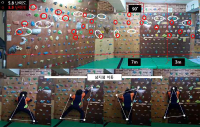
[Purpose] The study was designed to examine the effects of a 10-week sports climbing training on body composition and surrogate indices of major lifestyle disease in obese elderly women. [Methods] Twenty elderly women, whose percent body fat was over 35%, were randomly assigned into one of two groups, i.e., sports climbing training group (TR: n=10) and control group (CON: n=10). The subjects in TR completed sports climbing training program with 5.8 and 5.9 of difficulty, at 11-13 of ratings of perceived exertion (RPE), 60 min/session, three sessions/wk for 10 weeks. Independent variables regarding body composition and major lifestyle disease, i.e., hypertension, dyslipidemia, and atherosclerosis, were measured and compared between two groups as well as between two tests simultaneously using a repeated two-way ANOVA. [Results] Regarding physique and body composition, there were significant interactions between group and test in body weight, body mass index, fat mass, and percent body fat. These variables decreased significantly in TR. 2) Regarding indices of hypertension, systolic blood pressure, diastolic blood pressure, mean arterial pressure, and pulse pressure decreased significantly in TR. Regarding indices of dyslipidemia, triglyceride decreased significantly in TR. Regarding indices of atherosclerosis, TG/HDL-C ratio decreased significantly in TR. [Conclusions] It was concluded that the 10-week sports climbing training would be beneficial for reduction of body fat despite its’ influence on fat-free mass was limited, and would also contribute on improving surrogate indices of hypertension, dyslipidemia, and atherosclerosis in obese elderly women. Future research investigating the effects of various period, intensity, duration, and frequency of sports climbing training would be warranted.
PURPOSE This study aims to investigate the effects of a 12-week equipment-based Pilates training on physical fitness, cardiovascular function, and vascular endothelial function in obese middle-aged women. METHODS Twenty-four women, aged 30-40 years with a body mass index ≥ 25 and percent body fat ≥ 30% were randomly assigned to one of two groups: the Pilates training group (TR; n=12); and control group (CON; n=12). The TR participants underwent three 50-minute equipmentbased Pilates training sessions per week for 12 weeks. Participants in the CON maintained their normal life patterns for the same intervention period. Variables regarding physical fitness, cardiovascular function, and vascular endothelial function were measured and compared pre-test and post-test u a two-way ANOVA with repeated measures. RESULTS The main results of the study were as follows: 1) Regarding physique and body composition, participants’ body weight, body mass index, fat mass, percent body fat, waist circumference, hip circumference, and waist-to-hip ratio decreased significantly in the TR. 2) Regarding physical fitness, muscle strength, muscular endurance, flexibility, and cardiorespiratory endurance increased significantly in the TR. 3) Regarding cardiovascular response, SV increased significantly in the TR. 4) Regarding vascular endothelial function, blood vessel diameter at rest and during vasodilation as well as blood flow volume during vasodilation decreased significantly in the CON, resulting in a significant interaction between group and test in FMD percentage. CONCLUSIONS It was concluded that the 12-week equipment-based Pilates program improved the physical fitness and vascular endothelial function in obese middle-aged women.
PURPOSE This study investigated the effects of 12 weeks of clubbell and stepbox training on physical fitness, badminton skills, and fatigue in male badminton, grade A (top grade) club members aged 20–30s, with over 5 years’ experience. METHODS Participants in a training group (TR: n=15) engaged in 12 weeks of clubbell and stepbox circuit training involving maximum 8–12 reps of clubbell exercises and stepbox exercises at over 77% of HRmax for 50–55 min/sessions three times a week. Participants in a control group (CON: n=15) maintained their normal lifestyle pattern during the same intervention period. Dependent variables were measured and compared using repeated measures two-way ANOVA. RESULTS The main results were as follows: 1) The groups showed no significant differences in body composition. 2) Regarding physical fitness, VO2max, relative peak power, relative average power, grip strength, push ups, repeated jump squats, SSPT (seated single-arm shot-put test), 10 m sprint, and hexagon agility increased significantly in the TR, while push ups decreased significantly in the CON. 3) As for badminton skills, forehand clear accuracy, badminton agility, badminton endurance, and smash speed increased significantly in the TR. Forehand clear accuracy decreased significantly in the CON, but badminton agility and smash speed increased significantly. 4) The groups showed no significant differences in fatigue. CONCLUSIONS In male badminton club members aged 20–30s, 12 weeks of clubbell and stepbox circuit training effectively improved physical fitness and badminton skills. However, lack of any improvement in body composition and fatigue warranted further research in these areas.
PURPOSE The purpose of this study was to investigate the effects of 8-week aerobic exercise and polyphenol intake on body composition, cardiovascular response, vascular endothelial function, and physical fitness at rest and during exercise in prehypertensive men. METHODS The study included twenty-eight males in their 20-30 years of age with prehypertension. Participants in the aerobic exercise + polyphenol intake group (EX + PP; n = 14) performed aerobic exercise three sessions/week, 30 min/session, at 65% of the heart rate reserve, and consumed polyphenol (grape seed extract 300 mg) for 8 weeks. Participants in the aerobic exercise + placebo intake group (EX + PL; n = 14) performed the same aerobic exercise; however, they consumed placebo instead of polyphenol. All independent variables were measured at pre-test and post-test, and the data were analyzed. RESULTS The main results of the study were as follows: 1) SBP and MAP at rest decreased significantly in EX + PP, while MAP decreased significantly in EX + PL group. 2) In the EX + PP group, CO increased significantly, whereas DBP, MAP, and TPR decreased significantly during the hand grip exercise. In contrast, CO decreased significantly, while DBP and TPR increased significantly in the EX + PL group during the hand grip exercise. 3) Regarding vascular endothelial function, % FMD increased significantly in EX + PP group. 4) Sit-up increased significantly in both EX + PP and EX + PL groups; however, sit-and-reach in EX + PP group was significantly higher than that in EX + PL group at post-test. CONCLUSIONS The findings of this study showed that the 8-week aerobic exercise would have positive effects on body composition, cardiovascular response, and physical fitness at rest and during exercise in hypertensive men. Additionally, polyphenol intake would contribute more towards reduction of blood pressure at rest and during exercise and improvement of vascular endothelial function.
PURPOSE This study aimed to investigate the effects of an 8-week unstable surface Pilates training on physical fitness, abdominal muscle thickness, lumbar isokinetic muscle function, and pain in women aged 30–40 who are living a sedentary lifestyle and experiencing nonspecific low back pain. METHODS The training group (TR, n = 15) performed Pilates using small apparatuses on an unstable surface for 50 min/session, three sessions per week for 8 weeks, whereas the control group (n = 13) maintained their usual living pattern during the same intervention period. RESULTS 1) The body weight, body mass index, percent body fat, and fat mass decreased significantly in the TR, 2) whereas the hand grip strength, trunk extension, sit-andreach, and modified Schober test scores improved significantly. 3) The thickness of the external oblique, internal oblique, and transversus abdominis increased significantly in the TR. 4) Lumbar isokinetic flexor strength per body weight increased significantly in the TR. The endurance and endurance per body weight of the lumbar isokinetic extensor and lumbar isokinetic flexor also significantly increased in the TR. 5) The Korean Oswestry disability index (KODI) and the visual analog scale (VAS) score decreased significantly in the TR. 6) Significant negative correlations were found between the change rates in the KODI and nondominant hand grip strength, external oblique thickness, transversus abdominis thickness, and lumbar isokinetic extensor endurance. A significant negative correlation was found between the change rates in the VAS score and external oblique thickness. CONCLUSIONS The results revealed that the 8-week unstable surface Pilates training was beneficial in improving physical fitness, abdominal muscle thickness, lumbar isokinetic muscle function, disabilityindex, and pain levels in women aged 30–40 years who were having a sedentary lifestyle and experiencing nonspecific low back pain.
Purpose The purpose of this study was to investigate the effect of a 10-week aerobic exercise training on cardiovascular function, atherosclerosis, and vascular endothelial function in elderly women. Methods Twenty impaired fasting glucose (IFG) and normoglycemic elderly women volunteered to participate in the study. The participants in aerobic exercise training group (TR: n=9) completed 20-40 minutes of aerobic exercise program at 30-50% HRR for 3 times per week during 10 weeks. The participants in control group (CON: n=11) were asked to maintain their normal life pattern during the same intervention period. Results Main results of the study were as follows: 1) There were no significant main effect or interaction in body weight, fat-free mass, fat mass, percent body fat, and body mass index. 2) There were no significant main effect or interaction in heart rate, stroke volume, cardiac output, total peripheral resistance (TPR), systolic blood pressure, diastolic blood pressure, mean arterial blood pressure, pulse pressure, and rate pressure product. However, interaction between group and test in TPR was close to statistically significant level (P =.054), and it tended to be decreased in TR group. 3) There was a significant main effect of test in high sensitivity C-reactive protein(hs-CRP), it tended to be decreased in TR group. There were no significant changes in total cholesterol(TC)/high density lipoprotein-cholesterol (HDL-C) ratio, triglyceride/HDL-C ratio, and low density lipoprotein-cholesterol/HDL-C ratio. 4) There were significant main effect of group, main effect of test, as well as interaction between group and test in % flow mediated dilation(FMD), and it increased significantly (P<.01) in TR group. Nitric oxide tended to be increased in TR group, even though it did not change significantly in both groups. Conclusions It was concluded that the 10-week aerobic exercise training would be beneficial for improvement of vascular endothelial function, resulting from the decrement of total peripheral resistance.

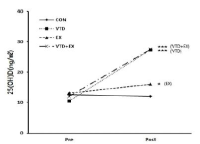
The objective of this study was to investigate the effects of 12-weeks of vitamin D supplementation and circuit training on skeletal muscle mass in elderly women with type 2 diabetes mellitus and vitamin D deficiency. Forty eight elderly women with type-2 diabetes mellitus and vitamin D deficiency were randomly assigned to control(n=10), vitamin D supplement(n=11), exercise(n=12), and vitamin D supplement+exercise(n=15) groups. Dependent variables were measured before and after the 12-week interventions. Major outcomes included body composition, fasting glucose, insulin, and 25(OH)D concentration. ASM(apeendicular skeletal muscle mass), SMI(skeletal muscle mass), and HOMA-IR (homeostasis model for insulin resistance) were calculated. Women assigned to the vitamin D supplement consumed 1,200 IU of vitamin D orally per week for 12 weeks. Women assigned to the exercise intervention performed a circuit training at an intensity of 60%~80% of HRmax with a frequency of 3 days per week for 12 weeks. Compared to control group, all groups had significant loss of body weight and increases in serum 25(OH)D after the 12-week intervention. ASM and SMI increased significantly in only vitamin D+exercise group. Regardless of treatments, no significant group differences were found in changed scores of fasting glucose, insulin, and HOMA-IR. In conclusion, vitamin D + exercise would improve the loss of ASM and SMI compared with vitamin D or exercise alone.
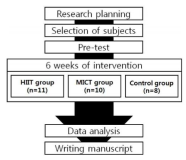
The primary purpose of this study was to investigate the effects of 6 weeks of high-intensity intermittent training (HIIT) and moderate-intensity continuous training (MICT) under relatively equal energy expenditure on body composition, aerobic capacity, cardiovascular function, insulin resistance, and blood lipid profiles in 20s overweight males. Twenty-nine males were randomized into one of the following groups: HIIT group (n=11), MICT group (n=10), and control group(n=8). Subjects in HIIT group completed 6 weeks of training for 25 min/sessions, three times/wk, and subjects in MICT group exercised for 33 min/session to equalize the energy expenditure with HIIT group. Subjects in control group were asked to maintain their normal life pattern during the same intervention period. Data were analyzed using two-way repeated measures ANOVA with post hoc test. Main results of the present study were as follows: 1) Body weight, BMI, fat mass, and WHR decreased significantly in HIIT group. 2) VO2max, VEmax, and time to exhaustion increased significantly in HIT group. 3) SBP decreased significantly in HIIT group and HRrest was tended to decrease in HIIT. 4) Fasting plasma insulin and HOMA-IR were tended to decrease in HIIT, but the changes failed to reach the statistically significant level. 5) HDL-C and TG were tended to improve in HIIT, but the changes failed to reach the statistically significant level. Results indicate that high intensity intermittent exercise training is more beneficial in aerobic capacity and cardiovascular function. It was also suggested that 6 weeks of aerobic exercise training in either high intensity intermittent or moderate intensity continuous was not sufficient enough to induce changes in body composition, insulin resistance and blood lipid profiles.
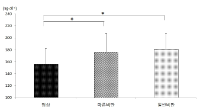
This study was designed to compare physical fitness, blood lipids, and insulin resistance according to body mass index (BMI) and percent body fat (%BF) in 20s females. Sixty women, aged 20-29 yrs, volunteered to participate in the study as subjects. There were three groups, i.e., normal group (BMI < 24 kg·m-2 and %BF < 25%; n = 25), normal weight obese group (BMI < 24 kg·m-2 and 28% < %BF < 40%; n = 22), and obese group (BMI > 26 kg·m-2 and 30% < %BF < 40%; n = 13). Physical fitness, blood lipid profiles, and surrogate indices of insulin resistance were measured and compared among three groups. Main results of the present study were as follows: 1) There were significant differences in all variables regarding body composition among three groups. All values were lowest in normal group and highest in obese group. 2) There was significant difference in sit-and-reach among three groups, whereas no significant differences were found in other variables regarding physical fitness among three groups. 3) There were significant differences in all variables regarding blood lipids among three groups. In particular, total cholesterol (TC), low density lipoprotein cholesterol (LDL-C), TC/HDL-C ratio, and LDL-C/HDL-C ratio were significantly higher in normal weight obese group than normal group. 4) There were significant differences in all variables regarding insulin resistance among three groups. Fasting plasma glucose and HOMA-IR were lowest in normal group and highest in obese group. It was concluded that there would be abnormal blood lipid profiles and insulin resistance in even normal weight obese individuals as well as general obese individuals in 20s females.

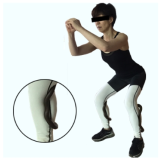
Purpose This study was designed to investigate the effects of weight-bearing exercise and CareRing treatment on cardiovascular responses, popliteal vein functions, and vascular elasticity of 30-40s women who had worked longer than eight hours a day in a standing position. Methods Thirteen subjects participated in 30 min of standing up treatment (STAND), weight-bearing exercise treatment (EX), and weight-bearing exercise with CareRing treatment (EX+RING). Each subject took part in the three trials repeatedly in a counter-balanced order and proceeded with a wash-out period of at least one week between the respective trials. Results The main results were as follows: 1) Significant reduction in EDV, no change in the diameter of popliteal vein, trend of reduction in blood flow of popliteal vein, and increased baPWV, indicating reduction of vascular elasticity of whole body, were shown in the STAND. 2) CO and EF increased significantly, and TPR decreased significantly in the EX. Blood flow velocity and blood flow volume of popliteal vein increased significantly, and baPWV decreased significantly from immediately after the treatment throughout the recovery phase in the EX. 3) HR, CO, and EF increased significantly in the EX+RING. Blood flow velocity and blood flow volume increased significantly in the EX+RING. Diameter of popliteal vein increased significantly immediately after the treatment and decreased significantly at 40 minutes of recovery. TPR and baPWV decreased significantly immediately after treatment compared to the STAND. Conclusions It was concluded that weight-bearing exercises would be effective in preventing venous or cardiovascular diseases occurred due to long-standing in 30-40s women, who are at high risk for such diseases. Furthermore, it would be more effective to combine pressure treatment with CareRing during weight-bearing exercises.
