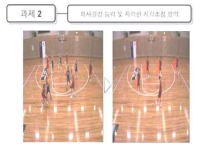
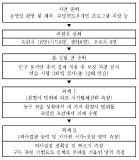
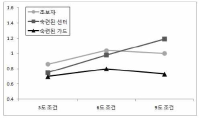
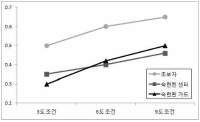
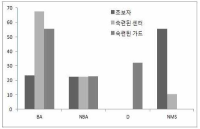
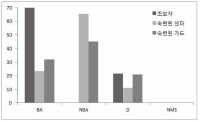
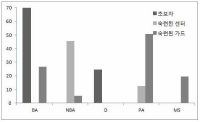
The purpose of this research was to investigate the difference in decision making and perceived eye-focus location on peripheral vision and attacker's expertise in basketball tactical game. A total of twenty four subjects who were expert guard players (n=8), expert basketball center players (n=8), and novices (n=8), participated in this experiment. All subjects participated two tasks. The first task was to anticipate the attack direction after viewing a sequence of basketball tactic film. These films simulated three situations including offensive patterns. The three situations were consist of 3, 6, 9 degree peripheral vision. The second task was to express the level of confidence on their anticipation and to verbalize the perceived visual cues immediately after responding. For this research, an Eyelink eye movement system, an equipment for measuring anticipating, basketball tactic film were used. The variables on anticipation of attack direction were speed, accuracy, and the level of confidence. The acquiring process of advanced visual cues was examined through analyzing visual search strategies and perceived eye-focus location. In order to examine the difference in visual search, in decision making, and in perceived eye-focus locations as a function of expertise, data were analyzed through descriptive statistics, two-way ANOVA, and two-way MANOVA. This research had the following results. First, there was a significant difference on the search rate among the three groups. But, on the other hand, expert guard and center exhibited more fixations of shorter duration than the novices in the 6 and 9 degree condition. Second, results from the ratio of fixation time allotted to areas in the 3 degree condition revealed that experts spent more time fixating the ball-attacker(BA) than novices. The results from the ratio of fixation time allotted to areas in the 6 and 9 degree condition revealed that expert guard and center spent more time fixating the non-ball attacker(NBA) than novices. Expert guard also fixated longer on the pass attacker(PA) and meaning space(MS) than novices. Finally, experts paid attention to two or three locations simultaneously, whereas novices did to only one location such as the ball, attacker, defender, non-meaning space in all condition.


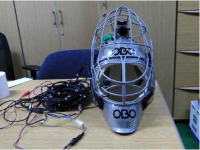
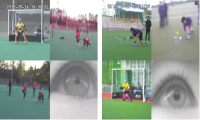
The purpose of this study is to establish the efficient defensive strategy from analyzing the goalkeeper’s gaze behavior and defensive motion in both field hokey penalty corner and penalty stroke. To achieve this goal, 3 national team goalkeepers’ gaze behavior and defensive motions were analyzed, as well as the player’s visual strategies from their interview contents. For the apparatus, multi-channel integrational system were used for analyzing goalkeeper’s reaction movement and personal visual strategies. The result is as follow: First of all, In the penalty stroke, goalkeepers were tended to focus on the bottom of the shooter’s hokey stick. Second, national hokey players had quicker anticipating saccadic movement. For this reason, their visual fixation locations were arrived in targets earlier than the hockey ball. Lastly, in the interview contents, they were reported to focus just on the ball from not disturbed by other various objects(body, hockey stick). However, they actually observed various body parts of shooters. These results imply that we need to develop an effective perceptual skill training in order to anticipate the shooting performance more accurately and rapidly. These types of perceptual and cognitive skill training should be conducted with information on knowing their specific visual cues in anticipating shooting direction.
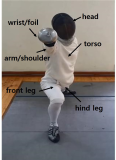
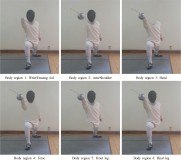
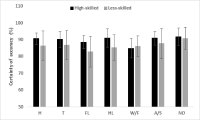
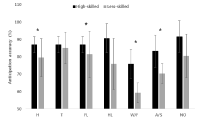
Purpose The purpose of this study was to establish the differences of anticipating accuracy and confidence according to fencing expertise and spatial occlusion region. Methods For the purpose of this study, the anticipation ability of 6 high-level fencing players and 6 low-level fencing players were analyzed. All subjects performed the 60 tasks of anticipating the attack positions(thorax, thigh, toe) from observing the fencing video screen using spatial occlusion technique. The spatial occlusion technique was used in 6 particular body of opponent’s movement. For statistic analysis, data was analyzed through independent T-test measure. Moreover, Paired t-test were used as follow-up analysis. Results The results of the study were as follows: In terms of accuracy anticipation, the main effect of expertise was significantly different. Specifically, when the spatial occlusion technique was applied in head, left leg, arm, and a foil, the accuracy of anticipation was significantly different. Moreover, comparing with no-occlusion condition, anticipation accuracy decreased when spatial occlusion technique was applied in arm and foil. In terms of confidence, there was no significant difference between level of expertise. Conclusions In order to effectively anticipate the opponent’s movement in fencing sports, it is necessary to focus on the visual cues of arm/shoulder, and the foil. Especially, focusing on the foil movement might provide the core informations on anticipation ability.