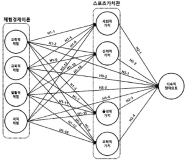
Purpose The purpose of this study was to examine the structural relationship between the sport values and continuous participation intention of the dance for all participants based on the 4 experience economy theory. Methods Frequency analysis, correlation analysis, confirmatory factor analysis and structural equation modeling using SPSS 21.0 and AMOS 18.0 were conducted to analyze the survey materials. Results First, the entertainment experience was a significant effect on all factors of sports value. Second, educational experience was a significant effect on all factors except sports entertainment value. Third, escapist experiences have a significant effect on all factors except physical value. Fourth, aesthetic experience has a significant effect on all factors of sports value. Fifth, social value and entertainment value was a significant influence on the continuous participation intention. Sixth, entertainment experience and aesthetic experience was a significant influence on the continuous participation intention. Conclusions Through these study results, it was confirmed that 4 experience, sport values and continuous participation intention of dance for all participants had a significant influence on each other.
PURPOSE This study aimed to identify the influence of certain factors on spectators' spectating behavior through the analysis of spectator-type Taekwondo spectators’ spectating behavior by applying the extended theory of planned behavior and embodied cognition theory and considering spectators’ desire to stay. METHODS A total of 305 surveys were used as the final sample. SPSS 24.0 and AMOS 26.0 were used for frequency , correlation, confirmatory factor, and structural equation model analyses. RESULTS First, attitudes, subjective norms, perceived behavioral control, and prior knowledge, which are predictors of the extended theory of planned behavior, had a statistically significant effect on the spectators’ desire to stay. Second, the spectators’ desire to stay had a statistically significant effect on the spectators’ content , environment, and behavior. Third , the spectators’ content and environment, which are sub-factors of the embodied cognition theory, had a statistically significant effect on the spectators’ behavior. CONCLUSIONS The study results suggest that attitudes, subjective norms, perceived behavior control, and prior knowledge, which are predictors of the extended theory of planned behavior, have a positive effect on the embodied cognition and spectator behavior of spectator-type Taekwondo spectators.
