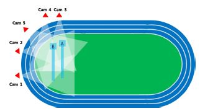
The purpose of the study was to investigate the relationship between the different kinematical variables with respect to the records and techniques performed by the participants during the 2011 Daegu IAAF World Championships Men's Pole Vault Event. Subjects chosen for the study were 8 male athletes who were selected for men's pole vault finals (highly skilled group) and 7 athletes who scored lowest record (skilled group) from the men's pole vault qualifying round. Personal best record of the each subjects were chosen to perform two dimensional (2D) and three dimensional (3D) video analyses. The data were obtained at 60 Hz with the use of five video cameras and digitizing was performed. Kinematical variables were calculated after smoothing the data using 2nd order Low-Pass Butterworth filter at cut-off frequency of 10 Hz and Independent samples t-test was performed to test any differences between two subject groups. The results: during the run-up stage, the horizontal velocity rate of the number of steps and run-up phase was obtained higher in highly skilled group than skilled group. During the take-off phase, deceleration in the horizontal velocity rate was observed in highly skilled group than skilled group. Distinct technical characteristics of distant and lower take-off of the take-off angle (angle of pole support) were also observed in highly skilled group than skilled group. During the pole bending and releasing phase, horizontal velocity was generally higher in highly skilled group than skilled group. It is considered that highly skilled group was able to jump higher as the vertical velocity during the pole bending as well as release phase was much higher in comparison to the skilled group.
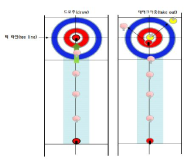
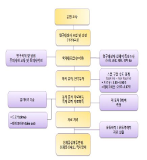
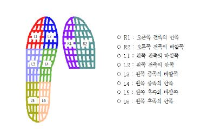
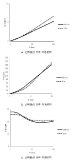
In this paper, we tried to find out the difference of CoM displacement, CoM velocity and Foot-pressure between draw motion and takeout motion in curling’s delivery motion. To do this, we experimented for 10 female athletes of curling national team(all athletes are in her 20th~30th ages) to carry out draw motion and takeout motion from backline to near hogline in state of speed limit. The limited speed was 3.80~3.90 sec for draw and 2.97~3.07 sec for takeout. From the experiments, we obtained the result like followings. 1. Draw motion is more increase than takeout motion in displacement of horizontal direction of CoM displacement. 2. Takeout motion is more increase than draw motion in displacement of vertical direction of CoM displacement. 3. Takeout motion is faster than draw motion in both of horizontal and vertical direction of CoM max. velocity. 4. Takeout motion is higher than draw motion in pressure of fore-foot and mid-foot of foot-pressure 5. Draw motion is higher than takeout motion in pressure of fore-foot and mid-foot of foot-pressure These result means that the characteristics of techniques for draw motion and takeout motion is differ from each other and it is necessary to take different training protocol individually to enhance athletes’s performance. And further research will contains another things like that the pursuit of curling stone’s rut by various delivery techniques