
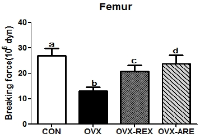
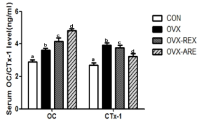
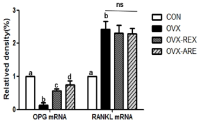
Purpose Osteoporosis is a systemic metabolic bone disease characterized by gradual decrease of bone mass and damage of the bone microstructure. In particular, postmenopausal osteoporosis is the most common type in women after menopause. This study aims to investigate the effects of combined exercise training on bone mineral density (BMD) and OPG/RANKL mRNA levels in ovariectomized rats. Methods A total of 40 Sprague-Dawley female rats were randomly divided into four groups: (1) CON (sham-operation, n=10), (2) OVX (ovariectomy, n=10), (3) OVX-REX (ovariectomy-resistance exercise, n=10), and (4) OVX-ARE (ovariectomy-combined aerobic and resistance exercise, n=10). Combined exercise training was performed on a treadmill and ladder adapted to rats in alternate days (4 days/wk, for 12 wk). Results Compared to the OVX group, all exercise treatments increased BMD and bone breaking force(p<0.05). In the bone turnover markers, serum C-terminal telopeptides of type-1 collagen (CTX-1) was significantly decreased in the exercise groups compared with OVX group and osteocalcin (OC) level was increased in the exercise groups (p<0.05). Additionally, in the exercise groups, expression of OPG mRNA was significantly increased compared with OVX group (p<0.05), and RANKL mRNA was slightly decreased but no significant between groups. Furthermore, OVX-ARE group showed more effects than OVX-REX group. Conclusions These results suggest that combined exercise may be a more effective therapeutic strategy to prevent and delay postmenopausal osteoporosis than resistance-only training.
Purpose Sperm quality and function are reduced by environmental factors (e.g., obesity), leading to increased infertility worldwide. Therefore, the purpose of this review paper was to investigate the effects of obesity and exercise training on sperm quality and function in animal and human models. Methods In order to determine the effects of obesity and exercise on sperm quality, motility, morphology, testosterone, oxidative stress, inflammation, we reviewed previous literatures with MEDLINE, PubMed, and Scopus databases. Results The most important factor to control the sperm motility is calcium ion, which is performed by the protein of CatSper (Cation Channel of Sperm). Obese men showed the decrease of number, concentration, motility, and volume in sperm, resulting in delayed or failed fertility. However, regular exercise training increased sperm-mediated factors including number, motility, and morphology, and festicular function-mediated factors including sperm concentration and serum testosterone. Conclusions While obesity exacerbates sperm quality and function in men, regular exercise training with moderate intensity increases sperm number and motility and reduces oxidative stress and inflammation, leading to the improvement of men’s fertility.
