The aim of this study is to analyze the correlation between per capita GDP and sports items' demand and to estimate the income elasticities of sports items' demand based on the International Social Survey Programme: Leisure Time and Sports - ISSP 2007 of the GESIS(Leibniz-Institute for the Social Sciences, Germany). The facts found from the analyses are as follows; First, in general, when the correlation coefficient of a particular sports item turns out to be both positive and statistically significant, the item can be interpreted to have a good possibility to be a luxury goods and when the coefficient is ascertained to be both negative and statistically significant, the item can be inferred to have a considerable chance to be an inferior goods. In this study, other team sports(excluding basketball, soccer, volleyball, baseball etc.), squash, walking/trekking/climbing, boat sports, hunting/fishing, horse riding/horse racing, motor sports, shooting, and snow sports were confirmed to show a luxury goods' features and basketball, soccer, volleyball, athletics, and martial arts were identified to have an inferior goods' characteristics. Second, similar to the results of the correlation analysis, in the income elasticities estimation, cockfighting appeared to be an inferior goods and other team sports, squash, walking/trekking/climbing, bowling/curling/bocce, boat sports, darts, hunting/fishing, golf/minigolf, horse riding/horse racing were proved to be a luxury goods.
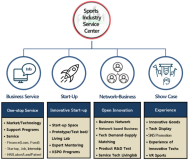
Purpose This study estimated the social value of the Sports Industry Support Center, which will be newly established and operated by the Ministry of Culture, Sports and Tourism, using the contingent valuation method. The survey designed a structured questionnaire for 480 households in 16 cities across the country to explain the necessity and major services of the Sport Industry Support Center and to investigate the willingness to pay for the social value of the center's sports industry support services. According to the NOAA panel's recommendation, the questionnaire survey consisted of dual dichotomous questionnaires and the form of payment in the form of income tax. As a result of analysis through logit model, statistically significant explanatory variables were payment amount, income level and gender. In particular, the higher the income level, the higher the willingness to pay, and the use of income tax as a means of payment was statistically significant. The social value granted to Sports Industry Support Center was 4,576.17 won per household per year, and it was estimated that there was a total of 469 billion won for the five years of income tax payment.
