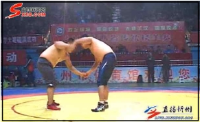
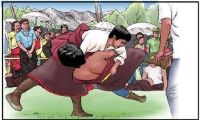
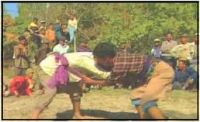
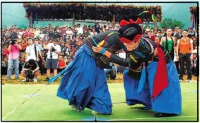
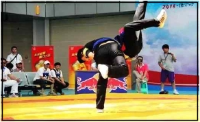
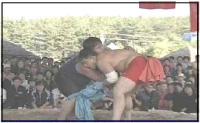
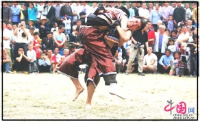
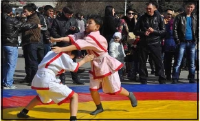
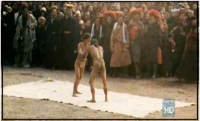
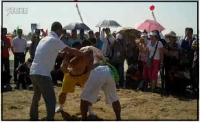
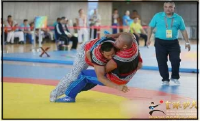
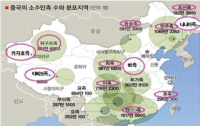
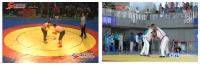
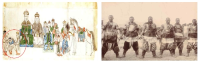
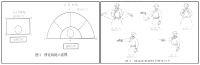
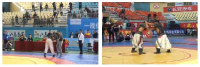
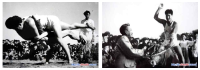
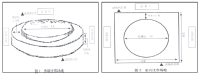
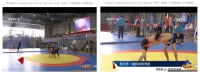
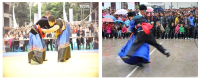
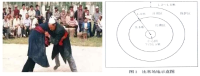
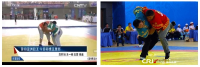
This research begins from the awareness that even though there are different forms of wrestlings in the ethnic minority groups in China, the study on their morphological aspects has reached the limit. Based on the documents and VOD data about these wrestlings of each ethnic group, their morphological characteristics can be verified as follows. First, The postures of Han and Mongolian people take the way of two players standing and playing, and Korean-Chinese people and Hui people take a saddle stance using a thigh band. Second, as for the arenas for the wrestlings, owing to some geographical features and natural environments, they were set up at a specific area during the traditional era using natural objects(grass, lawn, soil, sand). Yet, in the modern times, they have been changed as being installed and run in modernized gyms, sports fields, or parts following the standard of stadium facilities supervised by each organization. Third, with regard to the play wear of wrestling, some parts of the traditional costumes have been transmitted and worn. However, in case of most of the traditional costumes, it has been found out that modernized clothes which take the forms of garments developed since the modern era into consideration are being used. Fourth, in terms of the game equipments of wrestling, certain clothes(uniform, vest), running shoes and a band(a thigh band) should be worn.




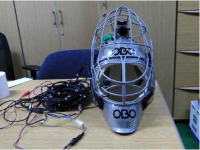
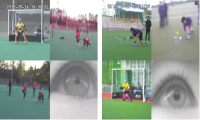
The purpose of this study is to establish the efficient defensive strategy from analyzing the goalkeeper’s gaze behavior and defensive motion in both field hokey penalty corner and penalty stroke. To achieve this goal, 3 national team goalkeepers’ gaze behavior and defensive motions were analyzed, as well as the player’s visual strategies from their interview contents. For the apparatus, multi-channel integrational system were used for analyzing goalkeeper’s reaction movement and personal visual strategies. The result is as follow: First of all, In the penalty stroke, goalkeepers were tended to focus on the bottom of the shooter’s hokey stick. Second, national hokey players had quicker anticipating saccadic movement. For this reason, their visual fixation locations were arrived in targets earlier than the hockey ball. Lastly, in the interview contents, they were reported to focus just on the ball from not disturbed by other various objects(body, hockey stick). However, they actually observed various body parts of shooters. These results imply that we need to develop an effective perceptual skill training in order to anticipate the shooting performance more accurately and rapidly. These types of perceptual and cognitive skill training should be conducted with information on knowing their specific visual cues in anticipating shooting direction.

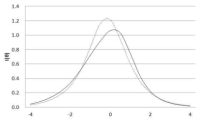
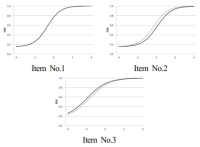
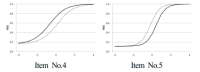
The purpose of this study was to analyze and confirm whether the items used in final paper and pencil test was determined to DIF when school sports clubs in each school operated by discriminatory curriculum in accordance with gender. Participants were 8th middle school students(male=135, female=141). They joined in school sports club every week from freshman to sophomore 1st semester. At that time, boys of them participated in soccer and basketball, and girls played dodge ball. They studied soccer unit at sophomore 1st semester, and had a final examination consisting of 5 soccer items. Using the data, differentially functioning item by the population difference between male and female were analysed quantitatively and qualitatively. The results showed that Mantel-Haenszel method(using classical test theory), comparison of item characteristic curve and likelihood ratio test(using IRT) determined item number 4 and 5 to differentially functioning item. Finally, item number 4 were identified differentially functioning item in favor of male students in intensive qualitative analyses. That item have low content validity and application-level of cognitive behavior classification. The result provides that application-level item can be functioning differentially to female students with little sports experience than male students in paper and pencil test of PE.