
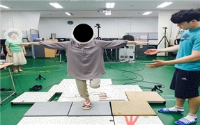
Purpose The purpose of the study was to investigate the effect of vibratory stimulus on the static postural control of 8 healty senior adults. Methods To achieve this goal, all subjects participated in two different kinds of static postural control tasks. Task 1 was a static postural control task, where both-legs stand on the ground. Second task was an unstable static postural control task using only single leg stance. As they maintain their balance, 6 different vibratory stimulus were provided on the sole of their feet(personal threshold 0%, 80%, 90%, 100%, 110%, 120%). Results The results of the study were as follows: First, there was no significant differences in postural control ability according to different types of vibrator intensity. Second, there was a significant difference in single-leg postural control ability according to vibrator intensity. Third, there was a significant difference in anterio-posterior stability according to the different types of vibrator intensity. Conclusion Stochastic resonance using vibratory stimulus was more effective in the single leg stance task, rather than the double leg stance task. Moreover, sub-threshold vibratory stimulus(80%, 90%) intensity were more effective than higher vibratory stimulus(100%, 110%, 120%).


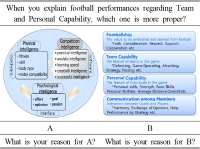
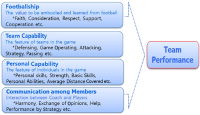
Purpose The following study was conducted to suggest and verify the validity of the concept of team performance, which has previously been considered as the total sum of individual performances. Method The concept of team performance was extracted by a conductive content analysis and an exploratory factor analysis of the data gathered from middle school football players. To verify the validity of the extracted concept, football experts' opinions were collected. Results The idea of team performance, categorized by Footballship, Team Capability, Personal Capability, Communication among Members, has been taken differently from the total sum of individual performances. Footballship is the virtue that should be materialized, and simultaneously earned during the game. Team Capability is a available resource for team's performance, Personal Capability is a available resource for a player's performance, and Communication among Members is the intimacy of communication between coaches and players. The conglomeration of experts' opinions on the concept of team performance and its components shows that team performance is evidently different from the total sum of individual performances. Conclusion The following study has been conducted to suggest and verify the validity of the concept of team performance. Team performance exists, standing distinct from the sum of individual performance, and understanding the concept of team performance will contribute not only to understanding performance, but also to improve the effectiveness of training and managing the team. Interest of the sport society is looked forward to.
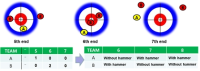
Purpose The purpose of this study is to investigate the characteristics of the winners and the losers of curling games to provide the winner strategies for the curling stakeholder. Methods For this study, data was collected from 2014 Sochi Winter Olympics web-site(http://sochi2014.curlingevents.com), which covers 199 games in total. Using the collected data, we extracted additional data such as the shot types and accuracy per players, team average score per end, whether or not with hammer per end and so on. and then a Chi-square test in statistic package SPSS 23.0 was used. The statistical significance was considered with p< 0.05. Results As a result, it was found that there were statistically significant difference between winners and losers of curling game on the shot type and accuracy(Draw, Front and Clearing). It was also found that there was not statistically significant between winners and losers about the number of blank end per end. It was found that 9th end average score was relatively lower than the other end in both the winners and the losers. It was found that the characteristics of the winners tends to be successful in more point from 5th end to 8th end with hammer and steal without hammer. Conclusion In conclusion, the strategies to win the curling game is to improve the shot performance of Lead and Skip, to organize the operation sequence for the successful blank end, and to develop the database and software in curling.

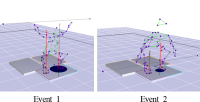
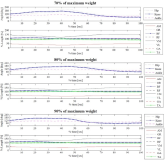
Purpose The purpose of this study was to identify the lower extremity muscles length change according to the increase of the weight during snatch. Also, through the muscle contraction velocity analysis, it is necessary to identify muscles that require rapid muscle contraction. Methods The subjects were 10 national weight-lifters. Their mean age was 29 ± 3.84 yrs, body weight 71.3 ± 16.04 kg, height 1.63 ± 0.07 m, and the highest recorded height 128 ± 36.30 kg. Experiments were performed during the snatch to 70%, 80%, and 90% of the individual highest records. The analysis variables were the lower extremity angle, angular velocity, muscle length and muscle contraction velocity and were calculated by biomechanical modeling. Statistical analysis was performed with a repeated measure with one-way ANOVA to analyze the difference between the increase weight (70%, 80%, 90% of peak) and the dependent variable (angel, angular velocity, muscle length and muscle contraction velocity). Results According to the results of the study, there was no statistical difference in angle, angular velocity and muscle length with increasing weight. However, in the comparison of the muscle length, muscle length of the vastus medialis, vastus lateralis, biceps femoris, rectus femoris were statistically higher than other muscles. Also muscle contraction velocity of the rectus femoris, biceps femoris, vastus medialis, vastus lateralis, rectus femoris were statistically higher than other muscles. Conclusion In the snatch, the dominant muscles were the muscles around the femur, and the co-contraction of biceps femoris and great adductor muscles would contribute to improve the performance.
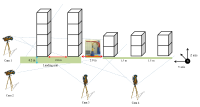
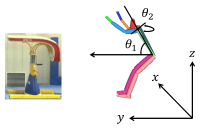
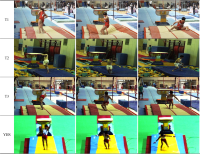
Purpose The purpose of the study was to perform a comparative analysis of the YANG Hak Seon technique carried out by "K" athlete with the kinematical data of "Y" athlete and propose a method to improve the YANG Hak Seon technique of "K" athlete. Method The subject recruited for the study was a male athlete from Korean national team (Age: 21, height: 1.65 m, body weight: 59.6 kg, and career: 11 years). Four high - speed cameras were used to analyze the 3D motion of the YANG Hak Seon technique performed by "K" athlete. The variables selected for analysis were the velocity of COM, displacement of COM, the rotational & torsional angle of the trunk and rotational & torsional angular velocity of the trunk. The results obtained were compared to the preexisting data of the "Y" athlete (data set from the published research). Results Firstly, the horizontal displacement of the YANG Hak Seon technique of the "K" athlete was observed to be shorter along with lower vertical displacement during landing compared to “Y” athlete. In addition, the overall horizontal velocity was low and vertical velocity was not generated which rises during the BC (board contact) phase. Although the rotational angular velocity of the trunk was lower during the BC, HC (horse contact) phase and LD (landing) phase, torsional angular velocity was higher during the LD. Conclusion In order to improve the completeness of the YANG Hak Seon technique of the K player, it is necessary to enter with a fast and low posture on the footplate during the initial phase. In the BC phase, it is essential to raise the COM simultaneously while landing on the footplate and increase the rotational angular velocity of the trunk.
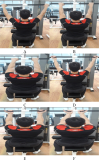
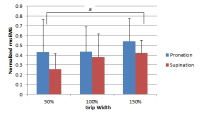
Purpose The purpose of this study is to investigate the effects of grip width and hand orientation on muscle activities of upper body during the lat pull-down. Methods Eight healthy men performed the 6 grip variations (3 grip width × 2 hand orientation) using an experimentally determined load of 70% of 1 repetition maximum. Five trials were analyzed for each grip type. Participants maintained a cadence of 2-second concentric and 2-second eccentric phases. The grip widths were normalized for each individual by using their biacromial diameter (100%), and then set the grip width 50% of biacromial diameter and 150% of biacromial diameter. Surface EMG of the latissimus dorsi, pectoralis major, infraspinatus, biceps brachii, triceps brachii, rectus abdominis, erector spinae and middle trapezius was recorded, and the root mean square of the EMG was normalized, using a maximum isometric voluntary contraction. Results Latissimus dorsi showed higher muscle activities in 100% grip width than those of 50% grip width. Pectoralis major and rectus abdominis showed higher muscle activities in 50% and 100% grip width than those of 150% grip width. Middle trapezius showed higher muscle activities in 150% grip width than those of 50% grip width. Conclusions Two-way repeated measures ANOVA for each muscle revealed that latissimus dorsi and middle trapezius (the posterior muscles of trunk) showed higher muscle activities in wide grip, on the other hand, pectoralis major and rectus abdominis (the posterior muscles of trunk) showed higher muscle activities in narrow grip.




Purpose The purpose of this study is to examine the socio-cultural background and the current issues of camp training system. This work could find the reason why camp training is continuing despite the regulatory policy. Methods This study compared past national and social situation, sports and education policies of each government, and the changes of sports paradigm through literature review. Results The settlement background of camp training system was explained by the national situation in 1970s and the elite sports policy. However, after the political democratization, the human rights ideology as universal value has developed, and the anti-human rights system which individuals sacrifice for the realization of community became not free in the school sports. Especially, since the 2000s, various social problems caused by camp training have been discussed and the school sports system is undergoing transition under various regulation. In this process, the conflict between the policy makers and the subjects is intensifying. The partial regulation, rather than radical reform, has been the cause of conflict without resolving 'the remnants of past elite sport policy'. The current regulation is limited to the "partial regulatory system", omitting fundamental changes such as the revision and abolition of the student-athletes' college entrance system. Conclusion This study presented two issues to normalize school sports. First, it is necessary to discuss the revision or abolishment of the student-athletes' college entrance system. Second, the existing school athletic system should be transformed into a future-oriented club system. By solving these problems, we can expect the policy effectiveness of current regulation and it will be able to reach the future that the regulatory policy are aiming at.

Purpose This study was designed to develop a team building program that helps freshmen student-athletes to adapt to college life and enhance team function and process and to examine the effects of this program. It could provide basic information of a team building program that effectively accelerates team function in the college team sports domain. Methods The program was developed through this process. First, an open-ended questionnaire was utilized to discover the needs of the program. Second, the results of needs of the program and important factors of team-building program were taken into consideration. Third, expert meetings were conducted. Consequently, the program consisted of three stages of total 10 sessions which was 90 min long. The questionnaires(Group Cohesion Questionnaire and Coach-Athlete Relationship Questionnaire), experience report, and program evaluation form were used as measures to identify the effects of the developed program. SPSS version 24.0 and inductive analysis were used to analyze the data. Results The results of this study are as follows. First, there was no statistically significant influence between developed program and the level of group cohesion. In contrast, the level of coach-athlete interaction was significantly increased. Second, the analysis of experience report revealed that this program reduced interpersonal conflict between team members and formed positive interpersonal relationship by mind of respect and consideration. Conclusion In conclusion, the hierarchical culture was strongly formed and team member suffered from the dual role of athlete and student in Korean college team sports. Thus, these should be resolved in order to enhance team function and process. As a results, this process could increase team performance as well as offer psychological stability to college student-athletes.

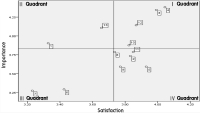
Purpose The purpose of this study is to grasp consumers' perception of badminton racket brand image using MDS and ISA. Methods To do this, we conducted questionnaires on those who participated in badminton and had experience of participating for 6 months or more in Seoul and Gyeonggi province from April 12 to 28, 2017, selected and analyzed a total of 313 copies as valid samples of this study. Results The results of study are as follows. First, as a result of MDS analysis, it showed that only the price of brand image attributes were in order of Trion > Joobong > Lining > Victor > Yonex, and the other attributes(Design, Functionality, Quality, Awareness, Advertising image, Event, Color, Popularity, Sophistication, Originality, Trust, Service) were in order of Yonex > Victor > Lining > Joobong > Trion. Second, as a result of ISA analysis, in I quadrant, Yonex showed functionality, quality, sophistication, and trust and Trion showed price, design, functionality and quality, Victor showed price, design, functionality, quality, color, sophistication, trust, service, and Joobong showed price, functionality, quality, and trust in this area. In quadrant Ⅱ as concentrated area, Yonex showed price and service, Trion showed color, trust, service, Victor showed price, Lining showed trust and service, and Joobong showed service in this area. In quadrant Ⅲ as low rank, Yonex showed advertising image, event, Trion showed awareness, advertising image, event, popularity, sophistication, originality, Victor showed advertising image, event, popularity, originality, Lining showed awareness, advertising image, event, popularity, originality, and Joobong showed design, advertising image, color, popularity, sophistication in this area. In quadrant IV as excess avoidance, Yonex showed design, awareness, color, popularity, originality, Victor showed awareness, Joobong showed awareness, event, originality in this area.




Purpose The purpose of this study was to compare the technique and power of the Korean national athletes and international athletes in the start phase of the 500 m speed skating to improve the performance and to understand the relationship between the biomechanical variables affecting the record. Method The subjects were 8 Korean national athletes (Korean athletes) and 6 international athletes (international athletes). For the three dimensional motion analysis, 5 high-speed cameras were used to capture the 40 m start phase of the athletes participating in the international competition. The variables selected for analysis were the kinematic chain, 100 m net time, time to 9 strokes, horizontal position of center of mass after 2.5 sec, range of motion of trunk, knee, push-off angle, net power output, total power loss. Results The correct kinematic chain ratio of Korean athletes was 61.2%, which was lower than 76.0% of international athletes. The time to 9 strokes was 2.82±0.25 sec for Korean athletes, which was significantly lower than 2.53±0.11 sec for international athletes (p=.001). The range of motion of the push-off angle was 60.15±2.75° for Korean athletes, which was significantly lower than 64.76±2.55° for international athletes (p=.001). The net power output was 887.2±269.9 W for Korean players and 1103±264.1 W for international players (p=.021). The variables related to the 100 m net time were the horizontal position of center of mass after 2.5 sec (r=-.956, p=.001), the net power output (r=-.931, p=.001), and the total power loss (r=-.904, p=.001). Conclusion In order to improve the start performance of Korean athletes, it is necessary to maximize the efficiency of skating through skill training to use the correct kinematic chain. Also power enhancement training is needed to improve leg power because the net power output related with 100 m net time.

