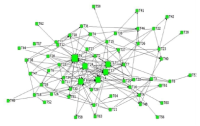
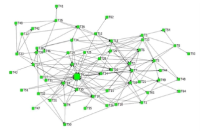
Previous work has shown that coaches sought information from several sources; however, there was a strong reliance on learning from other coaches within their social networks. There has been limited research examining the nature of these social networks with other coaches (Trudel and Gilbert 2004). Thus the purpose of this study was to examine the structures of coaches’ social networks of Korean rhythmic gymnasts. Research questions were: (1) What are the network structures of Korean rhythmic gymnasts’ coaches? (2) What structural parameters contribute to coaches’ network structures, and (3) Is there an association between coaches’ network and flow of information in their networks? A total of 37 coaches of youth rhythmic gymnasts (6-18 years old) participated in this study. Each of those coaches was asked to complete a Name Generator Questionnaire (i.e., list four names that you have a close relationship with) and general socio-demographic survey. Data were analyzed using social network analysis tools such as UCINET, p-net, and Quadratic Assignment Procedure. Analysis of network centrality, density, and strong components showed that (1) homophily was identified in the structure of coaches’ social networks (2) homophily (e.g., by gymnasts’ ranking, mentor coaches) contributed to the total social network of coaches, and (3) interacting only with close coaches in the network, coaches received information about coaches/coaching from the strong ties rather than weak ties (Granovetter, 1973). This study also has strong links to Wenger’s (1998) community of practice which posited that groups of people share a common characteristic in practice.

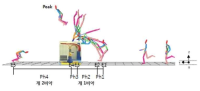
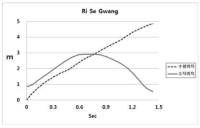
The aim of this study was to acquire essential information regarding Ri Se Gwang motion(element group Ⅱ, difficulty 6.4 point, double Tsukahara with tucked 1/1 twist), which Ri Se Gwang of North Korea performed during the final vault event of artistic gymnastic at Incheon Asian Game 2014, by analyzing motional characteristics. Firstly, Ri Se Gwang technique had second jump airborne time of 1.07 seconds and airborne height of 2.91m, which have great influences on the success of technique while having horizontal and vertical velocity of 2.73 m/s and 3.87 m/s, respectively, at the takeoff. These were sufficient jump motion for successful accomplishment of the technique however flight pattern was somewhat small which was mainly oriented vertically when compared to previous studies of Yeo and YANG Hak Seon 2 techniques. Secondly, blocking angle of vault contact was small at 9 degrees while having very small takeoff angle of 79 degrees. However, it had fast average trunk rotational velocity of 545 deg./s at the vault contact phase by rapidly bending trunk from the board takeoff until approaching the vault leading to achieve fast trunk rotational velocity of 452 deg./s after the take off in order to complete the airborne rotation successfully. Thirdly, the preparation phase of Ri Se Gwang technique had a distinct characteristics that the trunk was rapidly bent during the approach to the vault attempting aggressive blocking which leads to vertically oriented flight. It showed that this characteristic assists the motion of thigh snatch and the regulation of twist which strengthen airborne rotation for airborne rotational motion. And it also showed that sufficient landing and twist angles at the landing phase are possible with free rotational motion if the height of second jump reaches 3 m.