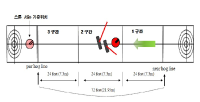
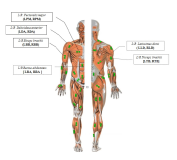
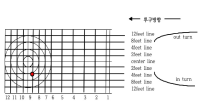
Purpose This is to provide essential data for training necessary for sweeping through the analysis of muscle activity generated at this time and how much sweeping and what trajectory moves the stone when the movement of the stone is controlled through sweeping. Methods To check and record the distance between the stones by checking the stop position of the stone made by sweeping each section, the length (progress distance) and width (progress direction) were recorded using a reference table and a record preparation table. With the EMG attached, a total of 60 sweeps were made 20 times each from the beginning of the section to the end of the section. Sweeping subjects were asked to sweep as much as possible under the same conditions in all three sections. Results As a result of the study, the muscle mobilization patterns of the 1st and 2nd sections of the stone with the faster speed and the 3rd section with the stone's slower speed appeared differently. It was confirmed that the sweeping motion of curling is a motion that is used evenly among the muscles of the upper extremity, and it can be verified that it is a suitable item for the development of upper body muscles. Also, the right deltoid's muscle activity rate during push and the right triceps brachii during pull was high. Conclusion Each section of the stone's sweeping effect is an exercise that has many variables, such as changes in atmospheric temperature and humidity, changes in ice temperature, temperature-size-number of pebbles, and the edge state-resilience of stones, etc. It is judged that experience can cope with these variables and requires training.
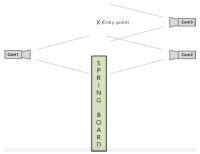
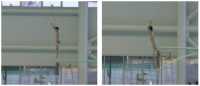
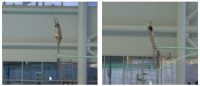
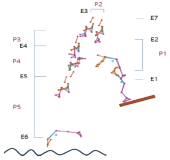
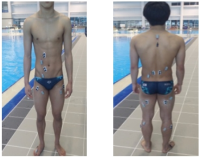
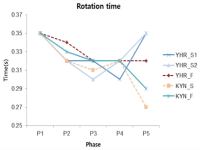
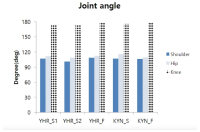
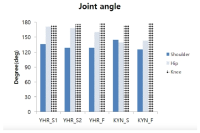
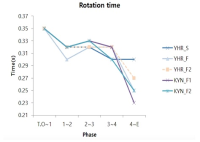
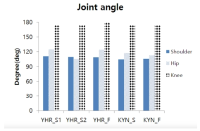
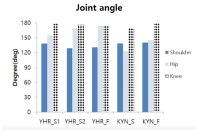
Purpose The purpose of this study is to overcome the shortcomings of 109C(Forward 4 ½ somersault) skill(Level 3.7) for two members of the men’s national diving team(YHR, KYN). Methods For qualitative analysis of the performed skill, three high-speed cameras and water-attached EMGs consisting of a total of ten placements were used. We instructed the two players to perform single-leg jump and double-leg jumps a total of three times each. Results The results of this study indicate that YHR and KYN appeared to increase their time or maintain the same time compared to the previous phase and displacement appeared higher when skill success occurred after the double-leg jump. The Shoulder & hip joints of YHR, KYN appeared larger in E2 and the hip joint of KYN appeared to increase in E1. Single-leg jump appeared similar or decreased the performed time of the previous phase in the last P5. YHR appeared larger only at a hip joint angle and KYN appeared smaller at the hip joint. The muscle activity(iEMG) of the two players appeared greater during skill failure than most of the muscles. Conclusions When perfectly performing 109C skills, the acquisition of medals in international competitions is possible. Therefore, in the future, it is necessary to study all of the variables that pertain to 109C.