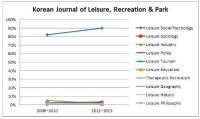
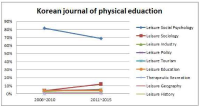
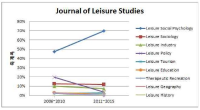
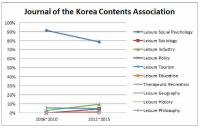
This study identified the trends in leisure and recreation research in Korea for the past 10 years. We classified previous research based on ten leisure and recreation research areas and compared the research trends of five journals: Korean Journal of Leisure, Recreation & Park, Korean Journal of Physical Education, Journal of Sport and Leisure Studies, Journal of Leisure Studies, and Journal of the Korea Contents Association. The results indicated that most research published over the last decade were included in the area of leisure social psychology, and the area of leisure social psychology showed the highest ratio in five journals compared with other research areas. To resolve the problematic results, this research suggests that future research needs to have diversity to extend the leisure and recreation research realm and to improve the quality of leisure and recreation research in Korea. We expect that this study would be used as a foundation for future leisure and recreation research.

PURPOSE Recreation specialization theory, which is characterized by a unique development process and progress, has been found to have varied pathways that develop in different patterns based on each dimension of recreation specialization. This study aimed to investigate how each sub-dimension of specialization changes as the degrees of experiential participation (frequency, period, and intensity of participation) and goods investment (expenditure) of the scuba divers increase. METHODS In the summer of 2021 (May-August), a purposive sampling method was used to collect samples from young scuba divers, and 278 copies of valid data were used for the final analysis. Frequency analysis, descriptive statistical analysis, confirmatory factor analysis, reliability analysis, correlation analysis, curve estimation analysis, and hierarchical regression analysis were performed using SPSS 24.0 and AMOS 24.0 ver. RESULTS The findings were as follows. First, the quadratic nonlinear model was identified as the optimal model for the relationships between the scuba divers’ participation intensity and cognitive, behavioral, and affective recreation specializations based on experience. Second, the cubic nonlinear model was identified as the optimal model for the relationships between the participation period, frequency of participation, and cognitive, behavioral, and affective recreation specializations of scuba divers. Third, the cubic nonlinear model was identified as the optimal model for the relationships between the expenditure cost of scuba divers and the cognitive, behavioral, and affective recreation specializations in the center of the goods. As the period, frequency, and expenditure of scuba diving participants increased, the relevant cognitive, behavioral, and affective specializations did not progress in a linear manner; instead, they went through an intermediate maintenance stage and developed to a higher level. CONCLUSIONS Progressive and meaningful consumption of experiences and goods further promotes recreation specialization. Any future follow-up study should identify a trade-off point in the development of the recreation specialization in a step by step manner.
