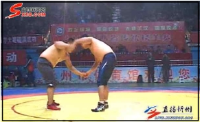
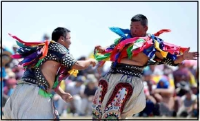
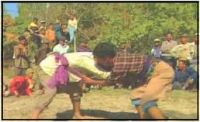
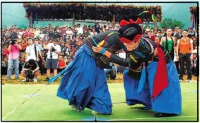
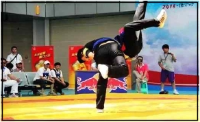
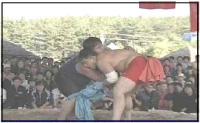
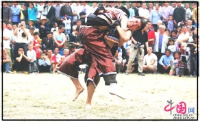
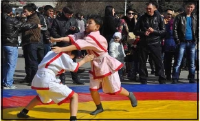
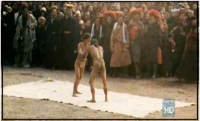
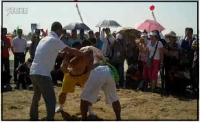
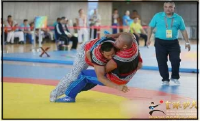
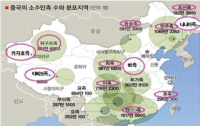
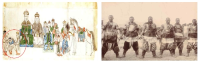
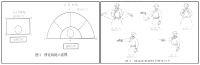
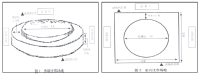
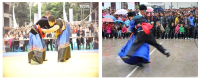
This research begins from the awareness that even though there are different forms of wrestlings in the ethnic minority groups in China, the study on their morphological aspects has reached the limit. Based on the documents and VOD data about these wrestlings of each ethnic group, their morphological characteristics can be verified as follows. First, The postures of Han and Mongolian people take the way of two players standing and playing, and Korean-Chinese people and Hui people take a saddle stance using a thigh band. Second, as for the arenas for the wrestlings, owing to some geographical features and natural environments, they were set up at a specific area during the traditional era using natural objects(grass, lawn, soil, sand). Yet, in the modern times, they have been changed as being installed and run in modernized gyms, sports fields, or parts following the standard of stadium facilities supervised by each organization. Third, with regard to the play wear of wrestling, some parts of the traditional costumes have been transmitted and worn. However, in case of most of the traditional costumes, it has been found out that modernized clothes which take the forms of garments developed since the modern era into consideration are being used. Fourth, in terms of the game equipments of wrestling, certain clothes(uniform, vest), running shoes and a band(a thigh band) should be worn.










Purpose The purpose of this study is to examine the elite sport system in Germany by selecting six keyword. Methods In order to review the literature, we reviewed the reports of sports organizations such as the Ministry of the Interior, the Olympic Games of Germany, the Sports Council of Germany, and the German sports policy, history, business, programs and financial status. Conclusion In Germany, athletic associations were created in the 40s and 50s and strengthened infrastructure, projects, and workforce infrastructure by the 60s and 90s. Through its long history and tradition, Germany is at the forefront of both the Winter and Sommer Olympics. Among them, the German Olympic Sports Federation, researchers Institute, Olympic training centers, Sports School, Kader-systems and federal police·military·customs are the main keyword of elite sports. In order to support the national players in Germany, the regional Olympic training center supports sports science, sports gymnasium, sports athletic high school, sports elite school, athletes' house are operated for selection and training of excellent athletes. And all the players are in the carder system and there is a system that allows them to enter the federal police, soldiers and customs so that they can support the human resources, facilities and programs as well as train and work at the same time.
PURPOSE The purpose of this study was to explore violence in the Korean sports world and examine the reality of sports violence in the past and present by reflecting the voices of the field and academia through an in-depth analysis. METHODS First, through a systematic literature analysis, the essential problems of sports violence that have been discussed in academia were explored. Next, based on this, perception was explored by applying a multi-case study method to an in-depth analysis of the opinions of experts in academia and the field. Finally, by deriving the research results and discussing them, implications for this study were provided. RESULTS First, the essential problem of sports ethics was the change in sports ethics perception that was different from the sports ethics problem caused by the diversification of victoryism. Second, the essential problems of sports violence were ethics and sports ethics in society with different standards, and the unaltered perception and culture of sports ethics. Third, the problems and causes of sports violence were institutional changes and practical limitations of physical violence, control of the possibility of violence, insensitive verbal violence, cyber violence as a new form violence due to changes in the times, and rationalizations of bystanders. CONCLUSIONS This study is expected to serve as a catalyst for the field and academia by exploring the phenomenon of sports violence in more depth through the problems of violence by type and its causes according to the changing times.
