PURPOSE The purpose of this study was to develop the estimating equations for 4 types of Wingate Anaerobic test setting. METHODS 80 male elite athletes performed 4 trials of the Wingate Anaerobic test by each type. Subjects were conducted the retest one week later. Data collected from the Wingate Anaerobic test included mean power, peak power, and power drop for 30s were measured. Coefficient of correlation was used for validity of type 1(DOS version) and the other types(ver. 2.24, 3.3.0, and 3.2.1). Pearson’s correlation coefficient was used to examine the reliability of test and retest. Simple regression analysis was used for calculating the estimating equation. RESULTS There was significant correlation for absolute value(Watt, p<.01) and relative value(Watt/kg, p<.01) of mean power, absolute value(W, p<.01), relative value(Watt/kg, p<.05), and power drop rate(%, p<.01). Test and retest reliability was excellent for all test variables(p<.01). CONCLUSIONS From the all results, the estimating equation was calculated to convert all outputs from each type to the other types of the Wingate Anaerobic test setting. These findings suggest that the estimating equations are compatiable to 4 types of Wingate Anaerobic test setting.
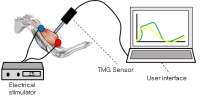
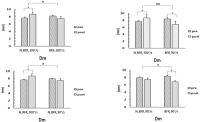
Purpose The purpose of this manuscript was to investigate the effect of high and low speed blood flow restriction versus non-blood flow restriction isokinetic exercise on isometric muscle strength, muscle fatigue, and muscle contraction displacement. Methods The subjects were consisted of ten males without non-specific muscular skeletal disease. They were classified into four training groups: ① high speed(300°/s) without blood flow restriction, ② high speed(300°/s) under blood flow restriction, ③ low speed(90°/s) without blood flow restriction, ④ low speed(90°/s) under blood flow restriction. Before and after the intervention, all of the subjects underwent measurements of isometric quadriceps strength, muscle fatigue, and muscle contraction displacement. Results In regard to isometric quadriceps strength before & after intervention, there was no significant difference between groups. For the lactic acid measurement before & after intervention, there was a signigicant difference between groups(p<.05). Also, there was a significant difference between groups(p<.05) in muscle contraction displacement in terms of Dm but there was no significant difference between groups in terms of Tc Conclusions Isokinetic exercise with blood flow restriction had effects on lactic acid and muscle contraction displacement.


PURPOSE This study investigated the effect of non-linear periodization strength training on basic and professional fitness of national cross-country skiers. METHODS The body composition (height, weight, BMI, body fat %), basic physical strength (grip strength, lung capacity), anaerobic power (peak power, average power), graded exercise test (maximum heart rate, running time, VO2max, lactic acid), isokinetic strength (trunk strength), and 1RM (bench press, dead-lift, squat, shoulder press, leg curl, bicep curl, cable triceps extension) of nine national cross-country skiers (male: 5, female: 4) were measured. All analyses were performed using SPSS 25.0, Kruskal-Wallis H tests were applied to observe the changes by training methods. Mann-Whitney U tests were used as Post Hoc. RESULTS The results indicated that running time and VO2max post-test improved compared to that for the pre-test for graded exercise test. The lumbar extension strength of the post-test was higher than that for pre-test. There was no significant difference in other variables. CONCLUSIONS It is suggested that nonlinear periodization strength training can be expected to improve running time, VO2max, and trunk strength for cross-country athletes; however, it does not affect the overall changes.
