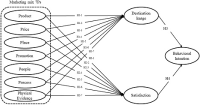
Purpose Limited research has investigated the marketing mix of international sporting events empirically. This study filled this gap by identifying the marketing mix and examined the structural relationships among marketing mix, destination image, satisfaction and revisit intention focusing on foreign spectators of 2019 Gwangju FINA World Championships. Methods The questionnaire was structured in four sections: sporting event marketing mix (seven dimensions and 21 items), host city image (three items), satisfaction (three items) and revisit intention (three items). Analysis of data from 396 foreign spectators in FINA Championships indicated that the proposed model fit the data well. Within a attitude-behavior theoretical framework, this study proposed and tested a structural relationships among the constructs. Results The results of this study presented that (1) product, place, and people in sporting event marketing mix significantly impacted foreign spectators’ destination image, (2) product, price, place, promotion, and physical evidence were appeared to be significant predictors of satisfaction, and (3) destination image and satisfaction had a significant effect on foreign spectators’ revisit intention. Conclusion The findings suggest marketing mix for the international sporting event and its influential mechanism on foreign spectators’ revisit intention. Practically, this study provides important implications for event organizers that can be utilized to develop strategic marketing mix in sporting events to enhance spectators’ destination image, satisfaction, and revisit intention.
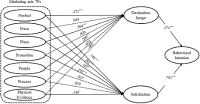

[Purpose] This study aimed to investigate the structural relationships among event quality, spectators‘ destination image, country image, and behavioral intention in the international cycle competition, Tour de Korea 2017. [Methods] The questionnaire was structured in four dimensions: event quality (three sub-dimensions and twelve items), destination image (three items), country image (three items), and behavioral intention (four items). A total of 292 spectators from six hosting cities (Yeosu, Gunsan, Muju, Yeongju, Cheongju, and Seoul) during the event participated in this study. Factor analysis, reliability, validity, correlation analysis, and structural equation modeling analysis were conducted utilizing SPSS 21.0 and AMOS 21.0. [Results] This study indicated that event quality in an international sporting event was found to be the significant factor of spectators’ destination image and country image, which, in turn, significantly influenced the spectators’ intention to revisit to the place of the event and/or the event itself. [Conclusions] The findings of the present study contribute to theoretical understandings of event quality that predicts spectators’ behavioral intention and destination image in a global sporting event. Practically, this study also provides some important suggestions for practitioners who plan marketing strategies for international sporting events.
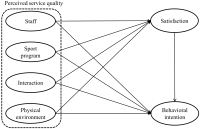
Purpose This study aimed to investigate the impact of perceived service quality on satisfaction, and behavioral intention in migrant members of German sport clubs. Methods The questionnaire was structured in four sections: perceived service quality (four dimensions and 12 items), satisfaction (two items), and behavioral intention (two items). With data from 438 members of 33 sport clubs in western Germany, SPSS 23.0 and AMOS 23.0 were utilized to conduct factor analysis, reliability, validity, and structural equation modeling analysis. Results The results of this study indicated that (1) staff, sport program, interaction, and physical environment in perceived service quality had a significantly influence on satisfaction, (2) staff, sport program, and interaction significantly affected behavioral intention, and (3) satisfaction was found to have significantly impact on behavioral intention. Conclusions The delivery of high-quality services can promote satisfaction, which in turn lead to behavioral intention. The empirical results suggest that the practitioners and sport club mangers should understand the importance of perceived service quality for the retention of members in sport clubs.
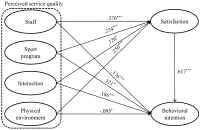
PURPOSE Sporting events constitute attractive platforms for providing participants with unique experiences. This study was aimed at investigating the structural relationships among perceived sporting event quality, image, trust, satisfaction, and loyalty of small-scale golf tournament participants. METHODS The questionnaire was structured in five dimensions: sporting event quality (4 sub-dimensions and 13 items), image (3 items), trust (3 items), satisfaction (3 items), and loyalty (4 items). A total of 217 amateur golfers from four Ecolian public golf clubs (Gwangsan, Jechon, Jeoungsun, and Younggwang) during the golf tournament participated in this study. Factor, reliability, validity, and structural equation model analyses were performed utilizing SPSS 24.0 and AMOS 24.0. RESULTS This study indicated that sporting event quality in a small-scale sporting event was the crucial factor of image, trust, and satisfaction, which, in turn, significantly impacted loyalty. CONCLUSIONS The results of this study contribute to theoretical understandings of sporting event quality factors that predict sport consumers’ image, trust, and satisfaction in the context of sports and leisure. Additionally, this study offers practical suggestions for administrators who develop marketing strategies for small-scale sporting events.
