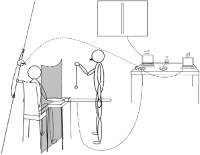
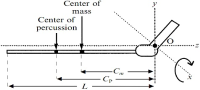
Purpose This study measured the haptic extroperception accuracy, that is, judging one hit position in a hand-held object. Especially, what factors associated the estimation of contact position when the impact is made at the grasped implement by hitting the ball. Methods Relative frequency and conditional probability based analysis verified that perceivers influenced not only the amount of pressure distinguished impressions by the coefficient of restitution but also the pressure distributions encoded impressions by the distance from the hand to the impact. Results Results conformed to previous invariant characteristic on dynamic touch in showing that perceiving the location of the impact of grasped objects, including dominant perceiving selectively modality, is constrained by inertial properties with such success requires appreciating the location of the implement’s center of percussion. Conclusion Investigated in this planes captured as a mechanical factor, we would suggest a broader hypothesis for further research into the effects of the rotational inertia related to haptic position accuracy in the hand-held object, and leading to different estimates of system function providing an account of generalization that accommodates of its varied aspects.
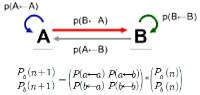
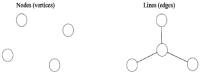
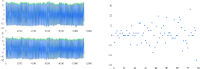
Purpose The primary purpose of this study is to show and guide how to construct a large variety of behaviors in systems dynamic for sport science. Methods By applying a simple algorithm to networked agents, which could, conceivably, offer a straightforward way out of the complexity, computational mechanism which along with its dynamics (payoff, failure, and strategy) involved. Results The model starts with the probability that systemic risk potential such as failure spreads. Even in a very random structure commonly used in sports field, propagation of the potential is guaranteed by an arbitrary network property of a set of elements. Despite the intensive systemic potential, the opposite type of potential like absence of failure could also be driven when there has been a strong investment in protection through a heuristically evolved protection level. Conclusion The implementation still needs to be polished against what happens in the real sports world, but in general, applied conceptual principle and methodological techniques behind the network-agent based mechanisms could be useful for researchers those who need to use systemes dynamic to guard in sport science.


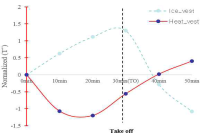
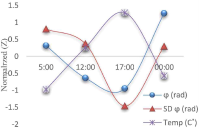
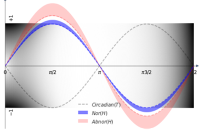
Purpose The present study explored biological autonomy and control of function in circumstances that assessed a presumed relationship to an environmental cycle. An understanding of this behavior appeals to the organism-environment system rather than simply the organism—we seek to expose the laws that underlie end-directed capabilities by measuring biological characteristics (motor synchrony) in an environmental cycle (circadian temperature). Methods Participants (n = 24) at the University of Connecticut (Storrs, USA) and the Seoul National University (Seoul, Korea) served in the study. The production of in-phase bi-manual coordination was examined at different circadian points (allowing comparison of day-night temperature effects) in two experimental designs; (1) normal temperature embedded in a 24 hour cycle (5:00, 12:00, 17:00, and 24:00), and (2) normal versus abnormal temperature [artificially decreasing or increasing] while embedded at two points (5:00 am, 5:00 pm) during the circadian process. A typical bi-manual stability measure varied significantly as a function of the day-night temperature cycle. Results While (i) circadian effects under the artificially perturbed temperature manipulation were not straightforward along the day-night temperature cycle, (ii) the circadian effect divided by the ordinary circadian seems to be constant along the day-night temperature cycle. Conclusions The discovery of direct and robust relation between biological aspects (body temperature and motor synchrony) an environmental process (circadian temperature cycle) may echo adaptation of our biological system to the environment. This relation supports the claim that the organism and the environment should be considered as integrated system in which biological (or physical) dynamics takes place as a mutual factor.