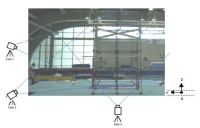
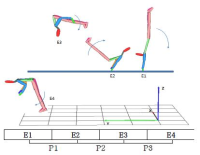
The purpose of this study was to identify the characteristics through technical analysis of dismount to perform the successful landing. The subjects in this study were male gymnastic players of the national team, hish-speed cameras were used to record the salto backward dismount on the parallel bars of the subjects and to study the qualitative and quantitative analysis. The evaluations including feedback of each subjects’problem were as follow: KHH showed early release timing compared to other players. It could be one of factors which can not decelerating the rotational speed, so the correction of posture is needed. NYI didn’t slide to the left at the release phase, and showed big rotation of body compared to other players so the center of mass moved to the rear. The correction of the hand position at flight phase is necessary to perform the V-shaped position. RSD landed in a state where the rotation is insufficient, so the training using elasticity of parallel bars at phase 2, and the correction of hand position are in need. PMS’s rotation angular velocity of body increased consistently, so showed instable land. Therefore the training to ensure the height of flight is required. PEJ showed high vertical position of CM at the release phase which is help for height of flight. He performed ideal V-shaped position, and took a relatively stable landing position. BGR also showed high vertical position of CM and performed ideal V-shaped position, so he landed in a posture in which the most stable. YHS should push vertically rather than horizontally at the moment of release. Especially, the hand position is not on the hamstring but on the back of the knee to perform the ideal V-shaped position. CJY showed little hip angle at the release phase, so he can’t take a position for vertical rise. Also he showed the lowest knee angle and performed rotation and landing in a state that cannot extend the knee. If such problems are corrected, it will be helpful to landing position not only in parallel bars but also in other events.
PURPOSE This study aimed to identify the lower limb muscle activity based on direction prediction presence or absence and gender during side cutting in healthy college students. METHODS The study participants included 14 healthy males and females (8 males; 6 females). All participants ran at full speed for a distance of 12m, and side-cutting was carried out at 45 degrees in a randomly indicated direction and in a fixed direction. Simultaneously, data regarding vastus medialis, vastus lateralis, semitendinosus, and biceps femoris muscle activity of the dominant leg were collected using an electromyography sensor, and data regarding vertical acceleration were collected using an inertial sensor attached to the pelvis. A sync webcam was used for obtaining the initial contact of side cutting and the stance period time. During the 10 milliseconds (pre-activation) prior to the initial contact and 50% of the stance phase (loading phase), vastus medialis, vastus lateralis, semitendinosus, and biceps femoris average muscle activity and hamstring to quadriceps ratio included as variables. RESULTS During the pre-activation and loading phase, the vastus medialis muscle activity of the male group was higher in the unexpected condition than in the expected condition. Furthermore, hamstring to quadriceps ratio was confirmed to be lower under unexpected condition compared to under expected condition during on loading phase. CONCLUSIONS The study results suggest that the risk of anterior cruciate ligament injury may increase with side cutting under unpredictable conditions. It is expected to provide useful information for identifying factors related to knee injury in the general population.
