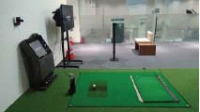
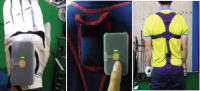
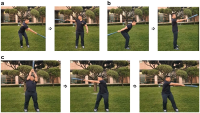
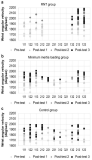
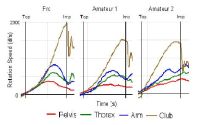
[Purpose] We examined the influence of reactive neuromuscular training (RNT) on golf swing coordination. RNT aims to induce proper coordinative movement by exaggerating the performer’s mistakes. Therefore, we applied RNT using inertia overloading to golfers who have problems with kinematic sequence during a golf swing. [Methods] To examine the effect of 12 weeks of RNT on golf swing coordination, we employed a ball tracking system (launch monitor) and motion analysis system (inertia sensors) were taken on four consecutive periods (pre-test and post-tests 4, 8, and 13 weeks later). Thirty Korean male cadets were divided into three groups based on inertial loading and practiced 7-iron golf swings combined with specific group tasks twice per week. [Results] At pre-test, most participants reached maximal angular velocity near the impact timing (95-100%). However, the deceleration timing of the maximum angular velocity of the proximal segments gradually moved toward mid-downswing as the training sessions proceeded, with the RNT group ultimately outperforming the two control groups. Additionally, the RNT group showed a significantly higher maximum angular velocity in the thorax and wrist. [Conclusion] Our results suggest that RNT can be sufficient to elicit and effective whole-body coordination pattern. Considerable follow-up research is needed on the use of RNT for various sports tasks and the effects of expertise on RNT results.
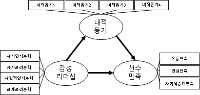
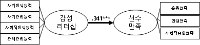
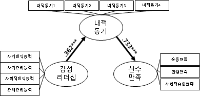
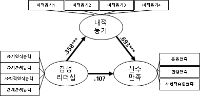
Purpose The purpose of this study was to examine the influence of coaches’ emotional leadership on athletic satisfaction and to investigate mediating effect of intrinsic motivation perceived by professional female basketball athletes in Korea and Japan. Methods 154 professional female basketball athletes in Korea and Japan participated in this study and responded to questionnaires which consisted of coaches’ emotional leadership, intrinsic motivation, and athletic satisfaction. The collected data were analyzed by frequency analysis, confirmatory factor analysis, reliability analysis, descriptive statistical analysis, correlation analysis, and structure equation analysis with using SPSS 23.0 and AMOS 23.0. Results The results of this study were as follows; Firstly, coaches’ emotional leadership had positive effect on athletic satisfaction. Secondly, coaches’ emotional leadership had positive influence on intrinsic motivation. Thirdly, intrinsic motivation had positively affect on athletic satisfaction. Lastly, intrinsic motivation completely mediated the relationship between coaches’ emotional leadership and athletic satisfaction. Conclusion In conclusion, these findings imply that coaches’ emotional leadership and intrinsic motivation are critical factors for improving athletic satisfaction.
Purpose The purpose of this study is to analyze the performance contents of men's floor exercise and to provide basic materials for achieving excellent results at world competitions. Methods Teams ranked 1 - 12 who participated in the World Championships' floor movement group competition selected a total of 59 players by the convenience sampling method and carried out technical statistics, frequency analysis, member variable variance analysis, and post hoc analysis. Results First, as a result of frequency analysis of the difficulty of each group, all the teams ranked 1 to 12 liked the most difficulty of C and found that they do not like the F difficulty the most. Secondly, there was a difference in average for each group's start score, ranking 1st to 4th> 5th to 8th> 9th to 12th place. Thirdly, there was a difference in average of difficulty levels for each group B, C, E, and it became very significant with E difficulty.Results of post hoc analysis B difficulty (9th to 12th> 1st to 4th, 5th to 8th), C difficulty (9th to 12th> 1st to 4th), E difficulty (1st to 4th> 5th to 8th ·9th to 12th). Conclusion These results show that in floor exercise, the art of more than C difficulty and the connection technology of A, B, C, difficulty, E and F, difficult difficulty such as difficulty, creative and dynamic performance composition is excellent It clearly states that it is a condition for getting results.
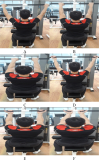
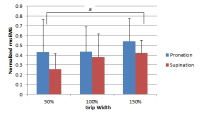
Purpose The purpose of this study is to investigate the effects of grip width and hand orientation on muscle activities of upper body during the lat pull-down. Methods Eight healthy men performed the 6 grip variations (3 grip width × 2 hand orientation) using an experimentally determined load of 70% of 1 repetition maximum. Five trials were analyzed for each grip type. Participants maintained a cadence of 2-second concentric and 2-second eccentric phases. The grip widths were normalized for each individual by using their biacromial diameter (100%), and then set the grip width 50% of biacromial diameter and 150% of biacromial diameter. Surface EMG of the latissimus dorsi, pectoralis major, infraspinatus, biceps brachii, triceps brachii, rectus abdominis, erector spinae and middle trapezius was recorded, and the root mean square of the EMG was normalized, using a maximum isometric voluntary contraction. Results Latissimus dorsi showed higher muscle activities in 100% grip width than those of 50% grip width. Pectoralis major and rectus abdominis showed higher muscle activities in 50% and 100% grip width than those of 150% grip width. Middle trapezius showed higher muscle activities in 150% grip width than those of 50% grip width. Conclusions Two-way repeated measures ANOVA for each muscle revealed that latissimus dorsi and middle trapezius (the posterior muscles of trunk) showed higher muscle activities in wide grip, on the other hand, pectoralis major and rectus abdominis (the posterior muscles of trunk) showed higher muscle activities in narrow grip.




Purpose The purpose of this research was to investigate the influence of professional baseball teams' message appeal type (emotional vs. rational) and message delivery method (article with photo vs. article without photo) on consumers' acceptance of the message. The hypotheses were two folds. First, compared with a rational apology article, a professional team's emotional apology article affected consumers' acceptance more positively. Second, a professional team's apology article with a photo attached influenced consumers' acceptance more positively than one without a photo. Methods To achieve the purpose of this study, the authors utilized a 2 (Message Appeal Type: emotional vs. rational) × 2 (Message Delivery Method: article with photo vs. article without photo) factorial experiment. An existing baseball team was selected and was assumed to have been involved in a game fixing situation. Out of 340 participants, 325 were used in the final analysis. Two-way ANCOVA of SPSS 23.0 was conducted to analyze the data. Results Findings revealed when a professional baseball team issued an emotional apology article, consumers were more positive about it than a rational one. Also when a professional team delivered an article with a photo, consumers accepted the article more positively than the one without a photo.


Purpose The purpose of this study was to examine the relationship between performance factors and physical fitness in secondary school female biathlon athletes. Participants in this study were 14 female biathlon athletes. Methods All factors such as aerobic capacity(VO2max, %AT), wingate test(peak power, average power, fatigue index), isokinetic test(trunk, knee, hip, ankle), 1RM test(leg press, chest press, lat pull down), physical fitness(grip, knee and back muscle strength, sit & reach, power, agility) were tested. In order to analyze collected data, pearson product moment and multiple regression analysis were utilized. The results were summarized as follows : First, there was a significant correlation between aerobic. Results The results were summarized as follows : First, there was a significant correlation between aerobic capacity and three factors(standing broad jump, isokinetic test 60° right knee extension)(p<.01). There was a significant correlation between wingate test and four factors(isokinetic test 30° left ankle ever, 30° right ankle ever, 120° left ankle inver, leg press)(p<.10). Conclusion These results suggested new evidence that ankle strength is necessary for performance in female biathlon athletes.

Purpose The purpose of the study was to investigate the effect of vibratory stimulus on the static postural control of 8 healty senior adults. Methods To achieve this goal, all subjects participated in two different kinds of static postural control tasks. Task 1 was a static postural control task, where both-legs stand on the ground. Second task was an unstable static postural control task using only single leg stance. As they maintain their balance, 6 different vibratory stimulus were provided on the sole of their feet(personal threshold 0%, 80%, 90%, 100%, 110%, 120%). Results The results of the study were as follows: First, there was no significant differences in postural control ability according to different types of vibrator intensity. Second, there was a significant difference in single-leg postural control ability according to vibrator intensity. Third, there was a significant difference in anterio-posterior stability according to the different types of vibrator intensity. Conclusion Stochastic resonance using vibratory stimulus was more effective in the single leg stance task, rather than the double leg stance task. Moreover, sub-threshold vibratory stimulus(80%, 90%) intensity were more effective than higher vibratory stimulus(100%, 110%, 120%).

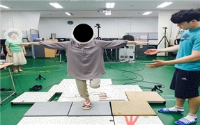


Purpose The purpose of this study was (1) to develop and to apply flipped learning strategies in Physical Education(PE) classes based on Sportscasting Model and (2) to examine the responses of students after PE lesson. Methods Participants were 10th high school students(N=216, male=115, female=101) in high school. Instruction strategies of flipped learning was developed after theoretical investigation, and the unit plans for curling and instructional materials were developed and applied. Open-ended questionnaires and in-depth interviews were used to collect the data. Qualitative content analysis combined with of structures in lesson was used to analyze the data. Results Results showed that (1) 11 instruction strategies of flipped learning were developed, (2) and the unit plan combining out-of class activities and in-class activities organically based on Sportscasting Model and instructional materials for unit of curling were developed and applied. In step of sportscasting, forcing relationship method-sportscasting based on the survey of students was developed and applied. (3) And 31 factors of Sportscasting Model and 15 factors of flipped learning were drawn from the analysis of questionnaires and interviews. Conclusion And to conclude, this research has a value of early study to develop and apply instruction strategies of flipped learning, the unit plan and instructional materials for combining Sportscasting Model with flipped learning organically. Discussions were provided in terms of the development of flipped learning applied in PE classes and responses of students.
Purpose Incidence and prevalence of Korean teenager cheerleading injuries were surveyed. Methods A total of 769 junior cheerleaders who participated in National Sport Cheerleading Competitions responded to a questionnaire, and 435 reported experiences of injuries. Results Risk factors for injury included older age (p<0.001), increased experience (p<0.001), and higher BMI (p<0.05). The most frequent injury occurred at wrist, ankle, knee, shoulder and waist. And the most responded types of injury were muscular pain and contusion. Cheerleading experience affected on injury prevalence. They were injured when they perform Elevator (<0.5 yrs), Cradle (0.5-1 yrs), Cradle and Basket toss (1-2 yrs), Cradle and Pyramid (2-3 yrs). These techniques involved in bodily movements of going up and cradle. About 56% of injury was treated at home or not treated at all, and 60% of injury was either self-treated or not intervened. And only 32% of cheerleaders practiced on a formal mattress. Conclusion Safety measures for these youth cheerleaders are necessary and guidelines for securing safety and preventing and treating injuries for these population are urgent.
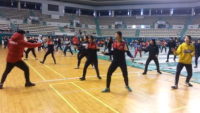
Purpose The purpose of this study was to investigate the effects of 3 weeks of fencing specific training on physical fitness in elite fencers. Methods Forty eight elite fencers participated in this program (Male= 24, Female= 24). Training program consists of dynamic stretching, step and agility training, and it was conducted with the general fencing practice during 3 weeks. Body composition and physical fitness (muscle strength/power, agility, anaerobic power and flexibility) were measured before and after training. Data were analyzed using IBM SPSS Statistics ver. 23.0 (IBM Co., Armonk, NY, USA). Paired t-test (pre vs. post) was used for comparison between groups. Results Muscle mass and body fat(%) were significantly changed after training in male group. Agility was significantly improved in change-step jump and reaction time after training both in male and female group. In Anaerobic power, peak power (relative power, absolute power) was significantly increased after training in female group. Flexibility was also significantly improved after training in left ankle ROM of female group. Conclusion Application of fencing specific training program focused on fencing movement seems to be effective on agility in both groups, muscle mass and body fat(%) in male group, and anaerobic power and flexibility in female group.