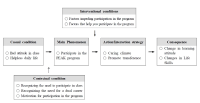
Purpose The purpose of this study was to explore the process of participation in the PEAK program of collegiate athletes based on grounded theory. Methods In-depth interviews were conducted with 12 athletes from Y University who were registered in Korea Taekwondo Association. The collected data were analyzed by using the open coding, axis coding, and selective coding of the grounded theory, completed the paradigm model among the extracted concepts, and extracted the core categories through the story outline. Results As the result of data analysis, 'participating in the PEAK program' was found as the central phenomenon, and the causal situation was 'bad attitude in class' and 'helpless daily life'. The contextual conditions were 'recognition of the need for class participation and dual career' and 'motivation to participate in the program', and the intervening conditions were 'factors that hinder participation in the program' and 'factors that help program participation'. The action/interaction strategies were ‘caring climate’ and ‘promoting transfer’, and depending on the consequence, ‘learning attitude change’ and ‘life skill change’ appeared. Conclusion Participants improved their learning attitude through the PEAK program and confirmed the possibility of life skills transfer. It is hoped that this study can lead to implementation of various studies and discussions about life skills and transfer.

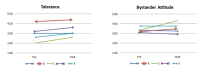
Purpose The purpose of this study was to apply the Self-Assertiveness Training based on Solution-Focused to student-athletes caused by violence in sports. Methods Participants were five Taekwondo athletes in this study. They were consisted of offenders, a accuser, and a victim. The head coach of the team asked for counseling to resolve the conflict. Data was collected with quantitative, qualitative data, and group dynamics. The group counseling program was conducted for 90 minutes a week for eight weeks. Results The results are as follows. First, (application process) the 8-week Self-Assertiveness Training based on Solution-Focused was assessed to be applied step by step and systematically. Second, (qualitative evaluation) as a result of analyzing the observation journal and the interview data, the participants experienced the change of attitude and thought of group members in a short period of time by focusing on enhancing self-assertiveness. Third, (quantitative evaluation) self-assertiveness and attitude of school violence measured by questionnaires were higher in post-survey than pre-survey. In addition, participants' satisfaction with the program was found to be very positive. Discussions and Suggestions Self-Assertiveness Training based on Solution-Focused was found to have a significant effect on conflict resolution among the student-athletes who have experienced violence in sport. This programs was expected to increase the value of use in the sport field. Based on this case study, We suggested for future research.