PURPOSE This study aimed to develop a model for life skills transfer in sport. METHODS A literature review of research on life skills transfer was conducted. The prior representative studies on sport life skills and transfer models were selected and discussed to improve the validity of this study. RESULTS First, based on the basic psychological needs of the internalization and generalization of life skills, the model for life skills transfer should consider the influence of the explicit and implicit climate and environment. Furthermore, access to cognitive processes is required based on the conceptualization and integration of transfer. Second, the concept of a transfer was defined, and key issues of the cognitive processes that support the connection between the sport domain and out of the sport domain were discussed. Third, the model for life skills transfer in sport was presented. In this model, life skills transfer occur through sport context, cognitive process, promoting factors, and out of sport context. CONCLUSIONS Since the 2000s, research on life skills and transfer in sport has developed quantitatively based on positive youth development theory. Unfortunately, research on this area in South Korea is very insufficient. This study suggests a model for life skills transfer in sport based on an extensive and systematic analysis of the prior research, and this model can be used for future research.
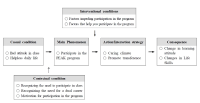
Purpose The purpose of this study was to explore the process of participation in the PEAK program of collegiate athletes based on grounded theory. Methods In-depth interviews were conducted with 12 athletes from Y University who were registered in Korea Taekwondo Association. The collected data were analyzed by using the open coding, axis coding, and selective coding of the grounded theory, completed the paradigm model among the extracted concepts, and extracted the core categories through the story outline. Results As the result of data analysis, 'participating in the PEAK program' was found as the central phenomenon, and the causal situation was 'bad attitude in class' and 'helpless daily life'. The contextual conditions were 'recognition of the need for class participation and dual career' and 'motivation to participate in the program', and the intervening conditions were 'factors that hinder participation in the program' and 'factors that help program participation'. The action/interaction strategies were ‘caring climate’ and ‘promoting transfer’, and depending on the consequence, ‘learning attitude change’ and ‘life skill change’ appeared. Conclusion Participants improved their learning attitude through the PEAK program and confirmed the possibility of life skills transfer. It is hoped that this study can lead to implementation of various studies and discussions about life skills and transfer.
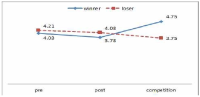
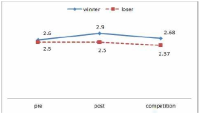
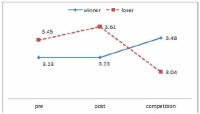
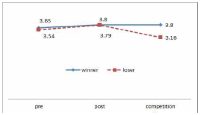
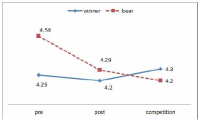
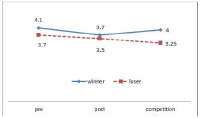
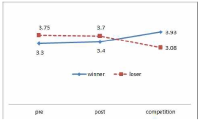
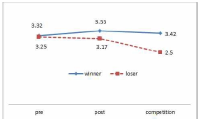
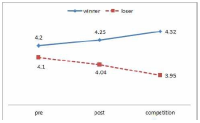
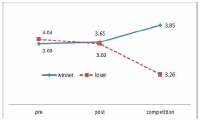
The purpose of this study was to confirm the differences between winner and loser groups of national team participated in the World Taekwondo Championships statistically and trends of psychological status according to applying mental coaching. In order to achieve the purpose it was the selection of 16 national members participated in the 2013 World Taekwondo Championships in Puebla. Data was selected by TOPS(test of performance strategy). The survey was conducted before and after applying the mental coaching and the game soon after. Data processing results were calculated utilizing Excel and SPSS 21.0 version. Based on the findings issue the conclusions were as follows. First, the psychological state of the winner and loser groups showed a different trend in the self-talk, emotion control, performed automatically, imagery, struggle, negative thinking, relaxation, condition factor. Winner group was shown maintenance or better trends of psychological state in the three times measurements on the other hand, loser group was shown decrease in the game soon after. Secondly, winner and loser groups are statistically significant differences in the psychological state of competition in self-talk, struggle, negative thinking, solving tension factors. In other words, The winner group had higher score in the four factors than loser group in the competition.
PURPOSE This study aimed to apply a capacity building program to sport life skill leaders and to provide cases of this process. METHODS The study participants included four leaders (male=2, female= 2, Mage=37.5) who were managing a sport life skills program at a university. They participated in a capacity building program, which consisted of (a) understanding (leader seminar), (b) application (managing the sport life skills program), and (c) evaluation (leader’s self-reflection), which were conducted in eight sessions. Four leaders conducted self-evaluations using program quality assessment (PQA) during every session, and quantitative and qualitative data were collected. Qualitative data were derived using a cross-case analysis, and quantitative data were used for calculating the effect size after performing the paired t-test. RESULTS Analyzing the reported cases of sport life skill leaders, the use value of the capacity building program was identified. Furthermore, the cases reported by the four leaders enabled observation of how the leader’s capabilities were strengthened. In the paired t-test, the effect size of physical and psychological safety, appropriate structure, supportive relationship, opportunities to belong, support for efficacy mattering, opportunities for life skill building, excluding integration of family, school, and community effort, were all significant. All effect sizes were found to have “very large effects.” CONCLUSIONS The capacity building program played a positive role in strengthening the leaders’ life skill coaching capabilities. These findings have practical implications—chiefly, it is important to strengthen leaders’ or coaches’ capabilities in order to foster life skill development and transfer of student-athletes.
PURPOSE The purpose of this study was to validate the Korean version of Coaching Life Skills in Sport Questionnaire (KCLSS-Q). METHODS Substantive, structural, and external stages were undertaken to address the purpose of this study. At the substantive stage, the scale was translated by discussing with an expert panel and testing item clarity. Ten coaches (9 males, Mage=33.80, SD=4.21) participated in the item clarity test. At the structural stage, descriptive statistics, exploratory factor analysis (EFA), and confirmatory factor analysis (CFA) were conducted. A total of 249 (214 male, Mage=34.18, SD=6.82) and 232 coaches (186 male, Mage=34.26, SD=7.69) participated in the EFA and CFA, respectively. At the external stage, correlation analysis using other scales (emotional intelligence in sport coaching, EISSC) was conducted to examine concurrent validation. A total of 130 copies of the CFA data were randomly extracted and used for this stage. RESULTS For the EFA, the scale extracted five factors with 27 items. In the CFA, however, five factors with 26 items were identified as an appropriate structure. Finally, the relationships of all sub-factors between KCLSS-Q and EISSC were statistically significant in the correlation analysis. CONCLUSIONS KCLSS-Q should reasonably consists of nine items on structuring and facilitating a positive sport climate, five on understanding life skills, four on practicing life skills, five on understanding life skills transfer, and three on practicing life skills transfer. KCLSS-Q can be used as a valid measure to evaluate the coaching life skills of Korean coaches.
