[Purpose] This study analyzes ethical issues about genetic technology used for the enhancement of athletes. In so doing, this study aims to rethink gene manipulation in sports and suggest theoretical groundwork for an ethical discussion of gene doping, as well as providing some guidelines. [Methods] For this purpose, this study looks at the relationship between genetic engineering and morality as discussed by eminent domestic and international philosophers, medical ethicists, and scholars of sport studies. Then, the pros and cons of the use of genetic engineering in sport are analyzed to show the different values embedded in each of the opposite positions. [Results] This study identifies three points of debate: fairness, coercion, dignity and autonomy. Through a literary and philosophical review, it is revealed that prior criticism against gene manipulation has logical loopholes. [Conclusion] Rather than approaching the issue with groundless fear and prejudice, it is necessary to look into its benefits and ethical problems in detail. In addition, better equipped ethical as well as practical grounds are required to control the introduction of gene doping technology.
[Purpose] It has been known that Korean Olympic Committee (KOC) was recognized by the International Olympic Committee (IOC) on June 20th of 1947, based on the fact that Korea National Olympic Committee (NOC) was recognized by the IOC session held in June of 1947. However, records and archives show that the recognition and the following conditions were somewhat different than what we have known. This study aimed to examine closely and explain how KOC was recognized in 1947, what was the conditions, and what was the role of Avery Brundage related to this agenda. [Methods] This study is a literature review. Brundage Collection, a package of records and letters which Avery Brundage has collected, and the archives of KOC in IOC Olympic Studies Center were examined. [Results] According to the records, Korean NOC was recognized provisionally with a condition of reviewing the situation of an independent nation and responsible for including the North Korean athletes. The unusual recognition appeared to be possible by the role and decision of Avery Brundage who defended the political and military situation of Korean peninsula. [Conclusions] The reviewed documents suggest a need of revision of KOC history as that KOC has been provisionally recognized in 1947 with some conditions. IOC viewed and recognized Korea as a single country and required KOC to include North Korean athletes. The role of Brundage should be revisited.
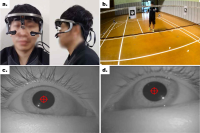
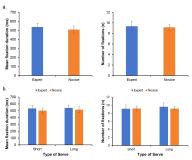
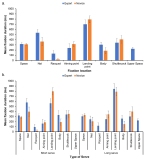
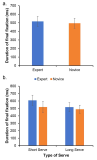
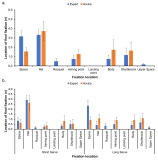
[Purpose] The purpose of this study was to examine the differences in visual search strategies between expert and novice badminton players while performing badminton serve. [Method] To this end, expert (more than 10 years experience) and novice (less than 6 months experience) badminton players performed 15 trials of two types of serve (i.e., short-serve and long-serve), in total 30 trials. All the participants’ eye movement was recorded during each trial, and mean fixation duration, fixation distribution, final fixation duration and location, and gaze entropy were analyzed. [Results] The results showed that there was no difference in mean fixation duration between expert and novice players. The analysis of mean fixation duration on each location showed that participants fixated more on the net while doing short serve whereas fixated more on the space when they did long serve. In particular, expert players fixated more on the space while doing long serve than novice players, and fixated more on the net and racquet for the short serve. However, novice players fixated more on the location of shuttle would be landed. The final fixation duration was not different between expert and novice players. Further, expert players showed higher gaze entropy than novice players. [Conclusion] The findings indicate that expert players fixated more on the net for the short serve, and the space for the long serve, and visual search strategies of experts were more varied than novice players.

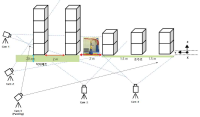
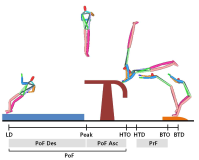
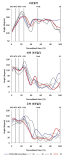
[Purpose] The purpose of this study was to compare Yeo 2 vault and YANG Hak Seon vault to verify the possibility of YANG Hak Seon vault. [Methods] The YANG Hak Seon vault and Yeo 2 vault performed by five Korean national gymnastic athletes, and the photographic images were collected using a high-speed camera and their kinematic characteristics were analyzed by 3D image analysis. [Results] The main variable of the post-flight phase S1, S4, and S2 were similar to YANG Hak Seon vault. S1 showed the largest at shoulder angle and the highest body center of mass at horse take-off. S4 showed the smallest shoulder angle at horse take-off, slow twisting at the post-flight ascending period, but faster femoral rotation during horse contact. S2 showed the slowest twist velocity in the ascending period of the post-flight and the smallest rotational distance and twist distance at the peak. S3 showed the slowest horse take-off velocity, the least time in the post-flight phase, and the hip joint was flexed at the peak. [Conclusions] S1 is required to increase the twist velocity by narrowing the shoulder angle during post-flight. S4 is required to strong push-up and an increase in the twisting velocity in the post-flight ascending period. S2 is required to shorten the horse contact time and increase the horse take-off angle through powerful femoral rotation after board take-off. S3 will have to get enough power from the preparation phase.

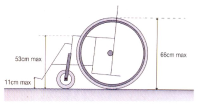
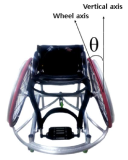
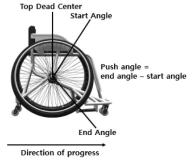
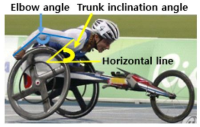
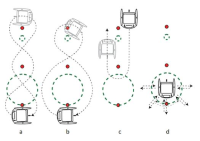
[Purpose] A potential issue for wheelchair sports are the characteristics of wheelchair design. The purpose of this review was to investigate the characteristics of design in wheelchair sports including the height of seat, camber and handrim size for improving the performance. [Results] The optimum height of seat related to trunk, arm length and handrim size. The lower seat showed the push efficient highly, while higher seat increased the energy expenditure. In energy expenditure, the optimum height of seat was 100-120° of elbow angle. Handrim size play the role in gear. The smaller handrim size acts like high gear, it gains disadvantages in acceleration, it gains advantages in maximum velocity. On the contrary, the higher handrim size acts like low gear, it gains disadvantages in maximum speed, it gains advantages in acceleration. The ratio of gear consideration in power and velocity. When increased camber enhanced the lateral stability, easier catch the handrim and easier arm motion. So it improved the energy expenditure and push technique. When increased camber enhanced the mechanical efficiency and stability, but it decreased the power. The racing wheelchair camber using the 8° and 10°. [Conclusion] Athletes, coaches and wheelchair experts are provided with insight in the performance effect of key wheelchair design settings, and they are offered a proven sensitive method to apply in sports practice, in their search for the best wheelchair-athlete combination.
[Purpose] The purpose of this study was to provide the physiological characteristics of female adults in their 30s by comparing the body composition and the maximal strength of the knee extension and flexion and bilateral ratio and ipsilateral ratio(H/Q: Hamstring and Quadriceps ratio) depending on age. [Methods] Body composition was measured by Hv-ps 7681(GE medical systems Lunar, USA). Isokinetic lower limb muscular strength was measured by Isomed2000(D&R Ferstl GMBH, Germany). 92 volunteers who were chosen by our selection criteria agreed to participate in our study. The participants were divided into three groups depending on age and classified as female adults in twenties(n=30), in thirties(n=34), in forties(n=28). To evaluate differences according to age, One-way ANOVA was used. [Results] The result in the test for female adults is as follows. In body composition, there were significant differences in lean mass, bone mineral density in the legs area among groups(p<.05). In isokinetic test, there were significant differences in muscular strength among groups in extensor of knee(p<.05). [Conclusion] The finding revealed that strength training based on the characteristics depending on age is required and ipsilateral ratio needs to be improved.
[Purpose] The present study attempted to verify the effectiveness of an early childhood physical health improvement program (subsequently in the present study, KICCE Early Childhood Health Improvement Program) developed in Korea by modifying and improving the Mission-X: Train Like an Astronaut program developed by NASA to be suitable for children of ages 4 and 5. [Methods] The subjects in the study were 679 children at 7 facilities in Seongnam city, Osan city, and Yongin city, of which 4 were daycares and 3 were kindergartens. The participant group consisted of 339 children, and the control group consisted of 340 children. The program consisted of total 24 activities 3 times a week over 8 weeks, of which 8 activities were related to nutrition and 16 activities were related to physical activity, and in the 9th and 10th weeks, the 16 physical activities were reconfigured and performed 3 times a week. Physical parameters and related fitness parameters were measured before and after the program, and an ANCOVA analysis was performed in which descriptive statistics and scores before the program were the covariate variables. [Results] The results show that first, growth statuses of participant children were in the upper middle section of the distribution, and second, of the 6 fitness developments, flexibility, balance, and quickness were improved, and in most areas, boys and below-normal-BMI group showed beneficial effects. [Conclusion] Thus, KICCE Early Childhood Health Improvement Program is conclusively proven to be effective for early-childhood physical development.
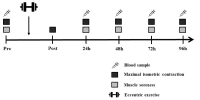
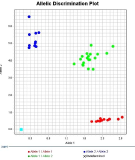
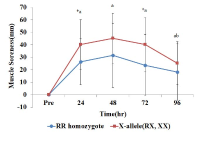
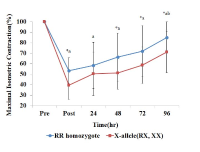
[Purpose] The purpose of this study was to examine the change of muscle damage markers after maximal eccentric exercise and to verify the difference of recovery according to ACTN3 gene polymorphism. [Methods] Fifty healthy males participated in this study. Subjects performed 25 times/1 set (total 2 set) maximal eccentric contractions of the elbow flexor muscles on a modified preacher curl machine with a between-sets rest time of 5 min. Maximal isometric contraction (MIC) was measured 6 times (pre, post, after 24 h, 48 h, 72 h and 96 h). Muscle soreness (SOR) was measured 5 times (pre, after 24 h, 48 h, 72 h and 96 h). Blood samples were collected 5 times (pre, after 24 h, 48 h, 72 h and 96 h). ACTN3 gene polymorphisms were identified using polymerase chain reaction (PCR). Data were analyzed using a 2-way repeated measure ANOVA and post hoc Bonferroni test. [Results] Analysis of ACTN3 gene polymorphism revealed the following distribution: 22% RR (n=11), 50% RX (n=25), and 28% XX (n=14). Individuals were classified into the RR homozygote group (n=11) and the X-allele group (n=39). MIC showed a significant difference between groups and interaction (p<.05). The groups differed significantly in MIC at 48 h, 72 h, and 96 h after exercise and the X-allele group decreased more than the RR homozygote group. The groups differed significantly in muscle soreness and interaction (p<.05). SOR in the X-allele group was significantly higher than in the RR homozygote group at 24 h after exercise. Although blood CK activity was lower in the RR homozygote group than in the X-allele group, but there was no significant difference between the groups (p>.05). [Conclusion] The RR homozygote group showed lower muscle strength reduction rate, muscle soreness and blood CK activity than the X-allele group. This indicates that RR individuals have a lower risk of exercise-induced muscle damage than those with an X-allele.
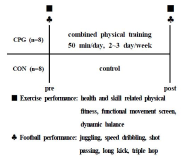
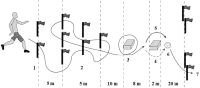
[Purpose] This study aimed to examine the effects of complex physical training on exercise and football performances in youth football players. [Methods] The subjects (n=16) were randomly assigned to either a complex physical training group (CPG, n=8) or a control group (CON, n=8). CPG was performed the complex physical training for 50 minute per day, and 2∼3 times per week, for 8 weeks. Exercise performance (health related physical fitness, skill related physical fitness, Y-balance and functional movement screen; FMS) and football performance (juggling, speed dribbling, shot passing, long kick and triple hop) were measured before and after 8 weeks complex physical training. [Results] Sit-up (p=0.002), sit and reach (p=0.040), 50-m run (p=0.031), side step (p=0.005), single-leg standing with eyes closed (p=0.040), plank (p=0.023), dominant composite score (p=0.002) and non-dominant composite score (p=0.005), deep squat (p=0.009), inline lunge (p=0.042), active straight leg-raise (p=0.015), rotary stability (p=0.049), total score(p=0.001), speed dribbling (p=0.030), dominant triple hop (p=0.001) and non-dominant triple hop (p=0.032) were statistical significant interactions between group and time. [Conclusion] Our findings indicate that complex physical training has beneficial effects on performance improvement of exercise and football in youth football players.
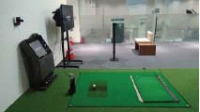
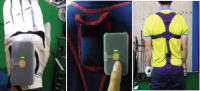
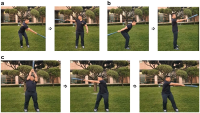
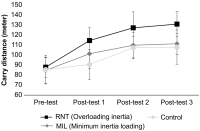
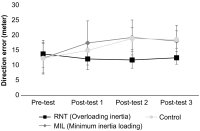
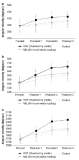
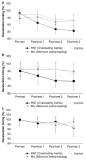
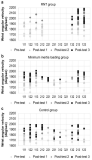
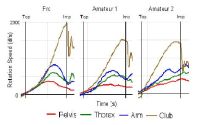
[Purpose] We examined the influence of reactive neuromuscular training (RNT) on golf swing coordination. RNT aims to induce proper coordinative movement by exaggerating the performer’s mistakes. Therefore, we applied RNT using inertia overloading to golfers who have problems with kinematic sequence during a golf swing. [Methods] To examine the effect of 12 weeks of RNT on golf swing coordination, we employed a ball tracking system (launch monitor) and motion analysis system (inertia sensors) were taken on four consecutive periods (pre-test and post-tests 4, 8, and 13 weeks later). Thirty Korean male cadets were divided into three groups based on inertial loading and practiced 7-iron golf swings combined with specific group tasks twice per week. [Results] At pre-test, most participants reached maximal angular velocity near the impact timing (95-100%). However, the deceleration timing of the maximum angular velocity of the proximal segments gradually moved toward mid-downswing as the training sessions proceeded, with the RNT group ultimately outperforming the two control groups. Additionally, the RNT group showed a significantly higher maximum angular velocity in the thorax and wrist. [Conclusion] Our results suggest that RNT can be sufficient to elicit and effective whole-body coordination pattern. Considerable follow-up research is needed on the use of RNT for various sports tasks and the effects of expertise on RNT results.