Purpose This study focuses on accessibility to sports facilities that can be classified into structural leisure constraints. The purpose of this study is to explore exploratory analysis of the types of reservation methods and payment methods, which are the initial stages of consuming sports facilities, and to explore inconveniences that consumers feel when making reservations. Methods A quantitative research method was used to derive the results, and data were collected through a questionnaire survey method. The collected data were analyzed by technical statistics focusing on the reservation method, payment method, and inconvenience during reservation. Results As a result, it was found that the main types of reservation methods and payment methods were homepage, homepage/telephone, telephone, homepage/app, and account transfer and card payment, respectively. In the case of inconvenience, the procedure was complicated, address and location, and reservation method were identified as the main matters. Conclusions Efforts must be made to secure both the convenience and publicity of accessibility at an early stage, such as reservation methods and payment methods for sports facilities.
Purpose This study aims to explore migration factors of Korean male footballers who have moved from South Korea to Southeast Asian countries. Methods Qualitative case study was conducted with 9 footballers, 4 their agents and 2 K-league staffs as the participant. Results As a result, by regarding their migration as involuntary decision, this study could provide academic and practical discussion on sport labor migration. First of all, this study established theoretical framework for involuntary migration of the participants through ‘Push-Pull Theory’ which focuses on demand and supply on the labor force. Second, this study found that a local rule (FA compensation system) of Korean professional football league (K league) and hierarchical collectivist culture contributed to their migration, which has not been reported by previous studies focused on the voluntary migration of mainstream players and it reflected local context of K league. Conclusions In conclusion, this study confirmed that sport labor migration was also considered as social phenomenon and reflected a cross section of a particular society. Through the migration of athletes, we can provide a variety of viewpoint on economic (market) structure, related policy and system in a particular society, and understand migration motives in terms of agency (subculture).
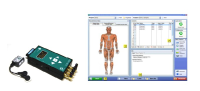
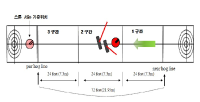
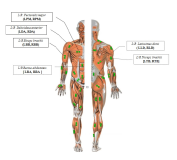
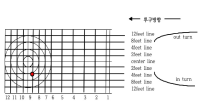
Purpose This is to provide essential data for training necessary for sweeping through the analysis of muscle activity generated at this time and how much sweeping and what trajectory moves the stone when the movement of the stone is controlled through sweeping. Methods To check and record the distance between the stones by checking the stop position of the stone made by sweeping each section, the length (progress distance) and width (progress direction) were recorded using a reference table and a record preparation table. With the EMG attached, a total of 60 sweeps were made 20 times each from the beginning of the section to the end of the section. Sweeping subjects were asked to sweep as much as possible under the same conditions in all three sections. Results As a result of the study, the muscle mobilization patterns of the 1st and 2nd sections of the stone with the faster speed and the 3rd section with the stone's slower speed appeared differently. It was confirmed that the sweeping motion of curling is a motion that is used evenly among the muscles of the upper extremity, and it can be verified that it is a suitable item for the development of upper body muscles. Also, the right deltoid's muscle activity rate during push and the right triceps brachii during pull was high. Conclusion Each section of the stone's sweeping effect is an exercise that has many variables, such as changes in atmospheric temperature and humidity, changes in ice temperature, temperature-size-number of pebbles, and the edge state-resilience of stones, etc. It is judged that experience can cope with these variables and requires training.
PURPOSE The purpose of this study was to develop the estimating equations for 4 types of Wingate Anaerobic test setting. METHODS 80 male elite athletes performed 4 trials of the Wingate Anaerobic test by each type. Subjects were conducted the retest one week later. Data collected from the Wingate Anaerobic test included mean power, peak power, and power drop for 30s were measured. Coefficient of correlation was used for validity of type 1(DOS version) and the other types(ver. 2.24, 3.3.0, and 3.2.1). Pearson’s correlation coefficient was used to examine the reliability of test and retest. Simple regression analysis was used for calculating the estimating equation. RESULTS There was significant correlation for absolute value(Watt, p<.01) and relative value(Watt/kg, p<.01) of mean power, absolute value(W, p<.01), relative value(Watt/kg, p<.05), and power drop rate(%, p<.01). Test and retest reliability was excellent for all test variables(p<.01). CONCLUSIONS From the all results, the estimating equation was calculated to convert all outputs from each type to the other types of the Wingate Anaerobic test setting. These findings suggest that the estimating equations are compatiable to 4 types of Wingate Anaerobic test setting.
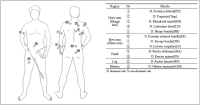
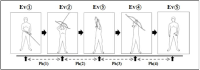
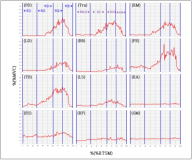
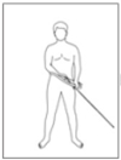
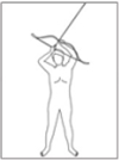
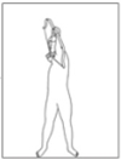
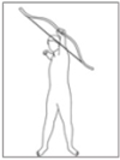
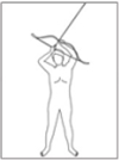
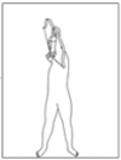
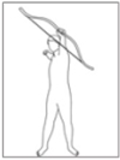
The past few decades has seen increasing kinematic studies using surface electoromyography (EMG) in archery, however there has been no such specific study in Korean traditional archery. The purpose of this study was to evaluate EMGs during archery shooting motion in Korean traditional archers. Ten men Korean traditional archers were participated, and divided into two groups according to the shooting stance; parallel stance group(PSG, n=5) and oblique stance group(OSG, n=5). The surface EMGs were measured 12 muscles during shooting motion of five events including Junbi(Set), Geogung(Set up), Manjak(Full draw), Balsi(Release), Machigi(Ending). At the result, muscle activity of posterior deltoid, trapezius, rhomboid major, latissimus dorsi, biceps brachii, forearm extensor bundle, triceps brachii, levator scapulae significantly increased at event of full draw and release, then significantly decreased again at event of ending, respectively(p<.01, p<.001). The muscle activity of erector spinae(ES) was also significantly increased at event of full draw and release(p<.01, p<.001), while no significant changes in muscles of rectus abdominis, rectus femoris(RF), gluteus maximus. As a result of comparing PSG and OSG, muscle activity of RF in OSG was higher than PSG at event of release(p<.05), it remained until event of ending(p<.05). On the other hand, the higher the tension of the bow, the higher the muscle activity of the draw arm at event of release(p<.05). These results suggest that when Korean traditional archery shooting, both side arm and back muscles are more activated than the abdomen, leg and hip muscles. The parallel stance might suppress the muscle activity of the lower extremities to twist the upper body. And the higher bowstring tension needs to increase of muscle strength in BB of draw arm.