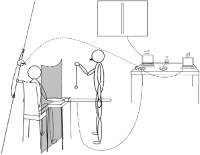
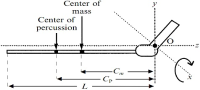
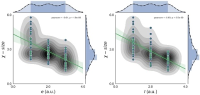
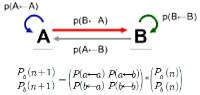
Purpose This study measured the haptic extroperception accuracy, that is, judging one hit position in a hand-held object. Especially, what factors associated the estimation of contact position when the impact is made at the grasped implement by hitting the ball. Methods Relative frequency and conditional probability based analysis verified that perceivers influenced not only the amount of pressure distinguished impressions by the coefficient of restitution but also the pressure distributions encoded impressions by the distance from the hand to the impact. Results Results conformed to previous invariant characteristic on dynamic touch in showing that perceiving the location of the impact of grasped objects, including dominant perceiving selectively modality, is constrained by inertial properties with such success requires appreciating the location of the implement’s center of percussion. Conclusion Investigated in this planes captured as a mechanical factor, we would suggest a broader hypothesis for further research into the effects of the rotational inertia related to haptic position accuracy in the hand-held object, and leading to different estimates of system function providing an account of generalization that accommodates of its varied aspects.
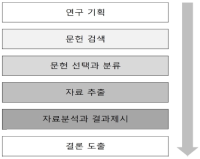
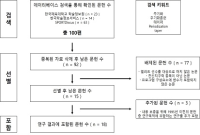
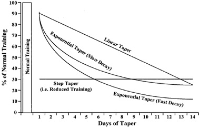
Purpose The aim of this study was to provide athletes and coaches on informations and benefits of a taper through evidence-based scientific studies and literatures in order to optimize an athlete’s top performance for the major competition. Methods Studies and literatures search was conducted using the databases RISS, KISS, SPORTDiscuss. Key words searched: taper AND(competition, OR performance, OR training, OR training). This study were eventually cited by 22 articles for results of this in total 100 articles. Results The training load is remarkably reduced during a taper. With a reduced training load, training intensity should be maintained during the taper. The training load reductions during the taper should be programmed with reducing training volume at 41% to 60% of pretaper training. The reduction of training frequency during a taper means that affect moderately trained athletes and highly trained subjects differently, reducing 30% to 50% of pretaper training and maintaining training frequencies, respectively. Detraining the duration of a taper is not easy. Most athletes is beneficial from a 2-week shorter or longer tapers, depending on their individual profiles of fitness loss, fatigue dissipation, and anxiety. The manipulations of this training program variables usually affect for most athletes and maximal performance gains. Conclusion Training intensity should be maintained during the taper, training volume reductions should be programmed at 41% to 60% of pretaper training. The reduction of training frequency could be reduced 30% to 50% of pretaper training, and most athletes is beneficial from a 2-week shorter or longer tapers. Future researches should be conducted the practical & effectual differences in individual and teamed-based sports after a taper procedure.

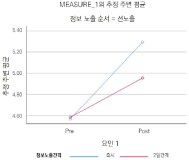
Purpose The purpose of the study was to examine the effect of exposure sequence and time gap between two exposures in image transfer in the context of sport sponsorship. Methods To accomplish the purpose of the study, one preliminary study and one main study were performed. The sample was drawn using a convenience sampling (33 for preliminary study and 120 for the main study). The data were analyzed using one sample t-test, repeated measure ANOVA(mixed design). Results The data for the main study indicated that the mean of the post-test was statistically higher than that of pre-test, which indicated that the image of the sporting event was transferred to the image of the brand Dell. This indicated that the image transfer actually took place although image similarity between sporting events and sponsoring brand was not conditioned. The hypotheses of the study were tested using a mixed design with exposure sequence and time gap between exposures as two between subject factors. The results indicated that the interaction was statistically significant. When two sponsorship information were given consecutively, the first sport event’s image was transferred more than the image of the secondly presented sport event, which indicated primacy effect. However, when the two sponsorship information was given with two days time gap, the image of the second sport event was transferred more than the first sport event’s image, which indicated a recency effect. Conclusions Two meaningful findins were delivered through the current study. First, even when there was no image similarity between sport event and brand, image transfer took place through sponsorship arrangement. Second, if primacy and recency effects are properly incorporated, image transfer can be achieved in a more effective way in sponsorship context.


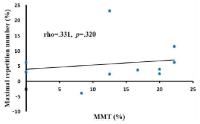
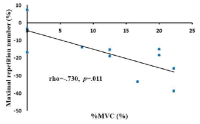
The purpose of this study was to determine whether maximum repetition number can be used as an indicator of strength imbalance. Eleven healthy, resistance-trained males were tested for one repetition maximum (1-RM) the chest-press exercise, and than manual muscle testing (MMT), two-arm at 80% of 1-RM and one-arm at 40% of 1-RM in the pectoralis major were measured for the maximum voluntary contraction (%MVC) and maximum number of repetitions during the chest press exercise. Exercise velocity was constantly 4 seconds (concentric: 2-s, eccentric: 2-s) per repetition. The changes in %MVC were significantly higher in non-dominant limb (NDL) compared with dominant limb (DL) pectoralis major during two-arm chest press (p < 0.01) and one-arm chest press exercise (p < 0.05). In contrast, the changes in MMT (p < 0.05) and maximum repetition number (p < 0.01) were significantly higher in DL compared with NDL during one-arm chest press exercise. There was no correlation between maximum repetition number and MMT (rho = 0.331, p = 0.320). However, maximum repetition number was significantly negative correlated with %MVC in two-arm chest press (rho = -0.730, p = 0.011). It is possible that maximum repetition number can be used as an indicator of strength imbalance.
There has been a growing advocacy for a critical approach to physical education teacher education(PETE) in the era of globalization and ubiquitous society. Drawing on critical pedagogy, the purpose of this paper was to explore the meanings and methods for developing critical professionalism in PETE through identifying the definitions and features of critical professionalism. The notion of critical professionalism includes four crucial components: critical reflection, social sensitivity, critical thinking, and practicability. This paper suggests an inquiry-oriented physical education teacher education to develop per-service teachers’ critical professionalism in terms of providing a range of teaching methods centered on microteaching, discussion-based lessons, critical reading and writing, and using media materials. Building on findings, it was concluded that there is a need of programs for the development of policy literacy understanding complex social and cultural contexts of school physical education. Furthermore, PETE should focus on the processes of critical reflection on the teaching and learning act itself within wider social contexts, by using an inquiry-oriented approach to PETE, which will contribute to fostering teachers’ critical capacities needed to guard the educational aims of physical education against political interference.
PURPOSE This study analyzed the difference in lower extremity joint angle and shock absorption patterns at the point of maximum ground reaction force during single-leg drop landing with or without anterior cruciate ligament reconstruction (ACLR). METHODS Forty adult males were recruited for this study, with 19 in the ACLR group (age: 20.52±1.43years, height: 179.26±5.18cm, weight: 74.91±6.29kg) and 21 in the control group (age: 21.42±1.61years, height: 174.97±6.83cm, weight: 69.27±7.56kg). Participants performed single-leg landings on a 30cm tall box. An independent sample t-test was used to analyze the difference in kinetics variables at the point of maximum ground reaction force upon landing, with significance set at p=0.05. RESULTS The lower limb joint angle showed significant differences in hip flexion, hip abduction, knee flexion, and knee valgus (p<0.05) between groups. There was no significant difference between the groups in terms of the results of kinetics variables during single-leg landing (maximum ground reaction force, lower extremity stiffness, and shock absorption time). CONCLUSIONS The ACLR group showed a clear difference in kinematics compared to the control group, but no significant difference in kinetic results was found. The two groups compensated for the same impact with different movements, though movements in the ACLR group may increase the risk of ACL re-injury. Those with ACLR should strive to reduce the risk of re-injury by training to use correct movements.
PURPOSE By analyzing trends in Taekwondo demonstrations, specifically in breaking and performances, to date, this study aims to offer timely insights and set the groundwork for future research. METHODS We used Korean abstracts from a total of 425 papers containing the keyword “Taekwondo demonstrations” spanning 20 years from April 2004 to April 2023. We employed Python 3.5.2 to conduct dynamic topic modeling (Latent Dirichlet Analysis, LDA) and to examine the correlation between the topic distribution by section and the publication year. RESULTS The main findings from the LDA are as follows. Topic 1 (10%): “The development of demonstrations: performance in culture and art, ” Topic 2 (11%): “The development of formalized rules and judgments in a demonstration event,” Topic 3 (08%): “A study on the educational courses and professionalism of Taekwondo coaches,” Topic 4 (11%): “Technical movements and kinematic characteristics,” Topic 5 (09%): “A study on marketing perspectives of demonstration performances,” and Topic 7 (33%): “Global exchange: the development and rise of internationalization.” In the correlation analysis between the topic share by section and the publication year, Topics 1 to 5 exhibited no statistically significant correlation. However, Topic 6, “A study on the attainment of events, training, and the psychological factors influencing athletes” and Topic 7, “Global exchange: the development and rise of internationalization,” also displayed a very statistically significant but negative correlation. CONCLUSIONS Future research should focus on studies on the psychological management of athletes during the performance of specific techniques and training methods. Further research considering the global characteristics of Taekwondo may be required.
PURPOSE The purpose of this study was to compare the dynamic postural control of youth athletes with and without a history of lateral ankle sprains. METHODS Twenty-eight youth athletes (14 lateral ankle sprain, 14 healthy control) participated in this study. All participants answered the Foot and Ankle Ability Measure questionnaire and were subject to the Star Excursion Balance Test (SEBT) for dynamic postural control evaluation to collect the joint angles of the lower extremity, a center of pressure (COP) path, and COP velocity. Independent sample t-test or Mann-Whitney U-test were performed to analyze the difference between the groups. RESULTS The lateral ankle sprain group (LAS) was found to have a long experience in participating in sports, and low Foot and Ankle Ability Measure scores were identified when compared to the healthy control (CON; p<0.05). LAS was observed with a short reach distance, less hip flexion, and dorsiflexion angles during the anterior direction of SEBT when compared to CON (p<0.05). Furthermore, LAS showed a slower anteroposterior and mediolateral center of pressure velocities in the posteromedial aspect of SEBT and a slower anteroposterior COP velocity in the posterolateral aspect of SEBT when compared to that of CON (p<0.05). There were no differences between the groups with respect to the other variables (p>0.05). CONCLUSIONS Based on these results, decreased anterior reach distance of SEBT may be affected by changing the dynamic posture control strategy of the lower extremity joint on the sagittal plane in LAS.
PURPOSE This study aims to investigate the problems posed by the new “Health Exercise Managers” qualification system implemented in 2015 and suggest a reformation plan for the qualification definition, written test, and practical–oral test. METHODS Eleven experts working in the academia and the exercise prescription field were selected as research participants using purposive sampling method (professors=5, director of sport science division in national research and development institute=1, head of national/private organization that issue Health Exercise Managers certificates=2, and health exercise managers working at university hospitals =3). The results were collected, examined and classified following numerous discussions among the authors. RESULTS First, the qualification definition should be based on “course completion” in the short term and “department certification” in the long term. Second, the written test can be reformed by identifying the core courses related to health exercise management and merging similar or overlapped courses. Also, the grades should be calculated for each question based on the knowledge gained in related courses. Third, the practical–oral test questions should be publicly available in advance to help candidates better prepare and learn practical skills, rather than set the standards for elimination. CONCLUSIONS An overall reformation of the qualification definition, written test, and practical–oral test will solve the problems posed on the quality of the “health exercise managers” qualification system.
PURPOSE The purpose of this study is to analyze various citation patterns such as the scope and intensity of the academic influence of Korean "Kinesiology" studies. METHODS To this end, this paper collected and analyzed 17,693 target articles published in 22 KCI-accredited “Kinesiology” related journals from 2001 to 2014, and 98,941 citing cases that took advantage of target articles as references. Specifically, this paper analyzed the citation pattern by dividing it into two parts. First, this paper analyzed the distribution of citations in individual target articles and the top-cited articles and top-cited researchers. Second, this paper also analyzed the citing articles; such as in which journal, what academic field, and in what pattern the “Kinesiology” target articles were cited. RESULTS As a result, 15% of the target articles were not cited at all for five years after publication, while 6.8% of papers were cited more than 17 times, which was exceptionally more cited compared to the majority of target articles. There were no research topics exclusively exerting influence in Korean "Kinesiology" research, but relatively many cited thesis topics include 'self-management, 'leisure statement', 'psychological well-being', 'self-confidence', 'service quality', and 'leisure flow'. Besides, the Korean "Kinesiology" articles accounted for 76% of the total of about 98,000 citations, having greater influence within the same academic field than other academic fields. CONCLUSIONS This study contributes to the relevant literature in that it is one of the early endeavors to study the citation pattern for the entire Korean kinesiology articles.
