PURPOSE This study aimed to explore the enactment and background of Korean and Japanese sports laws, comparatively analyze the major sports-related laws of both countries, namely Korean National Sports Promotion Act, Japanese Sport Promotion Act, and the Framework Act on Sport of both countries, and derive implications for the Korean Framework Act on Sport, sports-related laws, and sports policy. METHODS Research related to sports law were collected through academic databases and major search portals in both countries and analyzed. RESULTS First, as reviewed in previous studies, the Korean National Sports Promotion Act at the time of its enactment imitated the Japanese Sport Promotion Act in almost all articles. Second, Japanese Basic Act on sport, which was a complete revision of Japanese Sport Promotion Act, further expanded the concept of “sports,” and specified nonexistent “sports rights,” “sport nation,” and “sport as a universally shared human culture,” was evaluated as having quasi-constitutional character. Third, the Framework Act on Sport of both countries specified similar sports policies and concepts in many individual articles. The Korea’s Framework Act on Sport independently included articles for superordinate law, spread of sports values into environmental and political fields, inter-Korean exchange and cooperation in sports, sports donation culture, and so on . Japan’s Basic Act on Sport independently specified preamble, sports integrity-related articles, articles for prompt and appropriate resolution of sports disputes, and for promoting anti-doping activities, and so on. CONCLUSIONS This study offers suggestions for clarifying the legal concepts of “sports” and “physical education,” resolving contradictions in the articles of the Korean Sports-related Act, establishing an independent sports policy implementation organization, establishing the legal system of the Korean Sports-related Act, and supporting the “life career” from the time of active athletes.
PURPOSE This study investigated the impact of underweight and hand grip strength (HGS) levels on the risk of all-cause mortality in older adults. METHODS Data from the 2006 baseline and 2020 follow-up assessments of the Korean Longitudinal Study of Aging (KLoSA), involving 3,009 older Koreans (≥65 years) were used in the study. Participants were categorized based on body mass index (BMI) as underweight, normal, overweight, or obese and grouped according to the Asian Working Group Sarcopenia criteria into high or low HGS. Cox proportional hazard models were used to estimate the hazard ratio (HR) and 95% confidence interval (CI) of all-cause mortality according to BMI and HGS categories. RESULTS During the 11.3±4.0 years follow-up period, 1,334 deaths from all causes occurred. The risk of death by BMI and HGS level was analyzed. The results showed that the risk of death in the overweight and high HGS group (HR=0.773, p=.016) was significantly lower than that in the normal weight & high HGS group (HR=1). In comparison, the risk of death in the underweight & low HGS group (HR=1.930, p<.001) and the normal weight & high HGS group (HR=1.225, p=.014) were significantly higher than normal weight & high HGS. However, the risk of death in the underweight and high HGS group showed no significant difference compared to the normal weight and high HGS group. CONCLUSIONS The current findings suggest that improving muscle strength through regular exercise may be important in preventing the risk of all-cause mortality due to being underweight.
PURPOSE The purpose of this study was to investigate the relationship between the integrated marketing communication (IMC) attribute of professional baseball teams, their fans’ perceived value, and voluntary behavior related to the parent company. METHODS In this study, the target population consisted of spectators watching a professional baseball game. A survey was conducted on 360 fans watching the KIA tigers’ and kt wiz’ home game using the convenience sampling method. Finally, a total of 261 were used for data analysis, and frequency, confirmatory factor, reliability, correlation, structural equation model analyses using SPSS 20.0 and AMOS 20.0. RESULTS Main findings are as follows: First, interactivity of professional baseball teams’ IMC had positive effects on the emotional value. Second, interactivity and reminders from the parent companies of professional baseball teams’ IMC had positive effects on social value. Third, stakeholder connectivity and reminders from parent company of professional baseball teams’ IMC had positive effects on altruistic value. Fourth, with regard to the social aspect, the fans’ perceived value had positive effects on loyalty, customer participation and customer cooperation of voluntary behavior related to parent company. Lastly, with regard to the altruistic aspect, the fans’ perceived value had positive effects on customer cooperation of voluntary behavior related to the parent company. CONCLUSIONS Therefore, professional baseball teams should identify the IMC elements that fans perceive as important and establish effective marketing communication strategies to enhance the perceived value of their brand among their fans, ultimately increasing their voluntary engagement with the parent company.
PURPOSE This study investigated the associations between mental health and physical activity with all-cause mortality in persons with disability. METHODS A total of 595 participants (39.3% women) aged 45≥ years, who participated in the Korean longitudinal study of aging (KLoSA) were included in this study. The Korean version of mini-mental state examination (K-MMSE) and the center for epidemiologic studies depression scale (CES-D) were used to assess cognitive impairment and depressive symptoms, respectively. The participants were classified into active and inactive groups based on physical activity of 150 min/week. Cox’s proportional regression analyses were used to determine the hazard ratio (HR) and 95% confidence interval (CI) of mental health and physical activity relating to all-cause mortality. RESULTS During the follow-up period (11.8±4.1 years), a total of 218 (36.6%) deaths occurred from all-causes. Participants in the inactive group had significantly higher cognitive impairment (p =0.046), depressive symptoms (p =0.001), and all-cause mortality (p=0.037) than those in the active group. Compared to participants in the normal (HR=1), cognitive impairment (HR=2.229, 95% CI=1.645-3.020, p<0.001), and depressive symptoms groups (HR=1.542, 95% CI=1.136-2.091, p<0.001), those in the inactive group had significantly higher HR related to all-cause mortality. However, in the active group, cognitive function and depressive symptoms were not associated with all-cause mortality. CONCLUSIONS The current finding suggests that the promotion of physical activity may play an important role in preventing premature death from all-causes in persons with disability, especially among those with mental health problems.
PURPOSE The purpose of this study was to verify the support effect of muscle activity and stability according to walking conditions (Level, Ramp, and Stair) before and after wearing a suit with a 12kg heavy weight load. METHODS To accomplish the purpose of the study, subjects (n=10) underwent Electromyography (EMG) measurement under the same conditions for 10 different muscles, and COP width was calculated through foot pressure measurement. The experimental movement was level walking, Ramp walking, and stair walking, each carrying a 12kg load, and measured once before and after wearing a wearable suit. RESULTS Electrolyography (EMG) measurement revealed a significant difference in the average EMG values of muscle activity of R.RF in level walking(p<.05), R.RF and L.RF in ramp walking(p<.01), L.RF and L.BF in stair walking (p<.05). COP width measurement revealed a significant difference in the reduction of COP width in all walks (level walking, ramp walking, stair) (p<.05, p<.01, p<.001). CONCLUSIONS The effects of wearing a wearable suit are as follows. First, the wearable suit has a significant effect of assisting the Rectus Femoris muscle. Second, there is a gait stability effect by wearing a wearable suit.
PURPOSE This study examined whether the intensity of participation in the National Fitness Award 100 (NFA100) program is associated with reductions in obesity prevalence and healthcare expenditure in South Korea. A continuoustreatment difference-in-differences (DID) framework with a pseudopanel structure was employed to address the absence of a natural control group. METHODS A pseudopanel defined by sex, age group, and month was constructed using administrative NFA100 records linked with external national statistics on obesity prevalence and healthcare expenditure covering the period from 2022 to 2024. Monthly counts of fitness measurements served as a continuous treatment indicator of participation intensity. To support causal interpretation, stringent diagnostics for the parallel trends assumption were conducted. Average treatment effects were estimated using two-way fixed effects (TWFE) models, and effect heterogeneity was examined through unit-specific interaction terms and a supplementary threecategory age-group specification. RESULTS Greater participation intensity in the NFA100 program was associated with statistically significant reductions in obesity prevalence. The magnitude of these effects was largest among adults in their 20s and 30s, whereas attenuated responses were observed among older adults. Healthcare expenditure also declined, although the estimated effects were modest in size. Substantial heterogeneity across age and sex groups was consistently identified. CONCLUSIONS Higher participation intensity in the NFA100 program contributes to meaningful reductions in obesity prevalence and modest decreases in healthcare expenditure, although program effectiveness varies considerably by age and gender. These findings underscore the importance of tailoring intervention strategies, particularly for older adults, and demonstrate the value of large-scale national health promotion programs.
PURPOSE Recently, local governments have demonstrated an increased interest in sports cities to strategically ensure sustainable urban competitiveness, revitalize the local economy, and improve residents’ quality of life. Therefore, this study identifies key factors and their priorities for building a sustainable sports city image in noncapital local governments based on city branding and local governance theories. METHODS Data were collected from a panel of 15 experts in sports cities using modified Delphi method and the analytic hierarchy process and analyzed using SPSS 23.0, Excel, and the cloud-based research automation platform SSRA, obtaining means, standard deviations, content validity ratios, interquartile ranges, stability, convergence, consensus, and consistency ratios. RESULTS The Delphi survey produced 6 key factors and 27 items. The key factors, according to relative importance, were as follows: “securing adequate financial resource,” “support from local government,” “revitalization of community-based sports activities,” “establishment governance among stakeholders,” “efforts toward sports city branding,” and “promotion of sports industry.” For each factor, important items were “mayoral interest and commitment,” “building cooperative networks with sport federations, local sports associations, and education offices,” “sufficient budgetary support from the local government,” “development of sports infrastructure,” “attracting professional sports teams,” and “designation and development of locally specialized sports.” CONCLUSIONS Local governments should first establish structural foundations by securing sufficient budgets and providing administrative support, among other tasks, as a starting point for designing sports city policies. When branding strategies that systematically strengthen a sports city’s identity and symbolism are organically linked based on these structural conditions, the effectiveness and sustainability of sports city policies can be further enhanced.
PURPOSE This study sought to examine the psychological responses of nextgeneration national team athletes to injuries as well as on-site coping strategies and explore effective ways to apply these in practice. METHODS A total of 60 nextgeneration national team athletes and 5 national team coaches participated in indepth interviews and answered semistructured questionnaires to better understand psychological responses to injury. The collected data were then subjected to semantic and inductive content analysis. RESULTS The data produced three main themes: perceptions of injury (positive and negative), psychological responses to injury, and coping strategies such as rehabilitation processes and injury prevention. Analysis of negative psychological responses generated three categories: psychological withdrawal (104/58.4%), slumps (37/20.8%), and trauma (37/20.8%). Meanwhile, all positive psychological responses fell under one theme: positive attitude (28/100%). Additionally, an examination of national team coaches’ perceptions of player injuries highlighted three key areas: causes of injury (loss of concentration, psychological pressure, and arousal during competition), coaches’ response processes (immediate responses and hindering factors), and injury management strategies for field application (internal and external measures). CONCLUSIONS Psychological factors that emerge during the injury process of next-generation national team athletes must be identified to understand the challenges they face and allow coaches to implement appropriate support strategies in response to sports injuries.
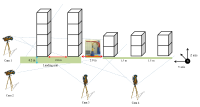
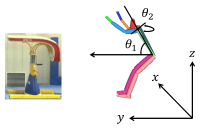
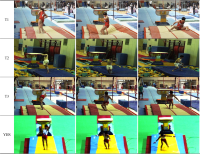
Purpose The purpose of the study was to perform a comparative analysis of the YANG Hak Seon technique carried out by "K" athlete with the kinematical data of "Y" athlete and propose a method to improve the YANG Hak Seon technique of "K" athlete. Method The subject recruited for the study was a male athlete from Korean national team (Age: 21, height: 1.65 m, body weight: 59.6 kg, and career: 11 years). Four high - speed cameras were used to analyze the 3D motion of the YANG Hak Seon technique performed by "K" athlete. The variables selected for analysis were the velocity of COM, displacement of COM, the rotational & torsional angle of the trunk and rotational & torsional angular velocity of the trunk. The results obtained were compared to the preexisting data of the "Y" athlete (data set from the published research). Results Firstly, the horizontal displacement of the YANG Hak Seon technique of the "K" athlete was observed to be shorter along with lower vertical displacement during landing compared to “Y” athlete. In addition, the overall horizontal velocity was low and vertical velocity was not generated which rises during the BC (board contact) phase. Although the rotational angular velocity of the trunk was lower during the BC, HC (horse contact) phase and LD (landing) phase, torsional angular velocity was higher during the LD. Conclusion In order to improve the completeness of the YANG Hak Seon technique of the K player, it is necessary to enter with a fast and low posture on the footplate during the initial phase. In the BC phase, it is essential to raise the COM simultaneously while landing on the footplate and increase the rotational angular velocity of the trunk.
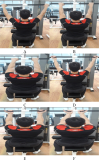
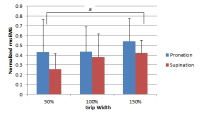
Purpose The purpose of this study is to investigate the effects of grip width and hand orientation on muscle activities of upper body during the lat pull-down. Methods Eight healthy men performed the 6 grip variations (3 grip width × 2 hand orientation) using an experimentally determined load of 70% of 1 repetition maximum. Five trials were analyzed for each grip type. Participants maintained a cadence of 2-second concentric and 2-second eccentric phases. The grip widths were normalized for each individual by using their biacromial diameter (100%), and then set the grip width 50% of biacromial diameter and 150% of biacromial diameter. Surface EMG of the latissimus dorsi, pectoralis major, infraspinatus, biceps brachii, triceps brachii, rectus abdominis, erector spinae and middle trapezius was recorded, and the root mean square of the EMG was normalized, using a maximum isometric voluntary contraction. Results Latissimus dorsi showed higher muscle activities in 100% grip width than those of 50% grip width. Pectoralis major and rectus abdominis showed higher muscle activities in 50% and 100% grip width than those of 150% grip width. Middle trapezius showed higher muscle activities in 150% grip width than those of 50% grip width. Conclusions Two-way repeated measures ANOVA for each muscle revealed that latissimus dorsi and middle trapezius (the posterior muscles of trunk) showed higher muscle activities in wide grip, on the other hand, pectoralis major and rectus abdominis (the posterior muscles of trunk) showed higher muscle activities in narrow grip.