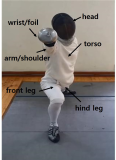
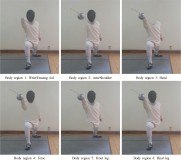
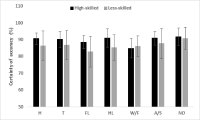
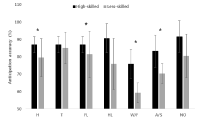
Purpose The purpose of this study was to establish the differences of anticipating accuracy and confidence according to fencing expertise and spatial occlusion region. Methods For the purpose of this study, the anticipation ability of 6 high-level fencing players and 6 low-level fencing players were analyzed. All subjects performed the 60 tasks of anticipating the attack positions(thorax, thigh, toe) from observing the fencing video screen using spatial occlusion technique. The spatial occlusion technique was used in 6 particular body of opponent’s movement. For statistic analysis, data was analyzed through independent T-test measure. Moreover, Paired t-test were used as follow-up analysis. Results The results of the study were as follows: In terms of accuracy anticipation, the main effect of expertise was significantly different. Specifically, when the spatial occlusion technique was applied in head, left leg, arm, and a foil, the accuracy of anticipation was significantly different. Moreover, comparing with no-occlusion condition, anticipation accuracy decreased when spatial occlusion technique was applied in arm and foil. In terms of confidence, there was no significant difference between level of expertise. Conclusions In order to effectively anticipate the opponent’s movement in fencing sports, it is necessary to focus on the visual cues of arm/shoulder, and the foil. Especially, focusing on the foil movement might provide the core informations on anticipation ability.

Purpose This study was conducted to analyze the differences of physical characteristics focused on the physique, strength, and power for cycling national athletes (Sprint cyclists and Road race cyclists). Methods We measured various factors (e.g., height, weight, body fat ratio, thigh circumference, waist circumference, anaerobic power, isokinetic muscular strength, muscle power, squat jump by 1RM intensity, and so on) for a total 11 male cycling national athletes (5 Sprint cyclists and 6 Road race cyclists). Results First, the body composition showed the significant differences only in weight (p=0.31) and BMI (p=.001) for Sprint cyclists. Second, the values of the anaerobic power for the Sprint cyclists were significantly higher than those for the Road race cyclists only at peak power (p=0.28), whereas there was no significant difference in average power, isokinetic muscular strength, and muscle power between the two groups. Third, the isokinetic trunk flexion muscle (p = .016) for the Sprint cyclists were significantly higher than those for the Road race cyclists. Fourth, the significant difference in Time to Peak Torque was not found between two groups. Fifth, the values for the Sprint cyclists showed the significant difference in all 5 intensity groups (0%, 30%, 50%, 60%, and 80%) (p=.001) of the squat jump. Also, there was a statistically significant difference only in 0% velocity between the two groups, except for exercise intensity. Conclusions From the various measures between two groups, the Sprint cyclists relatively showed the high weight, BMI (muscle mass), and maximum power. Additionally, the isokinetic trunk flexion muscle and the squat jump were higher in the Sprint cyclists than the Road race cyclists. These data may be used as basic data to improve the physical fitness factors related to the athletic performance of the athletes by reflecting them in the effective training plan and evaluation of the athletes.
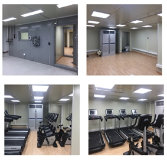
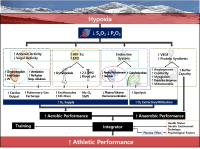
Purpose The purpose of this study is to emphasize the need for the establish and the use of altitude training center via examining exercise training method in natural or artificial altitude environment that is applied to various elite athletes in various advanced countries to maximize exercise performance and its effectiveness. Results Altitude training in natural or artificial altitude environment enhances aerobic and anaerobic exercise performance baesd on the hematological and nonhematological adaptations to hypoxic conditions. These altitude training methods can be classified into living high training high (LHTH), living high training low (LHTL), and living low training high (LLTH). LHTH (i.e., developed since the 1968 Mexico Olympics) and LHTL (i.e., developed in the 1990s by Levine and Stray-Gundersen) improve exercise performance via hematologic changes through erythropoiesis such as increased hemoglobin mass and erythrocyte volume. On the other hand, LLTH (i.e., has been developed variously since the 2000s) is composed continuous hypoxic training (CHT), intermittent hypoxic training (IHT) and repeated sprint training in hypoxia (RSH), and the altitude environment is constructed using a vacuum pump and a nitrogen generator. In general, LLTH method dose not induce hematological change in a short time within 3 hours. However, CHT and IHT enhance aerobic exercise capacity by improved exercise economy, supply and utilization of blood to tissues, capillary and mitochondrial densities, and oxidative enzyme activity through various biochemical and structural changes in skeletal muscle and cardiac muscle. RSH enhances anaerobic power and repetitive sprint performance by improving glycolytic enzyme, glucose transport, and pH control. In Korea, however, there are almost no facilities for altitude training that is applied to enhance athletic performance in advanced sports countries and recognition of the need for altitude training is also very poor. Conclusions Therefore, it is very urgent to develop altitude training for maximizing athletic performance in Korea and a lot of support and efforts are needed from the government and local governments.

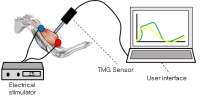
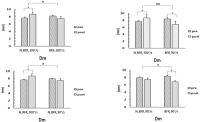
Purpose The purpose of this manuscript was to investigate the effect of high and low speed blood flow restriction versus non-blood flow restriction isokinetic exercise on isometric muscle strength, muscle fatigue, and muscle contraction displacement. Methods The subjects were consisted of ten males without non-specific muscular skeletal disease. They were classified into four training groups: ① high speed(300°/s) without blood flow restriction, ② high speed(300°/s) under blood flow restriction, ③ low speed(90°/s) without blood flow restriction, ④ low speed(90°/s) under blood flow restriction. Before and after the intervention, all of the subjects underwent measurements of isometric quadriceps strength, muscle fatigue, and muscle contraction displacement. Results In regard to isometric quadriceps strength before & after intervention, there was no significant difference between groups. For the lactic acid measurement before & after intervention, there was a signigicant difference between groups(p<.05). Also, there was a significant difference between groups(p<.05) in muscle contraction displacement in terms of Dm but there was no significant difference between groups in terms of Tc Conclusions Isokinetic exercise with blood flow restriction had effects on lactic acid and muscle contraction displacement.


Purpose Philosophical inquiries into physical education and sport pedagogy(PESP) have not been active until lately. A renewed interested has grown as scholars in UK and European countries have begun philosophical analysis since 2000. This study purports to review the philosophical studies in PESP during the last 50 years, and to forecast the future of SP in Korea based on its strength and weakness. Methods Literature review is adopted as the main method, as the philosophical study requires the conceptual analysis on the ideas. The past research, current main studies and future prospects are analyzed according to the three layers of the professional, the theoretical, and the personal dimensions. Results First, in the professional dimension, the philosophical inquiry by the SP philosophers and the educational inquiry by the sport philosophers are identified. Second, in the theoretical dimension, the exploration on the nature of research in PESP, the suggestions of PE models, the examination of teaching-learning in PE, the promotion of teacher/coach education and professional development, and the analysis of PE curriculum issues and policies are actively produced. Third, in the personal dimension, the practitioner research by PE teacher/professor/coach and the self-study of sport coaches have are begun to be conducted. Conclusions For the prospect of PESP in Korea, it can be said that study in the first dimension would not be bright, where as those of the second and the third would be very good for the near future.
Purpose The present study compared physical fitness, metabolic syndrome risk factors, and resting metabolic rate (RMR) according to body mass index (BMI) and percent body fat (%BF) in 20s females. Methods Fifty-one women in their 20s were recruited and assigned into three groups, i.e., normal group (n=18), normal weight obesity (NWO) group (n=18), and obesity group (n=15) according to BMI and %BF. Physical fitness, metabolic syndrome risk factors, and RMR were measured and compared among three groups. Results Main results were as follows: 1) Physical fitness were not significantly different among three groups. 2) Regarding 1-RM, arm curl and leg extension were significantly lower in normal group and NWO group than obesity group. Leg press was significantly lower in normal group than obesity group. 3) Regarding metabolic syndrome risk factors, there were significant differences in waist circumference, ordering from low to high such as normal, NWO, and obesity groups. Systolic blood pressure and diastolic blood pressure were significantly lower in normal group and NWO group than obesity group, while HDL-C was significantly higher in normal group than NWO group and obesity group. 4) Regarding RMR, absolute values of RMR such as VO2(㎖·min-1), RMR (Kcal·min-1), RMR (KJ·min-1), and RMR (Kcal·day-1) were significantly lower in normal group and NWO group than obesity group. On the other hand, relative value of RMR such as RMR (KJ·kg-1FW·h-1) was significantly higher in normal group than NWO group and obesity group. Conclusions It was concluded that obese women showed increased risk of metabolic syndrome and low relative RMR level, and NWO had similar problems. Active health management through physical activity and dietary control should be committed to NWO individuals because the NWO has possibility of high risk of metabolic syndrome and reduction of metabolic rate from 20s even though there was no problem in their external appearance.
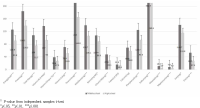
Purpose This study aimed to evaluate the nutrient intakes and diet quality of national youth badminton players participating in summer camp training in 2016. Methods Total of 40 middle school players and 60 high school players were included in the study. Two players with skipped meals were excluded from the final target. Food intake data for the 3-day using 24-hour recall method were obtained and analyzed using the CAN-pro 5.0 (Web ver. Korean Nutrition Society, Korea). Differences in nutrient intakes and diet quality were compared between middle school players and high school players using independent samples t-test. Results Intakes of vitamin C, vitamin E, vitamin B6, folic acid, calcium, chloride, magnesium, and zinc in both groups were lower than (RNI) recommended intakes of KDRIs. On the other hand, intake of sodium significantly exceeded the recommended nutrient intake (RNI) of KDRIs in both groups. The NARs (Nutrient Adequacy Ratio) of vitamin C, vitamin B6, folate, calcium and zinc were less than 0.75 in both groups. The NARs of 11 nutrients except for folic acid were significantly lower in high school players. The MAR (Mean Adequacy Ratio) of middle school players was 0.78, significantly higher than 0.64 of high school players. The INQs (Index of Nutritional Quality) of vitamin C, vitamin B6, folic acid, calcium and zinc were less than 0.75 in both groups. The INQs of vitamin A, vitamin B6 and zinc were significantly lower in high school players. On the other hand, the total DDS (Dietary Diversity Score) of high school players was 3.88, significantly higher than 3.29 of middle school players. The DDS of fruit group as well as milk and dairy group were particularly low. Conclusions The results suggest that balanced diet managed by professional dieticians along with nutrition education should be implemented to improve nutrients intake and diet quality of national youth badminton players.

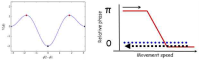
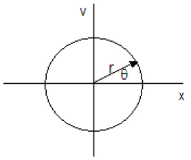
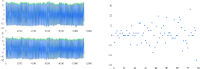
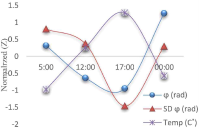
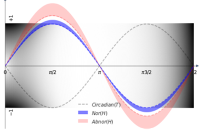
Purpose The present study explored biological autonomy and control of function in circumstances that assessed a presumed relationship to an environmental cycle. An understanding of this behavior appeals to the organism-environment system rather than simply the organism—we seek to expose the laws that underlie end-directed capabilities by measuring biological characteristics (motor synchrony) in an environmental cycle (circadian temperature). Methods Participants (n = 24) at the University of Connecticut (Storrs, USA) and the Seoul National University (Seoul, Korea) served in the study. The production of in-phase bi-manual coordination was examined at different circadian points (allowing comparison of day-night temperature effects) in two experimental designs; (1) normal temperature embedded in a 24 hour cycle (5:00, 12:00, 17:00, and 24:00), and (2) normal versus abnormal temperature [artificially decreasing or increasing] while embedded at two points (5:00 am, 5:00 pm) during the circadian process. A typical bi-manual stability measure varied significantly as a function of the day-night temperature cycle. Results While (i) circadian effects under the artificially perturbed temperature manipulation were not straightforward along the day-night temperature cycle, (ii) the circadian effect divided by the ordinary circadian seems to be constant along the day-night temperature cycle. Conclusions The discovery of direct and robust relation between biological aspects (body temperature and motor synchrony) an environmental process (circadian temperature cycle) may echo adaptation of our biological system to the environment. This relation supports the claim that the organism and the environment should be considered as integrated system in which biological (or physical) dynamics takes place as a mutual factor.


Purpose This study aims to explore the association between the awareness of naturalized players and the awareness of recruiting naturalized players for national players among sport fans. Methods Survey was conducted among 1,050 fans in professional sport, amateur sport, sport cafes at portal website among which 928 papers were used for final analysis. Collected data was processed by using SPSS 21.0 program. T-test, one-way ANOVA, correction analysis and multiple regression analysis were conducted to test hypothesis. Results Gender, age, household, and field income showed significant differences in the awareness of achievement among the awareness of naturalized players by fans. Age, school, and field revealed significant differences in the awareness of attitude. Age, school, household income, and field showed remarkable differences in the awareness of field and age and household income showed critical differences in the ascription awareness. Negative awareness showed that gender, age, school, and income were significantly different and the tolerable awareness showed that age, school, household income, and field revealed significantly different among the awareness of recruiting naturalized players for national players. Achievement, attitude, and ascription factors had positive impacts, while field factors had negative impacts in terms of the influence on negative awareness among the awareness recruiting foreign players for national players. In terms of the influence on the tolerable awareness, achievement, attitude, and field affected positively. Conclusions This study demonstrated that fans need to be aware of trust and assurance on achievement, attitude, and field factors of players to induce the recruitment of naturalized players for national players in a tolerable way.
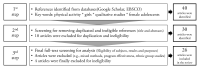
Purpose The purpose of this study was to develop a comprehensive model for facilitating and hindering factors about girls' participation in physical activities. Methods Based on systematic analysis, 26 foreign journals published from 2005 to 2016 were comprehensively analyzed. The journals were directed to facilitating and hindering factors of girls' physical activities. A model was developed by categorizing various factors in the previous studies, and by conceptualizing those categories, and by creating visualization of relations between the categories. Results Seven facilitating factors are referred to as 'SPORTS', including ‘Self-recognition’, ‘Physical environment’, ‘Opportunities’, ‘Relationship’, ‘Treatment’, and ‘Social supports’. In contrast, nine hindering factors are conceptualized as 'INCAPABLE' which includes 'Internalized gazes’, ‘Negative feedback’, ‘Competitiveness’, ‘Alternativeness’, ‘Perceived danger’, ‘Appearance’, ‘Bad feeling’, ‘Lack of opportunities’, and ‘Effeminate norms'. Conclusions It is suggested that the girls' physical activity patterns vary depending on whether the girls subjectively interpret the physical activity or girls are being objectified by other's evaluation. And those individual, relational, and environmental levels are needed to strengthen the subjectification of girls.

