PURPOSE This study aimed to investigate the effects of an 8-week unstable surface Pilates training on physical fitness, abdominal muscle thickness, lumbar isokinetic muscle function, and pain in women aged 30–40 who are living a sedentary lifestyle and experiencing nonspecific low back pain. METHODS The training group (TR, n = 15) performed Pilates using small apparatuses on an unstable surface for 50 min/session, three sessions per week for 8 weeks, whereas the control group (n = 13) maintained their usual living pattern during the same intervention period. RESULTS 1) The body weight, body mass index, percent body fat, and fat mass decreased significantly in the TR, 2) whereas the hand grip strength, trunk extension, sit-andreach, and modified Schober test scores improved significantly. 3) The thickness of the external oblique, internal oblique, and transversus abdominis increased significantly in the TR. 4) Lumbar isokinetic flexor strength per body weight increased significantly in the TR. The endurance and endurance per body weight of the lumbar isokinetic extensor and lumbar isokinetic flexor also significantly increased in the TR. 5) The Korean Oswestry disability index (KODI) and the visual analog scale (VAS) score decreased significantly in the TR. 6) Significant negative correlations were found between the change rates in the KODI and nondominant hand grip strength, external oblique thickness, transversus abdominis thickness, and lumbar isokinetic extensor endurance. A significant negative correlation was found between the change rates in the VAS score and external oblique thickness. CONCLUSIONS The results revealed that the 8-week unstable surface Pilates training was beneficial in improving physical fitness, abdominal muscle thickness, lumbar isokinetic muscle function, disabilityindex, and pain levels in women aged 30–40 years who were having a sedentary lifestyle and experiencing nonspecific low back pain.
PURPOSE This study investigated the effects of moderate-intensity continuous exercise (MICE) and high-intensity interval exercise (HIIE), performed postprandially, on blood glucose, blood pressure, and blood lactate levels in men aged 40–50 with prediabetes and prehypertension. METHODS Twelve men with prediabetes and prehypertension were selected. After consuming a liquid meal, the participants participated in three trials: MICE, HIIE, and a non-exercise condition, with a one-week washout period between each trial. The trials were conducted in a counter-balanced manner to ensure equal energy expenditure across conditions. The intensity of the MICE trial was set at 70% of the heart rate reserve (HRR), whereas the HIIE trial alternated between 50% and 90% of HRR for 30 minutes. Blood glucose, blood pressure, and blood lactate levels were measured at various time points during each trial, and a two-way repeated-measures ANOVA was used for analysis. RESULTS 1) In the MICE trial, significant reductions were observed in blood glucose (at 15 and 30 minutes during exercise), systolic blood pressure (SBP) (at 50 minutes post-exercise), and diastolic blood pressure (DBP) (at 20, 40, 50, and 60 minutes post-exercise). 2) In the HIIE trial, significant reductions in blood glucose (at 15 and 30 minutes during exercise), SBP (at 40 minutes post-exercise), and DBP (at 40 minutes post-exercise) were observed. Blood lactate levels significantly increased. 3) When comparing the two exercise trials, blood glucose in the HIIE trials showed a recovery trend post-exercise, and blood lactate levels increased to a greater extent. CONCLUSIONS These findings suggest that both MICE and HIIE effectively lower blood glucose during exercise, but HIIE causes a more rapid post-exercise increase in blood glucose compared to MICE. In addition, MICE results in a smaller rise in blood lactate. Therefore, MICE is recommended for improving prediabetes and prehypertension. Future research should compare these effects in healthy individuals and examine long-term adaptations to repeated exercise.
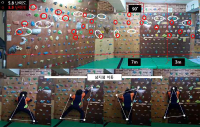
[Purpose] The study was designed to examine the effects of a 10-week sports climbing training on body composition and surrogate indices of major lifestyle disease in obese elderly women. [Methods] Twenty elderly women, whose percent body fat was over 35%, were randomly assigned into one of two groups, i.e., sports climbing training group (TR: n=10) and control group (CON: n=10). The subjects in TR completed sports climbing training program with 5.8 and 5.9 of difficulty, at 11-13 of ratings of perceived exertion (RPE), 60 min/session, three sessions/wk for 10 weeks. Independent variables regarding body composition and major lifestyle disease, i.e., hypertension, dyslipidemia, and atherosclerosis, were measured and compared between two groups as well as between two tests simultaneously using a repeated two-way ANOVA. [Results] Regarding physique and body composition, there were significant interactions between group and test in body weight, body mass index, fat mass, and percent body fat. These variables decreased significantly in TR. 2) Regarding indices of hypertension, systolic blood pressure, diastolic blood pressure, mean arterial pressure, and pulse pressure decreased significantly in TR. Regarding indices of dyslipidemia, triglyceride decreased significantly in TR. Regarding indices of atherosclerosis, TG/HDL-C ratio decreased significantly in TR. [Conclusions] It was concluded that the 10-week sports climbing training would be beneficial for reduction of body fat despite its’ influence on fat-free mass was limited, and would also contribute on improving surrogate indices of hypertension, dyslipidemia, and atherosclerosis in obese elderly women. Future research investigating the effects of various period, intensity, duration, and frequency of sports climbing training would be warranted.
Purpose The study was designed to compare physical fitness, indices of lifestyle disease, and biochemical property of muscle according to sarcopenia and obesity in elderly women. Methods One hundred elderly women were alloted to one of four groups, i.e., sarcopenia+obesity (SO: n=20) group, sarcopenia (S: n=20) group, obesity (O: n=29) group, and normal (N: n=31) group. Criterion for sarcopenia was 'appendicular skeletal muscle mass (ASM)/height2<5.4 kg/㎡', and criterion for obesity was 'percent body fat>35%'. Dependent variables regarding physical fitness, lifestyle disease, and biochemical property of muscle were measured and compared among four groups. Results 1) Regarding daily living fitness, grip strength, upper arm flexion, sit-and-reach, up and go, and VO2max in SO group and S group were significantly lower than N group. Regarding isokinetic function, peak torque and average power in SO group and S group were significantly lower, and relative values to body weight in SO group and O group were significantly lower than N group. 2) Regarding hypertension, resting HR and RPP in SO group and O group were significantly higher than S group and N group. Regarding diabetes mellitus, fasting plasma glucose and HOMA-IR in SO group and O group were significantly higher than S group and N group. Regarding hyperlipidemia, HDL-C in SO group and O group were significantly lower than S group and N group. Regarding atherosclerosis, TC/HDL-C ratio and LDL-C/HDL-C ratio in SO group and O group were significantly higher than S group and N group. 3) Regarding biochemical property of muscle, IL-6 in SO group and O group were significantly higher than S group and N group. Conclusion It was concluded that physical fitness was declined in sarcopenia elderly, and that relative value of isokinetic function, indices of lifestyle disease, and inflammation markers were deteriorated in obesity elderly. Especially, the decline and deterioration of physical fitness and indices of lifestyle disease were even more severe in the elderly who had the both status. Therefore, the efforts should be made to prevent and improve sarcopenia and/or obesity.
Purpose The purpose of this study was to investigate the effect of a 10-week aerobic exercise training on cardiovascular function, atherosclerosis, and vascular endothelial function in elderly women. Methods Twenty impaired fasting glucose (IFG) and normoglycemic elderly women volunteered to participate in the study. The participants in aerobic exercise training group (TR: n=9) completed 20-40 minutes of aerobic exercise program at 30-50% HRR for 3 times per week during 10 weeks. The participants in control group (CON: n=11) were asked to maintain their normal life pattern during the same intervention period. Results Main results of the study were as follows: 1) There were no significant main effect or interaction in body weight, fat-free mass, fat mass, percent body fat, and body mass index. 2) There were no significant main effect or interaction in heart rate, stroke volume, cardiac output, total peripheral resistance (TPR), systolic blood pressure, diastolic blood pressure, mean arterial blood pressure, pulse pressure, and rate pressure product. However, interaction between group and test in TPR was close to statistically significant level (P =.054), and it tended to be decreased in TR group. 3) There was a significant main effect of test in high sensitivity C-reactive protein(hs-CRP), it tended to be decreased in TR group. There were no significant changes in total cholesterol(TC)/high density lipoprotein-cholesterol (HDL-C) ratio, triglyceride/HDL-C ratio, and low density lipoprotein-cholesterol/HDL-C ratio. 4) There were significant main effect of group, main effect of test, as well as interaction between group and test in % flow mediated dilation(FMD), and it increased significantly (P<.01) in TR group. Nitric oxide tended to be increased in TR group, even though it did not change significantly in both groups. Conclusions It was concluded that the 10-week aerobic exercise training would be beneficial for improvement of vascular endothelial function, resulting from the decrement of total peripheral resistance.
Purpose This study was designed to examine the effects of 8 weeks of circuit exercise training on blood lipids, insulin resistance, cardiovascular function, and metabolic syndrome risk factors in 40~50s male bus drivers. Methods Twenty-nine bus drivers were randomly assigned to one of two groups, i.e., circuit exercise training group (TR: n=14) and control group (CON: n=15). Subjects in TR participated in circuit exercise training 30-40 min per session, three sessions per week for 8 weeks, whereas subjects in CON were asked to maintain their normal life pattern for same intervention period. The variables regarding body composition, blood lipids, insulin resistance, cardiovascular function, and number of metabolic syndrome risk factors were measured and compared between two groups as well as between pre- and post-test. Data were analyzed using repeated two-way ANOVA with post hoc test. Results Main results of the present study were as follows: 1) Waist circumference, waist-hip ratio, body mass index, and percent body fat decreased significantly in TR. 2) LDL-C decreased and HDL-C increased significantly in TR. 3) Fasting plasma insulin and HOMA-IR decreased significantly in TR. 4) Regarding cardiovascular function, diastolic blood pressure and mean arterial pressure decreased significantly in both TR and CON. hs-CRP were not changed significantly; however, it tended to be decreased TR. 5) Number of metabolic syndrome risk factors decreased significantly in TR(2.86±0.86 to 1.50±0.76). Conclusions It was concluded that 8 weeks of circuit exercise training would be beneficial for improvement of blood lipid profiles and insulin resistance, resulting in preventing metabolic syndrome. In particular, it would be very clinically meaningful that number of metabolic syndrome risk factors decreased from 2.86±0.86 to 1.50±0.76 by the circuit exercise training.
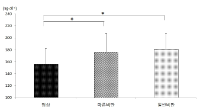
This study was designed to compare physical fitness, blood lipids, and insulin resistance according to body mass index (BMI) and percent body fat (%BF) in 20s females. Sixty women, aged 20-29 yrs, volunteered to participate in the study as subjects. There were three groups, i.e., normal group (BMI < 24 kg·m-2 and %BF < 25%; n = 25), normal weight obese group (BMI < 24 kg·m-2 and 28% < %BF < 40%; n = 22), and obese group (BMI > 26 kg·m-2 and 30% < %BF < 40%; n = 13). Physical fitness, blood lipid profiles, and surrogate indices of insulin resistance were measured and compared among three groups. Main results of the present study were as follows: 1) There were significant differences in all variables regarding body composition among three groups. All values were lowest in normal group and highest in obese group. 2) There was significant difference in sit-and-reach among three groups, whereas no significant differences were found in other variables regarding physical fitness among three groups. 3) There were significant differences in all variables regarding blood lipids among three groups. In particular, total cholesterol (TC), low density lipoprotein cholesterol (LDL-C), TC/HDL-C ratio, and LDL-C/HDL-C ratio were significantly higher in normal weight obese group than normal group. 4) There were significant differences in all variables regarding insulin resistance among three groups. Fasting plasma glucose and HOMA-IR were lowest in normal group and highest in obese group. It was concluded that there would be abnormal blood lipid profiles and insulin resistance in even normal weight obese individuals as well as general obese individuals in 20s females.

This study was designed to investigate the effects of increment of physical activity for 12 weeks through aerobic exercise training or change from own vehicle to public transportation for commuting on physical fitness, insulin resistance, inflammatory markers, and liver function in middle-aged men. Forty-four subjects, aged 30-50 yrs, were randomly assigned to either one of three groups, i.e., aerobic exercise training group (TR: n=14), change to public transportation group (PT: n=15), or control group (CON: n=15). Subjects in TR performed aerobic exercise for 30 min per sessions, three sessions per week, subjects in PT changed from their own vehicle to public transportation for commuting, and subjects in CON maintained their life patterns during the same intervention period. Physical fitness, insulin resistance, inflammatory markers, and liver function were measured at pre- and post-test, and the data were analyzed by repeated two-way ANOVA. Main results of the present study were as follows: 1) All variables related to physical fitness improved significantly in TR. Right grip strength, standing long jump, side step test, and sit-and-reach improved significantly in PT. 2) Although there were no significant changes in all variables related to insulin resistance, the variables tended to be improved in TR and PT. 3) TNF-α decreased significantly in TR and PT. IL-6 and CRP tended to be improved in TR and PT; however, the changes did not reach statistical significant level. 4) ALT decreased significantly in PT. AST and γ-GT tended to be improved in TR and PT; however, the changes did not reach statistical significant level. It was concluded that the 12 weeks of change to public transportation as well as aerobic exercise training would be beneficial for physical fitness and inflammatory markers. These interventions also would be possible to improve insulin resistance and liver function. The increment of physical activity through change from own vehicle to public transportation was found to be equally beneficial for health promotion compared to aerobic exercise.
It has been known that β-alanine supplementation induce the increment of carnosine in vivo and was effective in delaying fatigue by buffering the hydrogen which was formed during exercise. This study was designed to investigate the effects of 4 weeks of β-alanine supplementation on physical fitness and blood lactate concentration in middle school soccer players. Nineteen middle school soccer players were randomly assigned to either one of two groups, i.e., β-alanine group (n=10) and placebo group (n=9). Subjects in β-alanine group consumed β-alanine 2 g/day during 1st and 2nd week, as well as 3 g/day during 3rd and 4th week, whereas subjects in placebo group consumed maltodextrin in the same manner. All subjects ate same menu and trained same amount at the same training camp during the intervention period. Body composition, aerobic capacity, anaerobic capacity, isokinetic function, and blood lactate concentration during maximal GXT were measured at pre- and post-test. Main results of the present test were as follows: 1) Fat mass and percent body fat decreased significantly in β-alanine group. 2) No significant changes were found in variables related to aerobic capacity in both groups. 3) Average power increased significantly in β-alanine group. 4) Isokinetic muscular endurance increased significantly in β-alanine group. 5) Blood lactate concentration did not change in eithet group; however, blood lactate concentration immediately after maximal GXT in β-alanine group tended to be increased more than placebo group. It was concluded that β-alanine supplementation would have positive effects for improvement of body composition, anaerobic capacity, and muscular endurance in middle school soccer players.

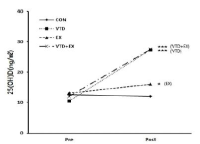
The objective of this study was to investigate the effects of 12-weeks of vitamin D supplementation and circuit training on skeletal muscle mass in elderly women with type 2 diabetes mellitus and vitamin D deficiency. Forty eight elderly women with type-2 diabetes mellitus and vitamin D deficiency were randomly assigned to control(n=10), vitamin D supplement(n=11), exercise(n=12), and vitamin D supplement+exercise(n=15) groups. Dependent variables were measured before and after the 12-week interventions. Major outcomes included body composition, fasting glucose, insulin, and 25(OH)D concentration. ASM(apeendicular skeletal muscle mass), SMI(skeletal muscle mass), and HOMA-IR (homeostasis model for insulin resistance) were calculated. Women assigned to the vitamin D supplement consumed 1,200 IU of vitamin D orally per week for 12 weeks. Women assigned to the exercise intervention performed a circuit training at an intensity of 60%~80% of HRmax with a frequency of 3 days per week for 12 weeks. Compared to control group, all groups had significant loss of body weight and increases in serum 25(OH)D after the 12-week intervention. ASM and SMI increased significantly in only vitamin D+exercise group. Regardless of treatments, no significant group differences were found in changed scores of fasting glucose, insulin, and HOMA-IR. In conclusion, vitamin D + exercise would improve the loss of ASM and SMI compared with vitamin D or exercise alone.