
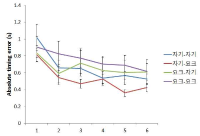
Purpose The present study was set up to investigate the effect of self-regulated learning and selection of feedback on learning of the relative and absolute timing. Methods 48 university student volunteers participated in the experiment and were randomly assigned four groups (n=12 for each) depending on practice task and feedback, namely: 1) self-regulated practice task - self-controlled feedback (self-self), 2) self-regulated practice task - york-controlled feedback (self-york), 3) york-regulated practice task - self-controlled feedback (york-self), and 4) york-regulated practice task - york-controlled feedback (york-york). The task was to examine the temporal timing error and the task goal was to press a computer keyboard 'J' and 'K' alternatively corresponding to time set. Prior to the experiment, the participants had a pre-practice session and then practiced one of three timing tasks provided by an experimenter in the acquisition phase. There were two transfer test to assess adaptability aspects of performing changes related to learning after 24 hours of the acquisition phase. Serial practice was applied in the transfer 1 and an effector transfer was examined in the transfer 2. The dependent variables were a relative timing error that is susceptible to discrepancy between the participant’s key press and the goal patterns and an absolute timing error that is susceptible to discrepancy in the time required to perform the sequence compared to the goal absolute time. Results The results showed that in the pre-test there was no significant difference in both the relative and absolute timing error across four groups. However, in acquisition phase there was a significant difference in both the relative and absolute timing error across block. The relative timing error was different across the group in the transfer test 1, however it was different only between the self-self and york-york group. Lastly, the absolute timing error was not different across the groups in the transfer test 2. Conclusion The findings revealed that the self-regulated strategy is effective to learn the relative timing in the effector transfer.





Purpose Lock and Heere (2017) argued that two different theories of social identity theory(SIT) and role identity theory have been used in previous studies of team identification. However, they failed to provide why such phenomenon existed in the literature of team identification. Thus, the first purpose of the study is to provide the possible reasons why the two theories were used as the ground of team identification in the previous literature. In addition, the current study examined whether team identification was properly developed from SIT by incorporating the cases of organizational identification and consumer-company identification in business literature. Results & Conclusion There are two possible explanations on why the two theories have been used in team identification studies. First, in the initial studies of team identification, theoretical ground of team identification was lacking. Thus, without a firm theoretical guidelines, authors might have used the two theories as the ground of team identification. Second, as previous literature noted, the two theories are like the two different sides of a single theory. Thus, authors may have not recognized the need of differentiating the two theories and used the two theories as the ground of team identification. This study also examined whether team identification was properly developed from SIT. The social category in team identification includes two different social identities(team members and fans), which is quite different from a social category with single identity in it. The locus of social category of team was arbitrarily expanded to include fans in the same category. This case is quite similar with consumer-company identification in marketing literature. Future study needs to examine whether the locus of social category can be expanded to include two different social identities.
PURPOSE This study analyzed the effect of dynamic lumbar kyphosis on the biomechnical factors affecting the lumbar joints during deep squats. METHODS Thirty adults in their 20s who had experienced weight training for more than one year participated in this study (age: 23.4±3.5years old, height: 175.3±4.3cm, weight: 75.8±6.5kg, squat single repetition maximum (1RM) weight: 115.3±19.5kg). Under both restricted dynamic lumbar kyphosis (RDLK) and dynamic lumbar kyphosis (DLK), subjects completed one repetition of deep squats at a load of 70% of their 1-RM weight. To verify the consistency of deep squat movements performed under DLK and RDLK conditions, intra-rater reliability was analyzed using intra-class correlation . The biomechnical variables of the lumbar joint were calculated during DLK and RDLK deep squats. Paired sample t-tests (IBM SPSS 27.0, Armonk, New York, USA) were used for statistical verification. RESULTS During the deep squat movement performed in DLK and RDLK conditions, the peak angles of the ankle, knee, and hip joints, the minimum height of the pelvis, and the time and tempo showed statistically high reliability, confirming the accuracy of the movement. The peak flexion angle and moment, left flexion moment, left rotation moment, and compression force factors of the lumbar joint during deep squat were significantly lower in RDLK than in DLK. CONCLUSIONS Restricting lumbar dynamic kyphosis during deep squats is essential for decreasing the risk of lumbar joint injury.
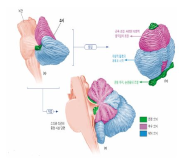
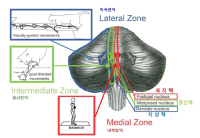
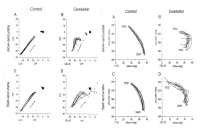
The cerebellum is one of the major parts of the brain involved in the motor control including motor coordination, muscle tone, balance, and the learning of motor skills. The purpose of this review paper was to explore of pathophysiology, anatomical function and neurophysiological mechanism for cerebellum. For this, we sought to examine of previous study related cerebellar disease. Specifically, this paper suggested that motor deficiency of limb movements, coordination, gait/posture balance, adaptation of during movement execution through information proprioception or kinaesthesia, and motor planning and programming of cerebellar patients. We expect that this review will be able to offer the useful information to research. For example, movement scientists will provide an academic information about cerebellar ataxia. Patients and their families will provide relevant information to the daily life (e.g., management and rehabilitation exercise).


PURPOSE This study was to examine safety awareness of sports among university students. METHODS Total 1950 university students of 9 regions responded to questionnaires on safety awareness of sports with using simple random sampling. The date were analyzed by frequency analysis and Two-way ANOVA. RESULTS The results of this study werew as follows: Fistly, male students were experienced safety awareness education more than female students. In addition, the education of safety awareness of sports took place in sports field, but most of students did not aware of safety personnel. Secondly, university students thought that sports was not safe because sports facilities and equipments were not managed and they were worn out. Thirdly, they perceived sports safety was managed generally normal. Furthermore, they perceived the aging of facilities and equipments at sports sites was major factor in the occurrence of safety accidents. In order to reduce sports safety accidents, it is necessary to facilitate safety education of sports at government. CONCLUSIONS The results of this study will be used as fundamental information to raise safety awareness in university students and to establish safe sports culture.

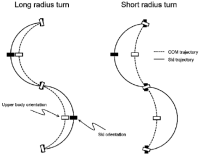
Purpose The purpose of this study was to investigate the three dimensional joint angles of the ankle, knee and hip during basic long turn, carving long turn, basic short turn and carving short turn. Methods Fourteen alpine ski instructors from Korea Ski Instructor Association participated in this study. Each skier asked to perform 4-types of turning technique, classified by radius and level. 8 inertial measurement units were used to measure three-dimensional joint angles of the ankle, knee and hip joint. Results Significant differences were found the lower extremity joint angles on the mediolateral and vertical axis during long-turn and carving-turn (p<.05). significant differences were found the lower extremity joint angles on the anteroposterior axis in the steering phases 1, 2 and complete phase (p<.05). Conclusions In the Alpine skiing, the short turn requires a complex movement of the lower limb joint compared to the long turn. When performing a long turn, the movement of the ankle joint on the vertical axis are required compared to the short turn. And the carving and short turn need to the movements of the lower limb joint on the mediolateral axis.

PURPOSE This study aimed to analyze the differences in ground reaction forces (GRF) and pelvis and trunk kinematic patterns between groups based on ball speed during pitching. METHODS Twenty-nine males were recruited for this study. Participants were categorized based on ball speed into high (HG), medium (MG), and low (LG) ball speed groups. Statistical analysis was performed using one-dimensional statistical parametric mapping (SPM1D) one-way analysis of variance to compare GRF and pelvis and trunk kinematic patterns, followed by Bonferroni post-hoc tests. RESULTS Drive leg anterior and resultant GRF were greater in the HG than in the LG (p<0.001). The posterior GRF of the stride leg in the HG was greater than in the LG (p<0.008). Additionally, the vertical GRF of the stride leg was greater in the HG than in the LG (p<0.003), as was the resultant GRF of the stride leg (p<0.003). CONCLUSIONS The GRF of the drive and stride legs was significantly related to ball speed, indicating that a pitching strategy to maximize the GRF of the drive and stride legs is required.
PURPOSE This study sought to analyze the velocity and asymmetry between bilateral lower extremity mechanics according to the load during walking. METHODS A total of 14 adults with right leg dominance participated in this study (Male=7, Female=7). We respectively applied 30% of body weight load carriage on the subjects. Gait characteristics were analyzed with 3-dimensional cinematography and ground reaction force (GRF) system consisted of a center of gravity (COG) velocity, center of pressure (COP) area, leg stiffness, and GRF components. RESULTS Change in velocity of the maximum-minimum COG showed statistically significant in the main effect of load. The 1st anterior-posterior GRF (braking force) and vertical GRF were statistically significant in the main effects of load and bilateral lower limbs. The 2nd anterior-posterior GRF (propulsive force) was statistically significant in the main effect of load. COP area and leg stiffness exhibited statistically significant differences in the main effects of load and bilateral lower limbs. Interaction was observed in the vertical GRF, COP area. Furthermore , one-way variance analysis revealed load main effect had a greater influence on the increase in the magnitude of the vertical GRF and COP area than the asymmetry of bilateral lower limbs. CONCLUSIONS This study revealed the differences in asymmetry between the dominant and non-dominant lower limbs according to the load during walking. These findings may explain the differences shock attenuation and stress mechanisms between the bilateral lower limbs.

Purpose This study was to explore construct of fear and courage behavior overcoming the fear and relationship between fear and courage in competition. Methods Total 65 national athletes of combat sports(Judo, Boxing, Taekwondo, Fencing) responded to open questionnaire about fear and courage behavior in competition. The data was analyzed by triangle verification and content analysis. Results Firstly, the fear of combat sports athletes consisted of five factors, which were negative consequences, lack of preparation for a game, concerns of performing one’s best, expectation of significant others, and internalized ego threat. Secondly, courage behaviors to overcome fear were self-effort, self-suggestion, self-conviction, selfish self-regulation, social self-control, self-analysis, and acceptance of experience. Finally, there were the relationship between fear and courage in competition. Conclusion These results will contribute to provide useful information for combat sport athletes and coaches in different level to cope with competition fear.
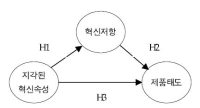
The Purpose of this study was to examines the effect of smart sport wear's innovation attribute on product attribute, focused on innovation resistance. Data were drawn from 253 college students and graduate college students in three different university. The model was tested using SPSS/PC ver. 18.0 for windows and AMOS 20.0 program. Data were analyzed using frequency analysis, reliability analysis, confirmatory factor analysis, correlation, and structural equation modeling techniques. The statistical significance level was set at a<.05. The results were as follows. First, perceived attributes of smart sport wear had a negative effect on innovation resistance. Second, innovation resistance had a negative effect on product attribute. Third, perceived attributes of smart sport wear had a positive effect on product attribute. Forth, innovation resistance partially mediated the relationship between perceived attributes of smart sport wear and product attribute.


