Purpose The purpose of this study is to examine the socio-cultural background and the current issues of camp training system. This work could find the reason why camp training is continuing despite the regulatory policy. Methods This study compared past national and social situation, sports and education policies of each government, and the changes of sports paradigm through literature review. Results The settlement background of camp training system was explained by the national situation in 1970s and the elite sports policy. However, after the political democratization, the human rights ideology as universal value has developed, and the anti-human rights system which individuals sacrifice for the realization of community became not free in the school sports. Especially, since the 2000s, various social problems caused by camp training have been discussed and the school sports system is undergoing transition under various regulation. In this process, the conflict between the policy makers and the subjects is intensifying. The partial regulation, rather than radical reform, has been the cause of conflict without resolving 'the remnants of past elite sport policy'. The current regulation is limited to the "partial regulatory system", omitting fundamental changes such as the revision and abolition of the student-athletes' college entrance system. Conclusion This study presented two issues to normalize school sports. First, it is necessary to discuss the revision or abolishment of the student-athletes' college entrance system. Second, the existing school athletic system should be transformed into a future-oriented club system. By solving these problems, we can expect the policy effectiveness of current regulation and it will be able to reach the future that the regulatory policy are aiming at.

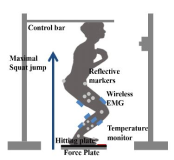
The human foot is only part that directly contact between the body and the external environment, and is ideally positioned to provide sensory information to the Central Nervous System (CNS) during static and dynamic tasks. Through cutaneous mechanoreceptors located in the dermis, the foot is able to recognize touch pressure and vibration stimuli, which provide important feedback information used for the fine coordination of movements. The purpose of this study is to quantitatively examine the effect of changing the foot cutaneous sensory by temperature stimulus on maximal performance and muscle activation using wavelet technique. Sixteen healthy subjects volunteered to participate in this study (Male: Age 21.4±2.4years; Height 174.7±5.3츠; Weight 70.6±5.2kg; Female: Age 20.5±0.6years; Height 163.2±3.1cm; Weight 55.6±4.8kg). Sensory pressure thresholds were determined for the plantar surface of the foot using monofilament. Kinematic, kinetic and EMG data which relative to maximal performance were collected while squat jumping in each temperature condition(cool 12-15℃ normal 28-30℃ hot 45-48℃). Maximal jump height was significant higher in normal condition. Vertical GRF in normal condition showed higher peak value the other conditions. And then EMG signal were significant different between temperature conditions during maximal performance. By changed sensory feedback on temperature, one can alter maximal performance and muscle activation pattern. Cutaneous feedback is important in performance and neuromuscular control, and temperature changes significantly influence on lower extremity during maximal squat jump performance of healthy subjects.


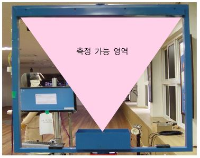
The purpose of this study was to investigate basal physical fitness and smash speed of elite national badminton players. To perform this study, total forty six korea national badminton player were participated : twenty two male players(age : 20.90±2.24years, height : 179.30±5.40cm, weight : 73.80±7.12kg, career : 11.27±1.88years) and twenty four female players(age : 19.45±1.95years, height : 167.83±4.36cm, weight : 61.39±3.60kg, career : 9.50±2.47years). Each subjects performed the 6 basal physical fitness trials : agility, muscular endurance, muscular strength, flexibility, balance and cardiorespiratory endurance. And the speed of badminton smash were analysis by using radar gun when players were standing smash success. To determine the difference between two groups, independent samples test was used. As a result, we found that there was a large difference male players and female players in basal physical fitness and smash speed. First, male players were significantly strong in agility(side step 10%), muscular endurance(repetitional jump 12%), muscular strength(left grasping power 3%, right grasping power 31%) and cardiorespiratory endurance(20m suttle run 31%). On the other hand, female players were relatively strong in flexibility(sit and reach 27%) and balance(standing on one leg with eyes closed 51%). Second, maximum smash speed show that male players were about 57km/h(24%) faster than female players(male : 247.72km/h, female : 190.37km/h). Based on the findings, we shall be applicable training program to improve flexibility, balance of male athletes and agility, muscular endurance, muscular strength, and cardiorespiratory endurance of female athletes. our results will be appliable to improve the athletic performances of national badminton players by the coaches in the future.
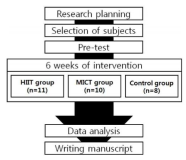
The primary purpose of this study was to investigate the effects of 6 weeks of high-intensity intermittent training (HIIT) and moderate-intensity continuous training (MICT) under relatively equal energy expenditure on body composition, aerobic capacity, cardiovascular function, insulin resistance, and blood lipid profiles in 20s overweight males. Twenty-nine males were randomized into one of the following groups: HIIT group (n=11), MICT group (n=10), and control group(n=8). Subjects in HIIT group completed 6 weeks of training for 25 min/sessions, three times/wk, and subjects in MICT group exercised for 33 min/session to equalize the energy expenditure with HIIT group. Subjects in control group were asked to maintain their normal life pattern during the same intervention period. Data were analyzed using two-way repeated measures ANOVA with post hoc test. Main results of the present study were as follows: 1) Body weight, BMI, fat mass, and WHR decreased significantly in HIIT group. 2) VO2max, VEmax, and time to exhaustion increased significantly in HIT group. 3) SBP decreased significantly in HIIT group and HRrest was tended to decrease in HIIT. 4) Fasting plasma insulin and HOMA-IR were tended to decrease in HIIT, but the changes failed to reach the statistically significant level. 5) HDL-C and TG were tended to improve in HIIT, but the changes failed to reach the statistically significant level. Results indicate that high intensity intermittent exercise training is more beneficial in aerobic capacity and cardiovascular function. It was also suggested that 6 weeks of aerobic exercise training in either high intensity intermittent or moderate intensity continuous was not sufficient enough to induce changes in body composition, insulin resistance and blood lipid profiles.
Impact of 9-week strength training of racing cyclist candidate during training camp on body composition, racing cyclist specific fitness, and racing cycle performance was examined. Two by two (cyclist experience, y/n and strength training (ST) participation, y/n) experiment design was employed. A total of 20 candidates participated and divided evenly into four groups; 1) experienced cyclist participating ST (CST), 2) non-experience cyclist participating ST (nCST), 3) experienced cyclist no participating ST (CnST), and 4) non-experience cyclist no participating ST (nCnST). Two programs were introduced; 1) non ST containing, pre-existing program emphasizing on sprint and acceleration training and 2) new-program containing ST and sprint and acceleration training. CST and nCST participated the latter program. Before and after the 9-week training, body composition, racing cyclist specific fitness, and racing cycle performance was tested. After 9 weeks, all groups decreased body weight(p<0.05), body fat content(p<0.05), body mass index, and CST and nCST increased lean body mass(p<0.05). Muscular strength measures such as grip strength, low back strength, 1RM of bench press, 1RM of squat, and anaerobic capacity improved after 9 weeks in all groups(p<0.05). The magnitude of changes was greater in order of CST, nCST, CnST, nCnST. Time trial of 200 meter sprint was faster after 9 weeks in all groups except CnST while 500 meter sprint was improved only in nCnST(p<0.05). After 9 weeks, regardless of previous cyclist experience, those who participated in ST ranked high places at racing cycle competition. Both training programs for the candidates improved body composition and racing cyclist specific fitness. When strength training was added to pre-existing training program emphasized on sprint and acceleration, the racing cycle performance was enhanced. Strength training for racing cyclist is highly recommended to improve their racing performance.
PURPOSE This study aimed to characterize the kinematic variables of stair climbing in adult women by analyzing the effects of varying heel heights on their climbing behavior. METHODS A total of 24 adult women (age: 22.08±1.28years; height: 160.43±4.30cm; weight: 54.10±6.39kg) participated in this study. All subjects wore the same type of high heels with heights of 1cm, 5cm, and 7cm while performing stair climbing on stairs measuring 18cm in height. Ten infrared cameras (200Hz) and ground reaction force sensors (1000Hz) were set up on the stairs, along with an 8-channel electromyography system (1000Hz) to analyze the maximum moments at each joint and the muscle activation during stair climbing. Data were analyzed using IBM SPSS Statistics version 27.0 (IBM., USA). All variables underwent the Shapiro–Wilk normality test, with repeated measure analysis of variance or the Friedman test applied based on the results. Post hoc tests were conducted using the LSD test or Wilcoxon signed-rank test. RESULTS Our study found four key findings. First, a significant decrease in maximum dorsiflexion, plantarflexion, inversion, and adduction moments of the ankle joint was observed with increasing heel height. Second, the maximum extension, adduction, and external rotation moments of the knee joint significantly decreased as heel height increased, while the maximum abduction and internal rotation moments significantly increased. Third, the maximum flexion, extension, and abduction moments of the hip joint significantly increased with higher heel heights. Fourth, muscle activity of the rectus femoris, vastus medialis, vastus lateralis, semitendinosus, and gastrocnemius decreased with increasing heel height compared to walking; however, muscle activity in the tensor fasciae latae increased. CONCLUSIONS The results of this study suggest that as heel height increases, the risk of injury may rise due to limited ankle use and increased moments in the knee and hip joints, potentially leading to muscle strength imbalances in adult women, particularly through the overuse of specific muscles.
PURPOSE The aims of this study were to prospectively investigate the seasonal incidence and epidemiological characteristics of sports injuries according to peak height velocity (PHV) status among Korean male adolescent soccer players and to examine the interaction effect between maturity and activity type on detailed injury patterns. METHODS A total of 70 middle-school soccer players participated in this prospective cohort study. Based on 6-month height velocity, players were categorized into Circa-PHV (n=43) and Post-PHV (n=27) groups. Details regarding anthropometrics, exposure hours, and all musculoskeletal injuries were collected using the IOC Injury and Illness Surveillance Guidelines. Injury incidence (per 1000 athlete-exposures, AE) and relative risk were analyzed using Poisson regression and descriptive statistics. RESULTS A total of 125 injuries were recorded. Poisson regression revealed no significant main effect of maturation on overall injury incidence (p=.944). However, a significant interaction effect was detected between maturation and activity type for noncontact injuries (p=.020), with the Circa-PHV group exhibiting the highest incidence during matches (84.39/1000 AE). Matches posed a 15.6-fold higher injury risk than training (IRR=15.59, 95% CI: 10.49–23.18, p<.001). Regarding injury types, the Post-PHV group showed a 2.5-fold greater risk of muscle strains than the Circa-PHV group (IRR=2.46, 95% CI: 1.09–5.53, p=.029). CONCLUSIONS PHV is a critical determinant of injury risk and patterns in adolescent soccer players. Circa-PHV represents a vulnerable window for noncontact injuries under high-intensity match demands, and Post-PHV is characterized by a transition toward increased muscle strain risks. These results emphasize the need for maturation-informed load management and individualized prevention strategies to ensure athlete safety and long-term performance.
PURPOSE This study investigated the associations among sociodemographic factors, physical activity (PA) types and frequencies, and various mental health indicators among adolescents. METHODS Participants included 45,006 adolescents who answered the online 2024 Korea Youth Risk Behavior Survey. Mental health– related variables, such as perceived sadness and despair, suicidal ideation, perceived loneliness, and generalized anxiety disorder diagnosis, were analyzed in relation to sociodemographic factors. Associations with PA type and frequency were examined as well. The data underwent simple and multiple logistic regression analyses, and odds ratios with 95% confidence intervals were calculated. RESULTS First, sadness and despair perceptions significantly differed by gender, academic achievement, residence type, student classification, and study time. Adolescents who performed low-intensity PA ≥4 days per week and high-intensity PA 1–3 days or ≥4 days per week had significantly lower odds of experiencing sadness and despair. Second, suicidal ideation was significantly associated with gender, academic achievement, socioeconomic status (SES), residence type, urban vs. rural classification, student classification, and study time. Adolescents who engaged in low-intensity PA ≥4 days per week and high-intensity PA 1–3 days or ≥4 days per week displayed a significantly lower likelihood of suicidal ideation. Third, loneliness perceptions significantly varied by gender, academic achievement, economic SES, type of residence, urban vs. rural classification, student classification, and study time. Engaging in low-intensity PA ≥4 days per week was significantly associated with lower odds of perceived loneliness. Finally, the diagnosis of generalized anxiety disorder was significantly associated with gender, academic achievement, SES, residence type, student classification, and study time. Performing low-intensity PA ≥4 days per week and high-intensity PA 1–3 days or ≥4 days per week was significantly linked to a lower likelihood of a generalized anxiety disorder diagnosis. CONCLUSIONS Regular PA is an effective strategy for promoting adolescent mental health; specifically, appropriate exercise intensity and supportive environments for adolescents’ PA play a critical role in improving their mental health.

Purpose This study was designed to develop a team building program that helps freshmen student-athletes to adapt to college life and enhance team function and process and to examine the effects of this program. It could provide basic information of a team building program that effectively accelerates team function in the college team sports domain. Methods The program was developed through this process. First, an open-ended questionnaire was utilized to discover the needs of the program. Second, the results of needs of the program and important factors of team-building program were taken into consideration. Third, expert meetings were conducted. Consequently, the program consisted of three stages of total 10 sessions which was 90 min long. The questionnaires(Group Cohesion Questionnaire and Coach-Athlete Relationship Questionnaire), experience report, and program evaluation form were used as measures to identify the effects of the developed program. SPSS version 24.0 and inductive analysis were used to analyze the data. Results The results of this study are as follows. First, there was no statistically significant influence between developed program and the level of group cohesion. In contrast, the level of coach-athlete interaction was significantly increased. Second, the analysis of experience report revealed that this program reduced interpersonal conflict between team members and formed positive interpersonal relationship by mind of respect and consideration. Conclusion In conclusion, the hierarchical culture was strongly formed and team member suffered from the dual role of athlete and student in Korean college team sports. Thus, these should be resolved in order to enhance team function and process. As a results, this process could increase team performance as well as offer psychological stability to college student-athletes.

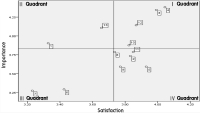
Purpose The purpose of this study is to grasp consumers' perception of badminton racket brand image using MDS and ISA. Methods To do this, we conducted questionnaires on those who participated in badminton and had experience of participating for 6 months or more in Seoul and Gyeonggi province from April 12 to 28, 2017, selected and analyzed a total of 313 copies as valid samples of this study. Results The results of study are as follows. First, as a result of MDS analysis, it showed that only the price of brand image attributes were in order of Trion > Joobong > Lining > Victor > Yonex, and the other attributes(Design, Functionality, Quality, Awareness, Advertising image, Event, Color, Popularity, Sophistication, Originality, Trust, Service) were in order of Yonex > Victor > Lining > Joobong > Trion. Second, as a result of ISA analysis, in I quadrant, Yonex showed functionality, quality, sophistication, and trust and Trion showed price, design, functionality and quality, Victor showed price, design, functionality, quality, color, sophistication, trust, service, and Joobong showed price, functionality, quality, and trust in this area. In quadrant Ⅱ as concentrated area, Yonex showed price and service, Trion showed color, trust, service, Victor showed price, Lining showed trust and service, and Joobong showed service in this area. In quadrant Ⅲ as low rank, Yonex showed advertising image, event, Trion showed awareness, advertising image, event, popularity, sophistication, originality, Victor showed advertising image, event, popularity, originality, Lining showed awareness, advertising image, event, popularity, originality, and Joobong showed design, advertising image, color, popularity, sophistication in this area. In quadrant IV as excess avoidance, Yonex showed design, awareness, color, popularity, originality, Victor showed awareness, Joobong showed awareness, event, originality in this area.