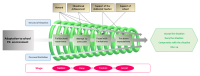
PURPOSE This study identified a company sports club’s dual characteristics— both for leisure activity and as an extension of work—to provide comprehensive interpretation and understanding of such clubs. METHODS A qualitative case study design was employed, incorporating in-depth interviews, nonparticipant observation, and supplementary data collection from 25 office workers who had participated in an in-house sports club for at least one year. RESULTS Participants reported a wide spectrum of motivations, from voluntary motives such as stress relief and health improvement to more obligatory or organizationally driven motives, including pressure from supervisors or colleagues and expectations related to performance evaluations. The club offered both team sports—which fostered teamwork and a sense of belonging—and individual sports—which offered personal development opportunities. However, some participants experienced blurring of work–leisure boundaries and reemergence of hierarchical organizational culture, leading to conflict and fatigue. CONCLUSIONS Overall, Although company sports clubs have become a welfare program that provides employees with opportunities for leisure and self-development and promote inter-departmental communication and collaboration, they also carry the latent risk of imposing additional burdens and pressures on employees. These findings underscore the need for refined operational strategies and institutional improvements to mitigate negative outcomes and maximize such programs’ original intent.
Purpose This study is a phenomenological research which tries to describe the subjective experience and to analyze multi-layered meanings, and it finds out the men's training experience and meaning. The purpose of this study is to investigate why the men do Yoga and what the subjective meaning of Yoga experience, and the study examines critically whether Yoga experience especially focused on women is against gender performance and dominant body discourse. Methods For the study, 6 middle & young-old aged men who do Yoga more than 6 months every week are selected as participants. Results The meaning of Yoga for middle & young-old aged men in their lives is as follows. First, it is hard for men to experience Yoga because of social and cultural background. Finding Yoga class which takes men's membership is difficult. Second, middle & young-old aged men's physical feature(interest in their health and disease) and personal background(women friendly daily life) become specific motivation to overcome the barrier to do Yoga. Third, Yoga is 'alterative training', not a training. Yoga is considered as a training which replaces the feature of training called men's sports previously. Fourth, Yoga has a meaning of 'healing' to have our own time. Fifth, Yoga is changed by itself in Yoga culture which is focused on women even though middle & young-old aged men do Yoga for a long time. Sixth, middle & young-old aged men realize that the feature of Yoga is not 'for only women', and they thought it is 'neutral training that men can do too.' Conclusion Consequently, the reason why middle & young-old aged men do Yoga is started from the motivation regarding physical characteristics and personal background, and the main purpose is to cure and to heal our bodies and mind. For them, Yoga means 'alternative training to fit their bodies' and 'their own time'. Moreover, old male adult's training experience and meaning are against gender performance in that it cause a crack in stereotyped gender sports area, but it is notable that there is no intention to resist the dominant gender body discourse.

Purpose The purpose of this study is to look into the life of MTB college athletes before and after their college entrances through long-term longitudinal narrative inquiry and investigate how the career exploration after graduation is conducted in a contextual way. Methods For this study, four MTB college athletes who entered the university as specialists are selected as research participants, and their life and career are examined through a long-term longitudinal narrative inquiry. Results As a result, the life and career of MTB college athlete appear as follows. First, MTB college athletes entered MTB because of 'self - will' or 'influence of family and acquaintances' and the motivation is 'extension of hobbies', 'college entrance', etc. Second, the MTB college athletes' training and goals are set in the 'college entrance examination', which means the entrance to higher college. Third, MTB college athletes' college life is closely related to 'management and support system for college athletes', and the career search for them is based on 'the prospect as a player' and 'professional prospect of MTB athletes’. However, MTB college athletes showed their plan B to prepare for their uneasy future or to retire. Conclusions In the end, the MTB college athletes came to think about life and career on the narrow stage of unpopular sports and was seen coming down from the narrow stage of unpopular sports. Based on these results, this study presents critical discussions about their life and career of MTB college athletes and seeks implications for the school elite sports in Korea.
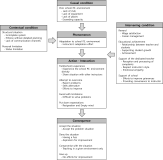
Purpose The purpose of this study is to explore the Instructor’s adaptation process of school P.E. environment in middle school sports club and to develop substantive level theory. Methods For this purpose, 17 sports instructors who had worked for more than 3 years at the middle school in Seoul were selected as research participants. The method of this study is the Grounded theory(Strauss & Corbin, 1990). Results The results of this study are as follows. First, as a result of open coding, the instructor's adaptation process of the school P.E. environment was organized into 104 concepts, 30 sub-categories, and 15 categories. Second, as a result of axial coding, a paradigm model for the adaptation process of the school P.E. environment was formed. Third, as a result of the selective coding, created the storyline of the adaptation process and made the core category, ‘instructor's adaptation process of the school P.E. environment in middle school’. Four types of adaptation process such as 'Acceptance type', 'Effort type', 'Compromising type' and 'Abandoning type' are derived through the formalization applied to the hypothesis of the core category. Conclusions Based on these results, the developed substantive level theory was evaluated and summarized.