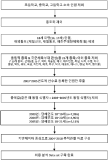
PURPOSE The purpose of this study was to examine the current status and pattern of exercise prescription. In particular, we analyzed exercise prescription trends according to the health-related physical fitness level of Korean adults, using large-scale data from the Korea National Fitness Award program. METHODS This study used healthrelated physical fitness and exercise prescription data collected from the Korea National Fitness Award between January 2018 and April 2023. A total of 475,555 adult participants were included in the analysis. Data processing involved frequency analysis, in which the frequency of each exercise prescription by fitness component was divided by the overall frequency of exercise prescriptions, allowing for the identification of exercise prescriptions specific to health-related fitness. Furthermore, association rules analysis was applied to examine prescription patterns across different fitness domains. RESULTS First, the most frequently prescribed exercises for Korean adults were core-centered activities such as the “sit-and-stand,” “prone hold,” and “sit-ups.” Second, although upper-body-focused muscle strength exercises were commonly prescribed, the overall prescription pattern was still dominated by core-based exercises. Third, exercises specific to muscular endurance and flexibility included “lying leg raises,” “lying arm and leg raises,” and the “lying sky bicycle.” Corecentered flexibility and endurance activities, such as “hip stretches,” “front thigh stretches,” and “abdominal stretches,” were also prevented. Fourth, in the domain of cardiopulmonary endurance, swimming emerged as a distinctive aerobic exercise, particularly prescribed for obesity management. The prescription pattern in this category was characterized by compound training, combining aerobic and resistance exercises. CONCLUSIONS These findings provide foundational evidence for the development of targeted exercise prescription manuals tailored to health-related physical fitness levels. Furthermore, they support the advancement of a personalized exercise prescription system designed to improve the effectiveness of the promotion programs for Korean adults.
Purpose The purpose of this study is to examine the location, rate, cause, and types of injuries according to the injured area by age and sports in female athletes. Methods The subject of the study was 426 female athletes who were registered as combat sports(Judo, Taekwondo, Fencing) athletes at the Korean Sports & Olympic Committee. We collected the data via online questionnaires, and conducted a frequency analysis using R statistics program. Results As a result, 51.4% of athletes experienced injuries in the past year, and the highest injury rate was shown in Taekwondo-University(0.43) during competition and Taekwondo-Professional(5.55) during training. The cause of injuries during competition was mainly due to 'as a result of me or the opponent's hittings, skills, or fouls' among internal factors, and 'recurrent injuries' among external factors. Among internal factors during training except for torso area and professional athletes, most of the injuries were also caused by ‘as a result of me or the opponent's hittings, skills, or fouls’ and ‘recurrent injuries’ among external factors. The frequency of injury was the highest in the lower extremity area across all age groups. The most frequently injured area, in the case of Judo, is skin-bleeding in the head, skin-bruise, muscle-inflammation, bone-fracture, spondylopathy(disc, stenosis, etc.) in the torso, muscle-inflammation in the upper extremity, ligament-sprain, rupture in the lower extremity. Taekwondo athletes had skin-bruise in the head, upper and lower extremities, and muscle-inflammation in the torso area, as the frequent injury cases, and Fencing athletes had all skin-bruise regardless of injuries. Conclusions The results of this study will be used to take measures for preventing injuries or to change training programs.
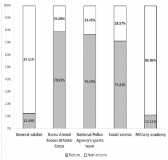
Purpose The purpose of this study is to identify the negative effects of long-term exercise (training and competition) suspension of male elite athletes due to compulsory military service on athletic performance, and to provide a basis for enhancing the importance of providing support systems and social conditions for maintaining athletic performance. Methods In this study, 17,418 male athletes aged 18 to 21 who were registered as athletes for the Korean Sports & Olympic Committee from 2003 to 2005 were enrolled. The athlete registration data includes information about the athlete's gender, age, sport and affiliation. According to the continuity of registration and belonging information, the compulsory military service type was classified into a manipulator. According to the form of Compulsory military service performed by male elite athletes, the return rate was confirmed and the career (year) was calculated. Results As a result of the survey, 12.49% of the athletes who served as general soldiers returned to the athletes after compulsory military service, showing a relatively low return rate compared to 78.91% of the Korea Armed Forces Athletic Corps, 76.55% of the National Police Agency's sports team, and 71.43% of the social service. Also, Athletes who served as general soldiers had a career of 2.46 years (± 1.94), while the Korea Armed Forces Athletic Corps was 10.21 years (± 3.58), the National Police Agency's sports team was 9.45 years (± 3.26), and the social service was 5.86 years (± 4.06), The exemption was 11.08 years (± 2.27), and the compulsory military service exception was 9.79 years (± 5.55). Conclusions Male elite athletes' decrease in athletic performance after compulsory military service is a natural result, as confirmed through the results of this study, and it is necessary to seek a support system between compulsory military service to maintain athletic performance.
Purpose The purpose of this study was to evaluate the moderate to vigorous physical activity(MVPA) and sedentary time measured by accelerometer. Furthermore, the level of physical activity and adherence rate of physical activity guideline(PAG) were compared with the self-reported questionnaire. Methods The MVPA, sedentary time, and adherence rate of PAG according to age and sex were examined to people who agreed to wear accelerometers among the participants of the 2014-2015 Korea National Health and Nutrition Examination Survey. To compare the relationship between accelerometer and self-reported questionnaire, Chi-squared test and Spearman correlation analysis were performed. Results The MVPA of the accelerometer-total(AT) was 40.6 minutes/day for men and 31.1 minutes/day for women. Sedentary time was 502.9 minutes/day for men and 498.9 minutes/day for women. The MVPA of accelerometer-bout(AB) estimates was 16.4 minutes/day for men and 14.2 minutes for women. On the other hand, the MVPA of the self-report was 95.8 minutes for men and 64.3 minutes for women, and the sedentary time was 471.2 minutes for men and 455.2 minutes for women. The adherence rate of PAG was 55.6% of the self-report, 56.1% of the AT, and 21.4% of the AB. The correlation between self-report and accelerometer was statistically significant(p < 0.01), but showed a weak correlation coefficient(rho=0.112-0.351). There was no association between AB and self-report(p < 0.01). The sensitivity and specificity of the self-report were 71.3% and 48.6%, respectively. The positive and negative predictive values of the self-report were 27.5% and 86.1%, respectively. Conclusions As a result of this study, self-reported physical activity level by questionnaire had more MVPA and less sedentary time than the accelerometer-determined physical activity. In addition, the adherence rate of the PAG differed from accelerometer and self-report. The difference was significantly increased when comparing AB with the self-report. Therefore, great care must be taken when interpreting accelerometer and self-report questionnaire. Further research will be needed on specific methods that can be used by complementing the two measurement tools.
Purpose The purpose of this study was to investigate the relationship between physical activity and depression according to the presence of disease. Methods A survey and basic assessment were conducted for 2,754 (Male=1,025 and Female=1,729) aged 40 and over who participated in the rural-based cohort study. The survey included physical activity, depression scale and disease preservation. The basic assessment measured height, weight, and body fat percentage. The measured data were analyzed by using logistic regression to examine the relationship between physical activity and depression prevalence. Results First, physical activity reduced the prevalence of depression by 33% and 51%, respectively, in the general population and in patients with the disease. Second, physical activity once or twice per week reduced the prevalence of depression in patients with disease by 51%, and at least three physical activities reduced the prevalence of depression by 37% in the general population and 33% of patients with disease. Third, physical activity less than 150 minutes per week reduced the prevalence of depression in patients with disease by 43%, and physical activity of more than 150 minutes and less than 300 minutes per week reduced the prevalence of 43% of the general population and 52% of patients with disease. Physical activity over 300 minutes per week had a 38% reduction in the prevalence of depression in the general population. Conclusions This study suggests that the level of physical activity suggested by the ACSM guidelines is appropriate to reduce the prevalence of depression. In addition, the patients with the disease was found to be effective with less frequency and amount of physical activity than the general person.
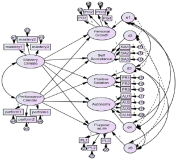
Purpose This study identified the influence of perceived motivational climate on psychological well-being in ballet majors. Methods Participants were 211(male=25, female=186) collegiate students enrolled in ballet department. Measures were The Perceived Motivational Climate in Sport Questionnaire(PMCSQ) and Psychological Well-being Questionnaire. Data were analyzed by using descriptive statistics, reliability test, correlation, and structural equation modeling. Results Results were as follows. First, mastery climate who ballet majors perceive significantly influenced on the five subscales of their psychological well-being: Mastery climate was positively related to personal growth, self-acceptance, positive relation with others, autonomy, and purpose in life. Second, performance climate who ballet majors perceive significantly influenced on the five subscales of their psychological well-being: Performance climate was negatively related to personal growth, self-acceptance, positive relation with others, autonomy, and purpose in life. Model fit indices were acceptable(RMSEA=.070). Conclusion In conclusion, this study indicated that motivational climate who ballet majors perceive was a important situational factor on their psychological well-being.
PURPOSE This study aimed to verify the criterion validity of the two-minute step test in older Korean adults, develop an equation for predicting VO2max, and verify cross-validation. METHODS A submaximal exercise test and the two-minute walk test were performed on 150 older adults (74 males and 74 females) aged 65 years or older. Correlation analysis was performed to confirm criterion validity. An equation for estimating VO2max was developed through multiple regression analysis, and cross-validation was confirmed by performing a correlation analysis between measured and predicted values of VO2max. RESULTS The correlation coefficient between VO2max and the two-minute step test was 0.457 (p<.001). The adjusted R2 of the developed VO2max prediction equation was 0.430 (p<.001), and the explanatory variables finally selected were sex, age, number of steps in the two-minute step test, and percentage of body fat. The correlation coefficient between the measured VO2max (19.08±4.36) and the predicted VO2max (19.73±3.36) was 0.654 (p<.001). CONCLUSIONS This study confirmed the criterion validity of the two-minute step test in older Korean adults, and the cross-validation of the developed VO2max prediction formula was verified. The explanatory variables of the prediction equation will be easy to apply in the field, and more meaningful results will be derived if the validity of the prediction equation developed for a larger number of participants is verified.
PURPOSE The purpose of this study was to investigate the current injury status and traits, including damage area, cause of damage based on the situation, and type of occurrence by age group for middle and high schools, university, and professional athletes, in record competition sports (swimming, track and field, and weightlifting). METHODS The study included 503 athletes enrolled in the Korean Sport & Olympic Committee in 2020, and an online survey was conducted using the R statistical program. RESULTS Approximately 38.4% athletes suffered injuries with weightlifting (0.81 times at university) and weightlifting (7.02 times at university) during training. The lower extremities were the most affected areas in all age groups (53.8% in middle school, 48.6% in high school, 44.4% in university, and 47.4% in professional). The causes of damage found to occur most frequently were ‘lack of physical strength, overuse or lack of rest, and recurrence’ and external factors, including ‘facility programs and weather problems.’ The results showed that internal factors during training were mostly associated with ‘overuse or lack of rest and excessive attempts at skills’, while external factors were found to occur in ‘weather problems’. According to the classification of each event, the top priority of frequent damage according to the damaged area was skin bleeding of the head in swimming and muscle inflammation in the torso and upper and lower extremities. Track and field resulted in muscle inflammation in the head, torso, and upper and lower extremities. Weightlifting caused damage to the head and torso, resulted in spinal diseases (disc, spinal stenosis, etc.), and muscle inflammation in the upper and lower extremities. CONCLUSIONS This study highlighted changes in the training environment and training environment, including level-specific physical training, reinforcement programs, scientific access to specific skills, sufficient rest and recovery, and continuous improvement of facilities and equipment.
