
Purpose The purpose of this study was to investigate the effects of 3 weeks of fencing specific training on physical fitness in elite fencers. Methods Forty eight elite fencers participated in this program (Male= 24, Female= 24). Training program consists of dynamic stretching, step and agility training, and it was conducted with the general fencing practice during 3 weeks. Body composition and physical fitness (muscle strength/power, agility, anaerobic power and flexibility) were measured before and after training. Data were analyzed using IBM SPSS Statistics ver. 23.0 (IBM Co., Armonk, NY, USA). Paired t-test (pre vs. post) was used for comparison between groups. Results Muscle mass and body fat(%) were significantly changed after training in male group. Agility was significantly improved in change-step jump and reaction time after training both in male and female group. In Anaerobic power, peak power (relative power, absolute power) was significantly increased after training in female group. Flexibility was also significantly improved after training in left ankle ROM of female group. Conclusion Application of fencing specific training program focused on fencing movement seems to be effective on agility in both groups, muscle mass and body fat(%) in male group, and anaerobic power and flexibility in female group.



Purpose The purpose of this study was to identify the effect of a power-specific weight training program in order to improve the muscle strength of Korean national team’s freestyle wrestlers. Methods Participants were 13 male athletes in the national freestyle wrestling team. The period of the program was 6 weeks. Muscle strength, muscular endurance, muscle power, flexibility, agility, cardiorespiratory endurance, anaerobic power and isokinetic muscle function were measured. Data were analyzed using IBM SPSS Statistics ver. 23.0 (IBM Co., Armonk, NY, USA). Paired t-test was conducted for comparison between pre-test and post-test score. Results There were significant difference and tendency in the leg isokinetic power and trunk isokinetic flexion strength. However, there was no significant difference in muscle strength, muscular endurance, muscle power, flexibility, agility and cardiorespiratory endurance. Conclusion The 6-week program focusing on the power-specific weight training indicated a significant difference not in every variable but in isokinetic muscle power, speed power and core strength. It is suggested that the training program was applied to the athletes less continuously and not in the long term because of frequent international games abroad and the need for losing weight. Consequently, a year-long training program with personalized methods should be developed to bring about more significant outcomes.
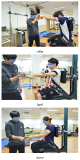
The purpose of this study was to explore and confirm Kumi-kata related factors of muscle strength by performance level in Korea elite female judoists. In order to achieve this purpose, 14 elite female judoists participated to this study. The subjects were divided to two groups (World Class Group and Non-World Class Group) according to their world ranking level(by ranked 30th). The analysis factors were repeated grip strength, Kumi-kata specific pulling strength and isokinetic strength of trunk joint. The results were as follows: Firstly, World Class Group had significantly higher repeated grip strength as compared to non-world class group (p<.001). Secondly, World Class Group had significantly higher specific Kumi-kata pulling strength as compare to non-world class group (p<.05). Finally, The differences between the two groups for isokinetic strength of trunk joint were non-significant. The results of this study indicates that a strong relationship exist between Kumi-kata related specific muscle strength and performance level in korea elite female judoists.
PURPOSE This study aimed to investigate the effects of accelerated rehabilitation exercise on physical fitness, lower extremity isometric strength, and blood variables in older adult women diagnosed with degenerative osteoarthritis. METHODS A total of 29 older adult women diagnosed with degenerative osteoarthritis residing in G city participated in the study, and 19 participants, excluding dropouts, took part in the experiment. They underwent exercise twice a week for 60 minutes per session over a period of 12 weeks. Pre- and post-experiment, the older adult fitness assessment (SFT), lower extremity isometric strength, and blood variables were measured. Data analysis was performed using SPSS 25.0, and paired sample t-tests were conducted to examine the effects before and after exercise. RESULTS The study results showed significant differences in body mass index (BMI) before and after exercise (p<0.05), and the older adult fitness assessment (SFT) showed significant differences in all items (p<0.01). Lower extremity isometric strength showed significant differences in absolute (Nm) and relative (%BW) values of 20° right flexion muscle (p<0.01). In terms of blood variables, significant differences were observed in creatine and ESR before and after exercise (p<0.01). CONCLUSIONS This study’s results suggest that regular physical activity and rehabilitation exercise programs can positively impact the muscular strength, cardiovascular endurance, exercise function, and blood composition of older adult women diagnosed with degenerative osteoarthritis. It is indicated that conducting future research, including periodic exercise programs, could be beneficial in promoting sustained exercise participation.
PURPOSE This study aims to investigate the problems posed by the new “Health Exercise Managers” qualification system implemented in 2015 and suggest a reformation plan for the qualification definition, written test, and practical–oral test. METHODS Eleven experts working in the academia and the exercise prescription field were selected as research participants using purposive sampling method (professors=5, director of sport science division in national research and development institute=1, head of national/private organization that issue Health Exercise Managers certificates=2, and health exercise managers working at university hospitals =3). The results were collected, examined and classified following numerous discussions among the authors. RESULTS First, the qualification definition should be based on “course completion” in the short term and “department certification” in the long term. Second, the written test can be reformed by identifying the core courses related to health exercise management and merging similar or overlapped courses. Also, the grades should be calculated for each question based on the knowledge gained in related courses. Third, the practical–oral test questions should be publicly available in advance to help candidates better prepare and learn practical skills, rather than set the standards for elimination. CONCLUSIONS An overall reformation of the qualification definition, written test, and practical–oral test will solve the problems posed on the quality of the “health exercise managers” qualification system.
