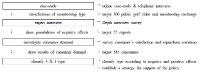
The purpose of this study was to identify problems that consumer and golf expert faced with and determine types of similar golf membership in Korea through analysing status of golf semi-membership. In addition, as the law related to golf facility was examined, current issues to improve management system of golf semi-membership were diagnosed, some improvements were deducted. In order to achieve the purpose of this research, case-study, expert interview, survey, examination of typical legal-system and expert advisory meeting were conducted. The results were as follows: First, the type of golf semi-membership was classified by 7. Second, the result of survey from consumer who experienced in purchasing golf semi-membership revealed that the number of experienced respondents was more than the unexperienced. Also, awareness of golf semi-membership brings positive effect to development of golf industry. According to the result of IPA, it was required that the current situation of golf semi-membership market would be improved and managed properly. Third, the results from investigating legal system in Korea showed that provision for reducing property loss associated with illegal contracts might be needed. Eventually, in order to minimize the property loss, complementary of membership contract, mandatory of information discloser, enacting provisions against violation and introduction of cooling-off system would be required.
The purpose of the study is to find the impact of social and economic factors in physical activity of children and youth. This study utilized the data from 4th Korean Children and Youth Panel Study(KCYPS), and the analysis were carried out based on the starting sample of 2,009 from ‘the elementary 4 panel’ and 1,978 from the ‘middle school 1 panel’ and 1,984 from the ‘high school 1 panel’, 5,971 full data were used in the final analysis. Data were processed using hierarchical regression analysis and it was statistically validated at the significance level of 0.05. First, Pearson r and Spearman ρ showed that all variables are statistically significant correlations. Second, among the first factors of personal and family characteristics, household income level(B=.113), family composition(B=-.049) and parental education (B=.060) were found on a significant impact on the movement of physical activity time, parental education (B=.027) was found on a significant impact on the subjective evaluation of physical education grades. Third, among the second factors of community-level characteristics, Gini coefficient (B=-.810), wealth concentrating (B=.120) were found on a significant impact on the movement of physical activity time, the Gini coefficient (B=-0.315) was found on a significant impact on the subjective evaluation of physical education grades. Additional factors that determine the coefficient of variation in the level 2 were found to be 0.623 and 0.001 respectively. Therefore, second factors of community-level characteristics are added such as Gini coefficient, wealth concentrating were explained to children and youth exercise time during physical activity 62.3%(p<.01) and subjective evaluation of physical education in grades 0.1%(p<.01). predictive power to
This article analyzes and compares the methodologies used in physical activity participation surveys from England, Australia, and South Korea. Specifically, it examines the “2021–22 Active Lives Adult Survey” from England, the “2021–22 AusPlay (15+)” from Australia, and the “2022 National Sports Participation Survey” from South Korea, highlighting both similarities and differences in their approaches. The analysis led to two key insights. First, there is a need to expand the scope of respondents in South Korea’s National Sports Participation Survey. Currently, the survey targets only 0.02% of the population aged ≥10 years, whereas the surveys in England and Australia gather data from a wider age range and more diverse regions. Therefore, South Korea should adopt online, postal, and mobile survey methods to widen the respondent pool and enhance the representativeness and reliability of the data collected. Second, South Korea needs to update its physical activity participation standards. The current benchmarks fall below international recommendations. Establishing new criteria that specify activity duration, intensity, and type is essential for effectively improving public health policies. The results of this study emphasize the importance of accurately assessing and enhancing physical activity participation in South Korea. These findings are expected to contribute to the development of effective sports policy standards in line with the World Health Organization’s global action plan.

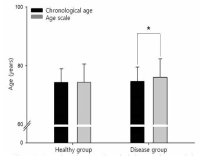
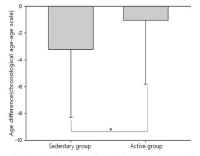
Purpose Evaluating the aging of senior and providing optimal sevices are important things for successful aging. This study identified functional fitness related with heath of aged 65 years or older and developed an age scale (longevity fitness age) for assessing their aging. Methods Participants were 458 older people (166 male, 292 female). They were divided into healthy group and disease group. Healthy group was used for the development of the longevity age equation and disease group was for investigating the validity of the equation. Participants completed 13 function fitness variables. The first principal component obtained from a principal component analysis was used to compute the equation. All variables except for grip strength and carrying beans were correlated with chronological aged. Grip strength and variables related lower functional fitness had differences between healthy group and disease group. Finally, 4 variables were selected for the equation. Results It was the following: longevity fitness age=0.942*X1+2, 185*X2+0.673*X3+0.051*X4+0.588*chronological age+58.401, where X1=standing up from a supine position, sec (s), X2=maximum walking (s), X3=standing up and sitting down a chair (s), X4=one leg balance with eyes open (s). The longevity fitness age of healthy group do not have a difference compared to their chronological age but disease group had a difference significantly. Age difference (chronological age-longevity fitness age) of sedentary group in disease group was significantly bigger than its active group. Longevity fitness age could assess an aging of senior. Conclusion We suggest that it can use as the tool for early detecting senior who need the health care service.

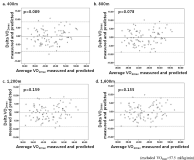
Purpose The purpose of this study was to develop the new indirect method assessing maximal oxygen uptake (VO2max) using heart rate (HR) and accelerometer during walk exercise. Methods One hundred seven participants (55 male, 52 female) performed a graded exercise test to determine VO2max and two types of 1,600 m walk exercises (fast walk and pace controlled walk). The equations for estimating VO2max was developed by stepwise multiple regression. The validity of developed equations tested through the correlation between measured VO2max and estimated VO2max, was assessed by predicted residual sum of squares, and Bland-Altman plotting. Results VO2maxwas correlated with time, and HR/activity count per minute (ACM) measured in pace controlled walk exercise at all distance (400 m, 800 m, 1,200 m, 1,600 m). The equations were valid significantly and their multiple correlation coefficients or standard estimated error were similar to that Åstrand-Rhyming cycle ergometer test or Rockport 1 mile walk test. Using HR/ACM in pace controlled walk (400 m), it was possible to estimate VO2max(R2: 0.675, %SEE: 10.7). The equation was: VO2max=121.659+6.656×Gender-0.865×Age-9.540×Time-2460.952×HR/ACM (Gender, 0=female, 1=male: Time, hundredth of a minute: HR, heart rate: ACM, activity count per minute). Conclusion Estimation equations developed in this study are considered to estimate VO2max through a shorter distance, or a lower intensity of walk exercise. It is required studies to target a wide range of ages or to develop walk test on a lower bpm.

The purpose of this study was to investigate the effect of running economy and energy return in lower extremities according to the increase of bending stiffness of the shoes, furthermore to investigate the relationship between running economy and energy return for the improvement of sports performance. Subjects employed for this study were 10 healthy male college students who have not had the experiences in lower extremities injuries. Four different kinds of shoes in bending stiffness as with 0.56 N/mm, 0.74 N/mm, 0.96 N/mm, 1.21N/mm were used respectively. 3-D cinematography and pulmonary gas analyzer were utilized for energy return and energy consumption data during running according to the increase of bending stiffness of the shoes to obtain the following results. As the bending stiffness of running shoes increased, the statistical significance were not founded, however, the tendency of decrease in max. flexion moment and power, increase in max. extension moment and power in lower extremity joint were showed. Joints energy showed no statistical significance in phase 1, however, the tendency of lesser absorbtion as the bending stiffness of running shoes increased were showed. More energy were generated as the bending stiffness of running shoes increased in phase 2 with no statistical significance. Energy economy increased according to the increase of bending stiffness of running shoes. Negative correlation were showed between flexion moment of hip joint and energy consumption(p<0.05). Slightly higher degree of correlation between max. flexion power of hip and ankle joint and energy consumption were showed without statistical significance. Negative correlation were showed between joints energy and energy consumption for ankle joint in phase 1(p<0.05).

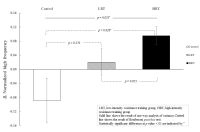
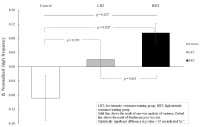
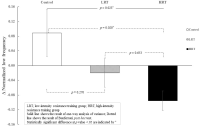
The purpose of this study is to investigate the influence of resistance training with different exercise intensities on heart rate variability(HRV) in habitual smokers. Twenty-eight healthy young smokers participated in this study were randomly divided into three groups; CON(control), LRT(low-intensity resistance training; 50% 1RM), and HRT(high-intensity resistance training; 70%1RM), respectively. LRT and HRT groups performed an 8-week resistance training(4 upper- and lower body exercises) using weight training machines, whereas CON group maintained their regular activities. All groups were evaluated basal body composition, hemodynamic parameters, HRV as autonomic nervous function, and muscular strength (1RM and isokinetic test) before and after the 8-week training. To assess the effect of 8-week training with different intensities on autonomic regulation, time and frequency domain indices of HRV were calculated from 5min R-R interval recording. As results, both LRT and HRT groups increased baseline 1RM and isokinetic strength compared to CON group. Meanwhile, high-frequency power reflecting parasympathetic activity was significantly increased in HRT compared to CON group. In addition, normalized low frequency power(LF nu) indicating a shift of sympathovagal balance towards sympathetic predominance significantly decreased while normalized high frequency power(HF nu) which reflects vagal predominance significantly increased in HRT compared to CON group. Furthermore, improved cardiac autonomic regulation and parasympathetic activation had significant association with increased muscular strength. Overall, the 8-week training has enhanced muscular strength in both training groups, particularly autonomic balance improved in young habitual smokers with high intensity resistance training.
PURPOSE This study aims to investigate the effects of a 12-week equipment-based Pilates training on physical fitness, cardiovascular function, and vascular endothelial function in obese middle-aged women. METHODS Twenty-four women, aged 30-40 years with a body mass index ≥ 25 and percent body fat ≥ 30% were randomly assigned to one of two groups: the Pilates training group (TR; n=12); and control group (CON; n=12). The TR participants underwent three 50-minute equipmentbased Pilates training sessions per week for 12 weeks. Participants in the CON maintained their normal life patterns for the same intervention period. Variables regarding physical fitness, cardiovascular function, and vascular endothelial function were measured and compared pre-test and post-test u a two-way ANOVA with repeated measures. RESULTS The main results of the study were as follows: 1) Regarding physique and body composition, participants’ body weight, body mass index, fat mass, percent body fat, waist circumference, hip circumference, and waist-to-hip ratio decreased significantly in the TR. 2) Regarding physical fitness, muscle strength, muscular endurance, flexibility, and cardiorespiratory endurance increased significantly in the TR. 3) Regarding cardiovascular response, SV increased significantly in the TR. 4) Regarding vascular endothelial function, blood vessel diameter at rest and during vasodilation as well as blood flow volume during vasodilation decreased significantly in the CON, resulting in a significant interaction between group and test in FMD percentage. CONCLUSIONS It was concluded that the 12-week equipment-based Pilates program improved the physical fitness and vascular endothelial function in obese middle-aged women.
PURPOSE This research explores the underlying mechanism that determines how people perceive their goal progress and its relation with their motivation and self-efficacy. METHODS Three hundred and sixty Koreans who participated in an online survey were given salient individual exercise goals (11 workouts), and they reported their self-efficacy, goal progress perception, and motivation. We conducted dummy variable multiple regression analysis (2 [absolute progress-low (27%) vs. high (73%)] X 2 [categorization vs. no-categorization]) and multiple moderated mediation analysis based on Process Model 7 and 21 (Hayes, 2017). RESULTS The findings showed significant interaction between categorization and absolute progress on progress perception. In low progress condition, the categorization group perceived more progress than no categorization group and contrary effect in high progress condition. For motivation, in low progress condition, categorization group was more motivated than no categorization group, and inverse effect in high progress condition. Moreover, there was no direct effect, but only low self-efficacy group played the moderating role between perceived progress and motivation in conditional indirect effect. Lastly, the result indicated significant multiple moderated mediation effect. CONCLUSIONS This research theoretically contributes to the domains of categorization and motivation. Sport marketers can utilize categorization as a strategy by breaking down yearly memberships into monthly categories based on consumers perceptions. Future research can include subsequent motivation after a superordinate goal is completed.
Purpose The purpose of this study was to investigate the effects of aerobic exercise intensity on body composition, health related fitness, and quality of life in elderly women. Methods 48 elderly women over 65 years of age without physical and mental problems were assigned to four groups: control group, low intensity, moderate intensity, and high intensity aerobic training group. The aerobic exercise group applied a heart rate reserve (HRR) to low-intensity group (HRR 40-55%), moderate intensity group (HRR 55-70%), high intensity group (HRR> 70%) for 12 weeks, 3 times a week for 20 minutes a day. Subjects of the control group were to maintain their usual lifestyles during the same intervention period. Body composition, health related fitness, and quality of life were measured and analyzed using repeated two-way ANOVA. Results The main results obtained in this study are as follows. 1) There was a significant decrease in sitting forward bending in the low intensity group and a significant increase in EQ-VAS. 2) There was a significant decrease in body weight, BMI, and 6 minutes walking in the moderate intensity group, and a significant increase in grip strength and EQ-VAS. 3) The high intensity group showed a significant decrease in weight, BMI, waist circumference, sitting forward bending, and 6 minutes walking, and a significant increase in grip strength, sit and stand, functional reach, and VO2max. On the other hand, there was no significant change in all variables in the control group. Conclusions In conclusion, aerobic training was found to be effective for body composition, health related fitness and quality of life in elderly women. In particular, it can be concluded that high intensity aerobic training is effective for health related fitness, and low and moderate intensity aerobic exercise is effective for improving quality of life.
