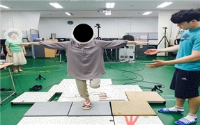
PURPOSE The purpose of this study is to analyze the biomechanical variables involved in ballet dancers’ ankle muscle imbalance when performing relevé movements. METHODS The subjects of this study (n=14, age: 22.29±1.73 years old, height: 161.4±5.06cm, weight: 51.88±7.51kg) were 14 ballet dancers with 9 years of experience. Based on the reciprocal muscle strength ratio, the dancers were divided into the following groups: Close to the normal value (RMIS) and far from the normal value (RMIB) using the maximum values of plantar flexion and dorsiflexion of the ankle joint using an isokinetic measurement equipment (60°/sec). RMIB). The biomechanical variables, namely the ankle joint movement and ground reaction force, were subsequently measured. SPSS 26.0 was used for data analysis and independent t-test was used for statistical verification. RESULTS The ground reaction force in the Z (vertical) direction based on the ankle joint muscle strength imbalance of ballet dancers was significantly lower in the RMIB group. In addition, although it was not a statistically significant difference, the plantar flexion movement was lower in the RMIB group, and there was a significant difference in the generation of ankle joint movement in the Z direction. CONCLUSIONS In conclusion, in order for a ballet dancer to efficiently utilize the force generated from the supporting leg when performing a movement, ankle imbalance must be taken into consideration when training.
PURPOSE Since the COVID-19 pandemic, the demand for home training, with exercises or workouts at home, has steadily increased. As a result, the popularity of home training YouTube content, which shows how to use exercise equipment or workouts without professional influence, has also increased. Therefore, this study focused on the characteristics of YouTube home training content (specialization, diversity, and interaction), personal health awareness, exercise awareness, and expectation-confirmation model to identify which required exercise continuation intention through YouTube home training. METHODS SPSS and AMOS software were used to conduct frequency, reliability, and confirmatory factor analyses, as well as to conduct correlation analysis and construct a structural equation model. RESULTS First, health and exercise awareness had a positive effect on confirmation. Second, among the characteristics of home training content, only specialization had a positive effect on perceived usefulness. Third, confirmation had a positive effect on perceived usefulness and viewing satisfaction, perceived usefulness had a positive effect on viewing satisfaction and exercise continuation intention, and viewing satisfaction had a positive effect on exercise continuation intention, which proved the expectation-confirmation model in this study. CONCLUSIONS To increase exercise continuation intention through home training YouTube content, creators need to produce professional content that can stimulate viewers' internal motivation.
PURPOSE Taekwon gymnastics is expected to be a program that can overcome the management difficulties currently faced by Taekwondo gyms and contribute to the expansion of Taekwondo base. Therefore, this study aimed to examine the relationship among organizational identification, flow experience, intention to continue participation, and recommendation intention of Taekwon gymnastics participants. METHODS In this study, data was collected from 313 teenagers participating in Taekwon gymnastics at Taekwondo gyms in the metropolitan area from September 10 to 24, 2021. A total of 267 questionnaires were selected as the final sample, and data analysis was conducted using SPSS 23.0 and AMOS 23.0. RESULTS Organizational identification had a significant effect on flow experience, challenge only had a positive effect on intention to continue participation, flow experience did not significantly affect recommendation intention, and intention to continue participation had a significant effect on recommendation intention. CONCLUSIONS The results of this study confirmed that organizational identification can contribute to improving inner pleasure and self-esteem, and it is necessary to examine the role of factors that can mediate the relationship between flow experience and behavioral intention in the future. Furthermore, managers of Taekwondo gyms should hold various events that can inspire teenagers’ sense of challenge to encourage intention to continue participation.
PURPOSE The purpose of this review was to summarize the current knowledge on the trends in athletes’ health problems (and their preventive strategies) caused by low energy availability (LEA) and relative energy deficiency in sports (RED-S). METHODS In this narrative review, we summarized previous studies by searching the literature in the PubMed, Google Scholar, and Science Direct databases. RESULTS Energy availability (EA) refers to the amount of energy from caloric intake used for exercise, and a LEA is considered as a surrogate marker of RED-S. In several previous studies, chronic low energy availability in female athletes has been reported to cause health problems such as endocrine dysfunctions, immunosuppression, and psychological disorders, and to also affect the hypothalamic-pituitary-gonadal (HPC) axis and bone health. Moreover, it has been suggested that an increase in injury risk and a decrease in exercise performance may occur. CONCLUSIONS Since it can be difficult to recover from the health deteriorations caused by RED-S, early detection (of related signs and symptoms) and prevention are very important. Therefore, athletes, coaches, and parents need to develop educational programs that ease the recognition of the problems caused by various symptoms related to RED-S and promote educational interventions.
PURPOSE This study was conducted to investigate the effects of a 12-week walkingbased exercise program with square stepping exercise (SSE) on chronic pain and sleep in community-dwelling Korean older adults. METHODS A total of 42 older adults who had not participated in a registered exercise program in the past 3 months were included, among whom 20 participants in the exercise group engaged in a walking exercise program once a week for 60 min per session for 12 weeks. Repeated measures two-way analysis of variance was used to analyze pre- and postinterventions data on chronic pain and sleep. RESULTS The exercise group showed a significant improvement in the chronic pain score after the intervention (2.0 ± 1.4 vs 1.4 ± 0.8, p < .05). Similarly, there was a significant difference in the Korean version of the Pittsburgh Sleep Quality Index score in the exercise group after the intervention (6.1 ± 1.8 vs 4.9 ± 2.6, p < .05). CONCLUSIONS The walking-based exercise program with SSE is an effective intervention for alleviating chronic pain and simultaneously improving sleep quality in older adults. Our study suggests that a walking-based exercise program, which includes varied stepping patterns, could be a viable approach for addressing societal challenges, including the increasing healthcare expenses due to chronic pain or sleep disorders in a super-aging society.
[Purpose] The purpose of this study was to provide the physiological characteristics of female adults in their 30s by comparing the body composition and the maximal strength of the knee extension and flexion and bilateral ratio and ipsilateral ratio(H/Q: Hamstring and Quadriceps ratio) depending on age. [Methods] Body composition was measured by Hv-ps 7681(GE medical systems Lunar, USA). Isokinetic lower limb muscular strength was measured by Isomed2000(D&R Ferstl GMBH, Germany). 92 volunteers who were chosen by our selection criteria agreed to participate in our study. The participants were divided into three groups depending on age and classified as female adults in twenties(n=30), in thirties(n=34), in forties(n=28). To evaluate differences according to age, One-way ANOVA was used. [Results] The result in the test for female adults is as follows. In body composition, there were significant differences in lean mass, bone mineral density in the legs area among groups(p<.05). In isokinetic test, there were significant differences in muscular strength among groups in extensor of knee(p<.05). [Conclusion] The finding revealed that strength training based on the characteristics depending on age is required and ipsilateral ratio needs to be improved.
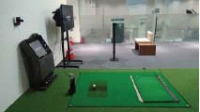
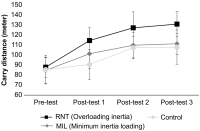
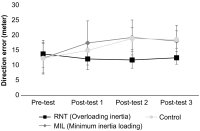
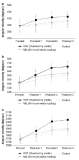
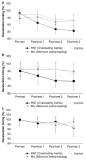
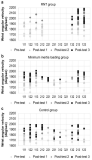
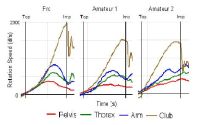
[Purpose] We examined the influence of reactive neuromuscular training (RNT) on golf swing coordination. RNT aims to induce proper coordinative movement by exaggerating the performer’s mistakes. Therefore, we applied RNT using inertia overloading to golfers who have problems with kinematic sequence during a golf swing. [Methods] To examine the effect of 12 weeks of RNT on golf swing coordination, we employed a ball tracking system (launch monitor) and motion analysis system (inertia sensors) were taken on four consecutive periods (pre-test and post-tests 4, 8, and 13 weeks later). Thirty Korean male cadets were divided into three groups based on inertial loading and practiced 7-iron golf swings combined with specific group tasks twice per week. [Results] At pre-test, most participants reached maximal angular velocity near the impact timing (95-100%). However, the deceleration timing of the maximum angular velocity of the proximal segments gradually moved toward mid-downswing as the training sessions proceeded, with the RNT group ultimately outperforming the two control groups. Additionally, the RNT group showed a significantly higher maximum angular velocity in the thorax and wrist. [Conclusion] Our results suggest that RNT can be sufficient to elicit and effective whole-body coordination pattern. Considerable follow-up research is needed on the use of RNT for various sports tasks and the effects of expertise on RNT results.
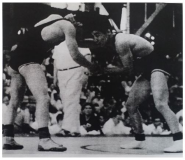
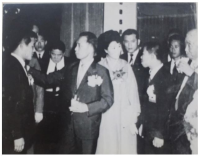
[Purpose] The purpose of this study was to investigate the process of Jang Changsun’s winning gold medal in the 1966 Toledo World Amateur Wrestling Championship and its meaning. [Methods] Jang Changsun and Katsumura Yasuo who had competed with Jang Changsun for the gold medal were selected as participants, a player and an executive who had participated in the Championship were selected as informants. Data had been collected by in-depth interview were analyzed firstly by using the Patton(1991)’s data analysis method, and the following conclusions were obtained by comparing with preceding studies, press releases, reports etc. [Results] Jang Changsun won a gold medal through the three stages of desperate struggles. The first struggle was to loose weight. Jang Changsun lost three times more weight than other players through fasting treatment, intensive training and dehydration in order to secure an advantageous position in the competition. His second struggle was the sparring itself. He made his mind to win gold medal 2 years before the Championship and started to strengthen his physical fitness and polish up his techniques to fight with strong players from powerful nation of wrestling. He finished the sparring by winning 4 games and tieing 2 games resulting in the same deduction points with Katsumura. It was inevitable for him to fight desperately to lose weight again to get gold medal. He eventually won the gold medal by losing his weight until he fainted because of injuries and serious dehydration. [Conclusion] The first gold medalist Jang Changsun contributed a lot to development of Korean sports by offering chance to consider significance of improving elite player’s exercising environment, scientific coaching, gaining self-confidence to win medal, and realizing the importance of sports informations.

Purpose This study was conducted to investigate the appropriateness of the concept of condition for athletes and to conceptualize condition in a way suitable for field and then to produce a tool to test condition that reflects usability. Methods 30 college athletes and national athletes with more than 5 years of experience were selected. In the conceptual review stage, the appropriateness of the concept of condition was verified. In the conditional element collection stage, the condition concept reflecting usability was extracted. In the development stage of the conditional questionnaire, a condition questionnaire was developed in consultation with the data provider to reflect usability. Results Previous studies on the condition of athletes were complicated and the necessity for consideration of usability was raised. As a result of conceptualization with consideration of the application to the sport scene, condition in a scene is summarized into both physical and psychological states. As a result of the appropriateness evaluation of the tool that produced the condition inspection tool reflecting the condition element based on universality and peculiarity of conditionality, the athletes evaluated that the condition inspection tool properly reflects condition, is easy to apply and can be used for condition control. Conclusion The development and application of psychological testing instruments reflecting usability will accelerate the application of sports psychology in the appropriate direction. The reflection of usability will contribute not only to the reliability and validity of the psychological testing tools used in the field of sports psychology, but also to the improvement of the possibility of intervention by leaders and athletes, the convenience of development procedures, and the utility of response results.

Purpose The purpose of the study was to investigate the effect of vibratory stimulus on the static postural control of 8 healty senior adults. Methods To achieve this goal, all subjects participated in two different kinds of static postural control tasks. Task 1 was a static postural control task, where both-legs stand on the ground. Second task was an unstable static postural control task using only single leg stance. As they maintain their balance, 6 different vibratory stimulus were provided on the sole of their feet(personal threshold 0%, 80%, 90%, 100%, 110%, 120%). Results The results of the study were as follows: First, there was no significant differences in postural control ability according to different types of vibrator intensity. Second, there was a significant difference in single-leg postural control ability according to vibrator intensity. Third, there was a significant difference in anterio-posterior stability according to the different types of vibrator intensity. Conclusion Stochastic resonance using vibratory stimulus was more effective in the single leg stance task, rather than the double leg stance task. Moreover, sub-threshold vibratory stimulus(80%, 90%) intensity were more effective than higher vibratory stimulus(100%, 110%, 120%).