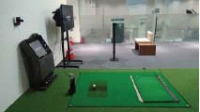
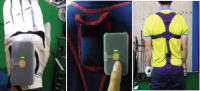
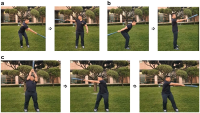
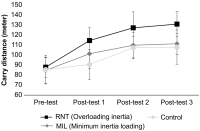
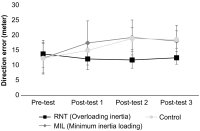
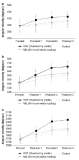
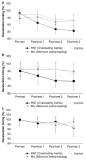
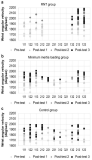
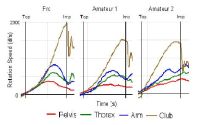
[Purpose] We examined the influence of reactive neuromuscular training (RNT) on golf swing coordination. RNT aims to induce proper coordinative movement by exaggerating the performer’s mistakes. Therefore, we applied RNT using inertia overloading to golfers who have problems with kinematic sequence during a golf swing. [Methods] To examine the effect of 12 weeks of RNT on golf swing coordination, we employed a ball tracking system (launch monitor) and motion analysis system (inertia sensors) were taken on four consecutive periods (pre-test and post-tests 4, 8, and 13 weeks later). Thirty Korean male cadets were divided into three groups based on inertial loading and practiced 7-iron golf swings combined with specific group tasks twice per week. [Results] At pre-test, most participants reached maximal angular velocity near the impact timing (95-100%). However, the deceleration timing of the maximum angular velocity of the proximal segments gradually moved toward mid-downswing as the training sessions proceeded, with the RNT group ultimately outperforming the two control groups. Additionally, the RNT group showed a significantly higher maximum angular velocity in the thorax and wrist. [Conclusion] Our results suggest that RNT can be sufficient to elicit and effective whole-body coordination pattern. Considerable follow-up research is needed on the use of RNT for various sports tasks and the effects of expertise on RNT results.
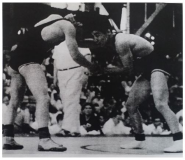
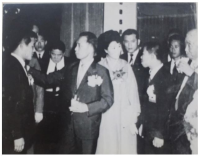
[Purpose] The purpose of this study was to investigate the process of Jang Changsun’s winning gold medal in the 1966 Toledo World Amateur Wrestling Championship and its meaning. [Methods] Jang Changsun and Katsumura Yasuo who had competed with Jang Changsun for the gold medal were selected as participants, a player and an executive who had participated in the Championship were selected as informants. Data had been collected by in-depth interview were analyzed firstly by using the Patton(1991)’s data analysis method, and the following conclusions were obtained by comparing with preceding studies, press releases, reports etc. [Results] Jang Changsun won a gold medal through the three stages of desperate struggles. The first struggle was to loose weight. Jang Changsun lost three times more weight than other players through fasting treatment, intensive training and dehydration in order to secure an advantageous position in the competition. His second struggle was the sparring itself. He made his mind to win gold medal 2 years before the Championship and started to strengthen his physical fitness and polish up his techniques to fight with strong players from powerful nation of wrestling. He finished the sparring by winning 4 games and tieing 2 games resulting in the same deduction points with Katsumura. It was inevitable for him to fight desperately to lose weight again to get gold medal. He eventually won the gold medal by losing his weight until he fainted because of injuries and serious dehydration. [Conclusion] The first gold medalist Jang Changsun contributed a lot to development of Korean sports by offering chance to consider significance of improving elite player’s exercising environment, scientific coaching, gaining self-confidence to win medal, and realizing the importance of sports informations.
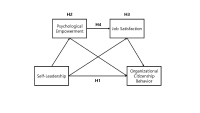
[Purpose] The purpose of this study is to draw practical implications applicable to the field through analysing serial multiple mediator model of self-leadership, psychology empowerment, job satisfaction and organizational citizenship behavior. [Methods] In order to achieve the purpose of this study, we surveyed Korea national league players(187 usable sample). Four hypotheses were tested using frequency analysis, exploratory factor analysis, reliability analysis, correlation analysis and PROCESS macro through SPSS statistics. [Results] The results are as follows. First, self-leadership has a significant effect on organizational citizenship behavior. Second, mediating effects of psychological empowerment between self-leadership and organizational citizenship behavior were significant. Third, mediating effects of job satisfaction between self-leadership and organizational citizenship behavior were significant. Fourth, serial multiple mediator effects leading to self-leadership→psychological empowerment→job satisfaction→organizational citizenship behavior were significant. [Conclusions] Korea national league players must perform self-leader, goal setting, self-observation, self criticism, constructive thinking strategies, dedication and voluntary attitude for clubs and colleagues. The team’s coaches should strive to praise the athletes for their pride, provide appropriate feedback, prevent job burnout, and the management of front office should make practical efforts such as improving the welfare environment and presenting the future vision of club.
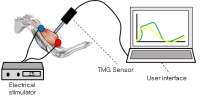
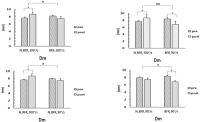
Purpose The purpose of this manuscript was to investigate the effect of high and low speed blood flow restriction versus non-blood flow restriction isokinetic exercise on isometric muscle strength, muscle fatigue, and muscle contraction displacement. Methods The subjects were consisted of ten males without non-specific muscular skeletal disease. They were classified into four training groups: ① high speed(300°/s) without blood flow restriction, ② high speed(300°/s) under blood flow restriction, ③ low speed(90°/s) without blood flow restriction, ④ low speed(90°/s) under blood flow restriction. Before and after the intervention, all of the subjects underwent measurements of isometric quadriceps strength, muscle fatigue, and muscle contraction displacement. Results In regard to isometric quadriceps strength before & after intervention, there was no significant difference between groups. For the lactic acid measurement before & after intervention, there was a signigicant difference between groups(p<.05). Also, there was a significant difference between groups(p<.05) in muscle contraction displacement in terms of Dm but there was no significant difference between groups in terms of Tc Conclusions Isokinetic exercise with blood flow restriction had effects on lactic acid and muscle contraction displacement.


Purpose The current study reexamined the financial value of National Fitness Award. Methods To determine the economic value of National Fitness Award, we incorporated 6 willingness to pay(WTP) models using contingent valuation method(CVM). The data were collected from 250 members and 250 non-members of National Fitness Award(NFA) who were over 19 years old. Out of 500 completed questionnaires, total of 489 usable questionnaires were used for data analyses. Among 489, the WTP were calculated after 125 protest responses were discarded. The data were analyzed with SPSS 24.0 for frequency analysis, descriptive statistics, reliability test, and exploratory factor analysis. Stata 14.0 and R programs were used for calculating WTP. Results First, WTP was positively influenced by household income. Second, WTP was positively influenced by satisfaction level among members. Third, willingness to pay (WTP) for the National Fitness Award were 30,877won (Mean WTP), 29,455won (Median WTP), 25,829won (Truncated WTP). The average WTP was 28,720won. Conclusions Although National Fitness Award has been provided as free service to Korean people, previous study noted problems in facility and promotion. For the National Fitness Award to possess sustainability with proper service quality, it may need to be changed to fee based service. The current study suggested that, should it be changed to fee-based service, the proper price for the service is 25,000won.
Purpose The present study compared physical fitness, metabolic syndrome risk factors, and resting metabolic rate (RMR) according to body mass index (BMI) and percent body fat (%BF) in 20s females. Methods Fifty-one women in their 20s were recruited and assigned into three groups, i.e., normal group (n=18), normal weight obesity (NWO) group (n=18), and obesity group (n=15) according to BMI and %BF. Physical fitness, metabolic syndrome risk factors, and RMR were measured and compared among three groups. Results Main results were as follows: 1) Physical fitness were not significantly different among three groups. 2) Regarding 1-RM, arm curl and leg extension were significantly lower in normal group and NWO group than obesity group. Leg press was significantly lower in normal group than obesity group. 3) Regarding metabolic syndrome risk factors, there were significant differences in waist circumference, ordering from low to high such as normal, NWO, and obesity groups. Systolic blood pressure and diastolic blood pressure were significantly lower in normal group and NWO group than obesity group, while HDL-C was significantly higher in normal group than NWO group and obesity group. 4) Regarding RMR, absolute values of RMR such as VO2(㎖·min-1), RMR (Kcal·min-1), RMR (KJ·min-1), and RMR (Kcal·day-1) were significantly lower in normal group and NWO group than obesity group. On the other hand, relative value of RMR such as RMR (KJ·kg-1FW·h-1) was significantly higher in normal group than NWO group and obesity group. Conclusions It was concluded that obese women showed increased risk of metabolic syndrome and low relative RMR level, and NWO had similar problems. Active health management through physical activity and dietary control should be committed to NWO individuals because the NWO has possibility of high risk of metabolic syndrome and reduction of metabolic rate from 20s even though there was no problem in their external appearance.
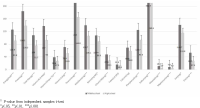
Purpose This study aimed to evaluate the nutrient intakes and diet quality of national youth badminton players participating in summer camp training in 2016. Methods Total of 40 middle school players and 60 high school players were included in the study. Two players with skipped meals were excluded from the final target. Food intake data for the 3-day using 24-hour recall method were obtained and analyzed using the CAN-pro 5.0 (Web ver. Korean Nutrition Society, Korea). Differences in nutrient intakes and diet quality were compared between middle school players and high school players using independent samples t-test. Results Intakes of vitamin C, vitamin E, vitamin B6, folic acid, calcium, chloride, magnesium, and zinc in both groups were lower than (RNI) recommended intakes of KDRIs. On the other hand, intake of sodium significantly exceeded the recommended nutrient intake (RNI) of KDRIs in both groups. The NARs (Nutrient Adequacy Ratio) of vitamin C, vitamin B6, folate, calcium and zinc were less than 0.75 in both groups. The NARs of 11 nutrients except for folic acid were significantly lower in high school players. The MAR (Mean Adequacy Ratio) of middle school players was 0.78, significantly higher than 0.64 of high school players. The INQs (Index of Nutritional Quality) of vitamin C, vitamin B6, folic acid, calcium and zinc were less than 0.75 in both groups. The INQs of vitamin A, vitamin B6 and zinc were significantly lower in high school players. On the other hand, the total DDS (Dietary Diversity Score) of high school players was 3.88, significantly higher than 3.29 of middle school players. The DDS of fruit group as well as milk and dairy group were particularly low. Conclusions The results suggest that balanced diet managed by professional dieticians along with nutrition education should be implemented to improve nutrients intake and diet quality of national youth badminton players.
