
This study aimed to analyze the patterns of service return and the 3rd stroke in relation to the winning and losing points in Badminton men's doubles matches. Especially the comparison of the patterns between rally point and service server game systems was made. Video records of 12 top elite teams were analyzed. As a result, there were significant differences in the total stroke patterns between the rally point system and the server game, and there was a higher offensive stroke tendency. After classification of situations with ‘after the service trial’ and ‘after the service return’, there were high number of winning ratio and offensive stroke in the after the service situations. There were no significant difference in the winning/losing points and winning ratio when the types of 3rd shot attempts were analyzed. I case of the win and lose in service return, there was a significant difference in the server game while not in the rally point system. Offensive stroke ratio in the server’s return categories and the service return strokes’ categories, and was no difference in shots after the return of service in the server team. From the investigation of offensive stroke ratio and winning ratio, there was a high ratio in the rally point system game but no difference in the server game. When aggressive service return took place, rally point system had higher winning ratio, but the server game system did not display such characteristic. Based on these results, recommendations of service anticipation and aggressive plays for Korean Men's doubles game have been suggested.

The purpose of this study was to examine the effects of congruence type between sporting event and corporate sponsor as well as the effects of advertisement exposure frequencies (1, 3 or 5 times) on advertisement attitude and advertisement effectiveness, including brand attitude and advertisement wear-in and wear-out effects. Data (N=150) were collected using a convenience sampling method and 3-group random assignment. The collected data were analyzed by means of frequency analysis, reliability analysis based on factor rho coefficient, correlation analysis, one-way ANOVA, confirmatory factor analysis, and latent mean analysis. The results were as follows; firstly, in case of higher functional congruence condition, advertisement attitude was most positive in a 3-time exposure situation and it decreased as advertisement exposure frequency further increased. However, in the lower functional congruence situation, advertisement attitude was continuously decreased as advertisement exposure frequencies increased. Secondly, in the higher image similarity situation, advertisement attitude was increased as advertisement exposure frequencies increased. On the other hand, in the lower image congruence situation, advertisement attitude was decreased as advertisement exposure frequencies increased. Lastly, advertisement attitude, brand attitude, and wear-in effects were statistically higher in the high functional and image congruence situations than did in the low functional and image congruence situations.

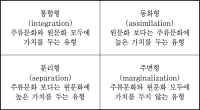
The purpose of this study is to examine acculturation strategies of expatriates in Korea in relation to spectator sport involvement. Berry's(1997) bi-dimensional model of acculturation was used as a theoretical framework to categorize the type of acculturation strategies of expatriates in Korea. Acculturation strategies of expatriates were classified into four types: integration, assimilation, separation, and marginalization. To be specific, there were 79 participants using the integration strategy, 28 using the assimilation strategy, 53 using the separation strategy, and 20 using the marginalization strategy. Research hypotheses were established to analyze differences on spectator sport involvement of expatriates between Korean spectator sport and their original cultural sport. There were significant differences in spectator sport involvement among foreigners in Korea. Firstly, the spectator sport involvement of the participants using the integration strategy was higher than that of marginalization. Second, participants categorized as using assimilation strategy were found to have lower sport involvement with Korea's spectator sport and had a higher involvement with their original cultural sport. Third, participants categorized as using separation strategy were found to have higher involvement with their original cultural sport than Korea's. Fourth, participants categorized as using separation strategy did not show significant differences with assimilation participants in comparing original cultural spectator sport. In conclusion, the result of the research indicated that expatriates living in Korea showed similar characteristics of Berry's (1997) acculturation strategies. Thus, It indicated that Berry's (1997) acculturation strategies are useful theoretical tools predicting psychological preference of expatriates in Korea. However, participants showed little difference in that all expatriates of four categories showed higher involvement with their original cultural spectator sport. Therefore, unlike Berry's (1997) theory, people with high level of acculturation showed higher levels of involvement with their original cultural spectator sport. It may provide useful information for Korean sport marketers regarding s foreign sport consumers in order to develop a market.
Impact of 9-week strength training of racing cyclist candidate during training camp on body composition, racing cyclist specific fitness, and racing cycle performance was examined. Two by two (cyclist experience, y/n and strength training (ST) participation, y/n) experiment design was employed. A total of 20 candidates participated and divided evenly into four groups; 1) experienced cyclist participating ST (CST), 2) non-experience cyclist participating ST (nCST), 3) experienced cyclist no participating ST (CnST), and 4) non-experience cyclist no participating ST (nCnST). Two programs were introduced; 1) non ST containing, pre-existing program emphasizing on sprint and acceleration training and 2) new-program containing ST and sprint and acceleration training. CST and nCST participated the latter program. Before and after the 9-week training, body composition, racing cyclist specific fitness, and racing cycle performance was tested. After 9 weeks, all groups decreased body weight(p<0.05), body fat content(p<0.05), body mass index, and CST and nCST increased lean body mass(p<0.05). Muscular strength measures such as grip strength, low back strength, 1RM of bench press, 1RM of squat, and anaerobic capacity improved after 9 weeks in all groups(p<0.05). The magnitude of changes was greater in order of CST, nCST, CnST, nCnST. Time trial of 200 meter sprint was faster after 9 weeks in all groups except CnST while 500 meter sprint was improved only in nCnST(p<0.05). After 9 weeks, regardless of previous cyclist experience, those who participated in ST ranked high places at racing cycle competition. Both training programs for the candidates improved body composition and racing cyclist specific fitness. When strength training was added to pre-existing training program emphasized on sprint and acceleration, the racing cycle performance was enhanced. Strength training for racing cyclist is highly recommended to improve their racing performance.
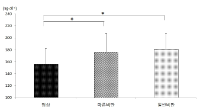
This study was designed to compare physical fitness, blood lipids, and insulin resistance according to body mass index (BMI) and percent body fat (%BF) in 20s females. Sixty women, aged 20-29 yrs, volunteered to participate in the study as subjects. There were three groups, i.e., normal group (BMI < 24 kg·m-2 and %BF < 25%; n = 25), normal weight obese group (BMI < 24 kg·m-2 and 28% < %BF < 40%; n = 22), and obese group (BMI > 26 kg·m-2 and 30% < %BF < 40%; n = 13). Physical fitness, blood lipid profiles, and surrogate indices of insulin resistance were measured and compared among three groups. Main results of the present study were as follows: 1) There were significant differences in all variables regarding body composition among three groups. All values were lowest in normal group and highest in obese group. 2) There was significant difference in sit-and-reach among three groups, whereas no significant differences were found in other variables regarding physical fitness among three groups. 3) There were significant differences in all variables regarding blood lipids among three groups. In particular, total cholesterol (TC), low density lipoprotein cholesterol (LDL-C), TC/HDL-C ratio, and LDL-C/HDL-C ratio were significantly higher in normal weight obese group than normal group. 4) There were significant differences in all variables regarding insulin resistance among three groups. Fasting plasma glucose and HOMA-IR were lowest in normal group and highest in obese group. It was concluded that there would be abnormal blood lipid profiles and insulin resistance in even normal weight obese individuals as well as general obese individuals in 20s females.

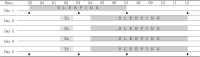
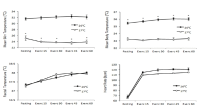
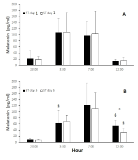
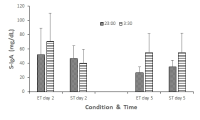
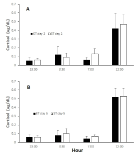
Whether a nocturnal exercise with concomitant increase of body temperature (Tb) would intensify circadian phase delay compare to exercise with a suppressed Tb increase was examined. Seven healthy men (20.57 ± 2.88 yrs, 174.43 ± 4.05 cm, 70.13 ± 6.07 kg, 10.74 ± 1.92% fat) participated in two tests. Each lasted 5-days. On the day of 1 of each test, subjects maintained habitual sleep time (23:00-07:00, 0.2 lux) in laboratory. From day 2 thru 5, they biked for 60 min at 55% of maximal capacity beginning at 01:30 (15 lux). Then they went to bed at 04:00 and woke at 12:00. During test, they exercised either at 26℃ with elevating Tb (ET) or at 17℃ with cooling devices for suppressing Tb (ST). Two tests were counter balanced and separated by 2 weeks. During exercise, rectal (Tre) and skin (Tsk) temperatures, and heart rate were continuously recorded. Body weight changes during exercise were measured. Urine volume and saliva sample were collected. Blood samples were taken at 23:00, 03:30, 07:00, and 12:00 on day 1 and 5 of tests and analyzed for melatonin. The average weight loss for 4 days of exercise in ET and ST was 0.62 ± 0.09 and 0.22 ± 0.07 kg, respectively (p<.001). Tre increased during exercise but not different between conditions. Tsk maintained at 32℃ in ET and 24℃ in ST (p<.001). Tb were higher in ET than ST during exercise (p<.05). The average total urine volume passed was 0.07 ± 0.07 in ET and 0.11 ± 0.07 liter in ST (p<.05). The melatonin concentration at day 1 was 23 ± 26, 107 ± 45, 98 ± 46, and 14 ± 5 in ET and 18 ± 10, 108 ± 65, 103 ± 75, and 14 ± 12 pg/ml in ST for each time period. At day 5, it was 9 ± 3, 64 ± 41, 122 ± 73, and 54.1 ± 17.8 in ET and 8 ± 1, 68 ± 21, 111 ± 52, and 32 ± 14 pg/ml in ST. Differences of melatonin between ET and ST at day 5 of 12:00 as well as between day 1 and 5 at 12:00 of both conditions were noticed (p<.05). Salivary cortisol and immunoglobulin-A were not different. A nocturnal exercise induced a circadian phase delay in both conditions. However, body temperature increase during exercise intensified the shift indicating the importance of thermal load during exercise for circadian shift.
This study was designed to investigate the effects of increment of physical activity for 12 weeks through aerobic exercise training or change from own vehicle to public transportation for commuting on physical fitness, insulin resistance, inflammatory markers, and liver function in middle-aged men. Forty-four subjects, aged 30-50 yrs, were randomly assigned to either one of three groups, i.e., aerobic exercise training group (TR: n=14), change to public transportation group (PT: n=15), or control group (CON: n=15). Subjects in TR performed aerobic exercise for 30 min per sessions, three sessions per week, subjects in PT changed from their own vehicle to public transportation for commuting, and subjects in CON maintained their life patterns during the same intervention period. Physical fitness, insulin resistance, inflammatory markers, and liver function were measured at pre- and post-test, and the data were analyzed by repeated two-way ANOVA. Main results of the present study were as follows: 1) All variables related to physical fitness improved significantly in TR. Right grip strength, standing long jump, side step test, and sit-and-reach improved significantly in PT. 2) Although there were no significant changes in all variables related to insulin resistance, the variables tended to be improved in TR and PT. 3) TNF-α decreased significantly in TR and PT. IL-6 and CRP tended to be improved in TR and PT; however, the changes did not reach statistical significant level. 4) ALT decreased significantly in PT. AST and γ-GT tended to be improved in TR and PT; however, the changes did not reach statistical significant level. It was concluded that the 12 weeks of change to public transportation as well as aerobic exercise training would be beneficial for physical fitness and inflammatory markers. These interventions also would be possible to improve insulin resistance and liver function. The increment of physical activity through change from own vehicle to public transportation was found to be equally beneficial for health promotion compared to aerobic exercise.
